
Day five in the studio was another short day. I have this routine, three days a week (when Sophie is in daycare): go to the gym for an hour in the morning, write for between one and two hours, then get into the studio at about midday and work until 4pm. At the moment I’m working on my neglected PhD, trying to cram a stack of writing and research into the next four months, while I’m still officially on leave from the program.
In the studio, day five involved getting oilier with my oil paints. All this means is that when you start painting with oils, the first layers have more turps (or solvent) in them, and as you lay down subsequent layers, you progressively mix more and more oil (or medium) in with the paint. Some people express this as working ‘lean to fat’. The reason for it is pretty simple. If you imagine mixing up some salad dressing in a jar, usually oil and vinegar, unless you shake it really hard all the oil will float to the top. This is because the oil is lighter than the acidic vinegar. (Or if you’ve ever worked in a bar, you’ll know that Baileys floats on just about anything else!).
It’s exactly the same principle with oil paint: you start painting with more turps (the vinegar) because if you did it the other way around, the layers with oil in them would try to ‘float’ to the top of the painting. This damages the substrate (think of a painting as being like a geological formation, or layers of different types of rock) because you’ve created something that is inherently unstable. Although we’re only talking about stuff that happens at a molecular level, the oil will always want to migrate to the surface of the painting. Like layers of rock, if the one down the bottom (and I’m talking small changes and very slow speeds here) moves faster than the ones above it, the surface of the earth will eventually give way and crack. Essentially an oil painting works the same way.

Another reason for working lean to fat is practical. Oil paint with more turps in it dries faster than oil paint with a greater ratio of oil in it. Turps, or solvent, has a much faster evaporation rate than oil (which relies on other stuff in the paint, and environmental factors such as heat and airflow, to dry). Painters typically spend the first phases of a painting working out the composition (some people plan this meticulously before beginning, other people, like me, like to embrace chaos or instinct) and blocking in their tonal values (I’m talking about relatively traditional methodologies here). Like laying the foundations of a house, it’s about big decisions and underlying structure, not fine detail. So you want to get it done quickly and be able to move the paint around freely, also quickly paint over stuff that isn’t working. If you’re working with very oily paint, this just can’t happen, as you’ll be sitting around waiting for it to dry.
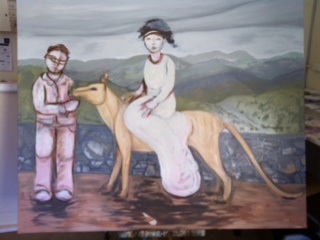
Another factor is that very turpsey paint won’t stick to very oily paint: it just beads and splits. Imagine the way spilled water separates into little drops or pools on a glossy marble bench top and you’ve got the picture. The water can’t soak into the surface, and the shininess of the surface repels it, so there’s nothing for the liquid to do except cling to itself. The same thing applies to oil and turps (or solvent): generally the turps won’t spread across the surface, because the surface is repelling it, and surface tension kicks in, encouraging the turps to form droplets (as opposed to spreading out in a flat layer). Fascinating stuff!
Finally a good reason for fat over lean is that some artists like to mix glazes (transparent or semi transparent layers of coloured oil paint with a high ratio of oil to turps) and apply them to the final stages of their painting. Again, this is a fairly traditional methodology. The purpose of a glaze is to make the paintings colours look richer, deeper or darker (or sometimes to make the surface of the painting shinier). If you imagine the way light goes through a stained glass window, this is sort of how a glaze works. Light passes through the glaze, a transparent layer of paint, hits the underpainting, and bounces back up again (refracts). The light coming off the surface of the painting intensifies its colour, making it blaze, just like sunlight through coloured glass. Very pretty.
If you wasted your formative years on a surfboard, you’ll intuitively understand how a glaze works. Picture this: sunny day, blue sky, drifting around on clear water in an area with sparkling white crystalline sand. As you get closer to shore, light hits the water, goes through it, hits the white sand on the bottom, and bounces up again. The water is an intense blue-green and the refracted light makes it hard to see. This, my friend, is like a glaze.
 Helen Hopcroft: an artist's life