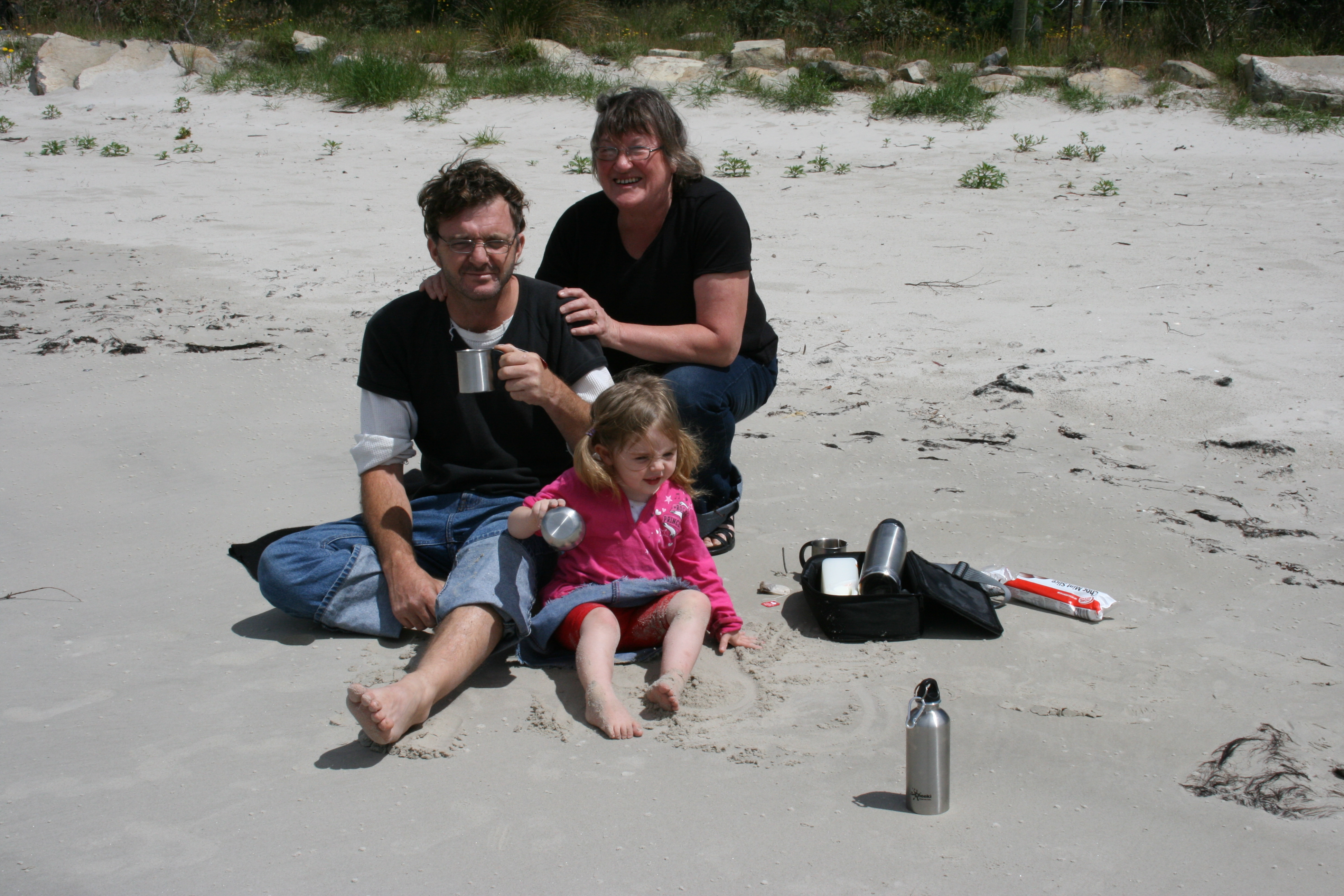
Summer day at a Tasmanian beach (a direct contradiction in terms)
The University semester starts next week bringing my beloved summer holidays to an abrupt end. One minute living in old jeans and egg splattered t-shirt; the next making an effort to look vaguely professional and like I know what I’m talking about. We’ve re-jigged one of the courses I’m teaching this semester so this week has been spent reading, reading, reading in preparation. Students, bless them, assume you know everything about the subject you’re teaching, and one doesn’t want to shatter their illusions, so I’m cramming.
My friend AV, who lectures in Fine Art at a University in Northern England, said she has perfected a thoughtful gaze, accompanied with an interested ‘ah…’ when yet another bright young thing bounces up to chat about an artist or theory she has only a passing acquaintance with. God bless Google is all I can say.
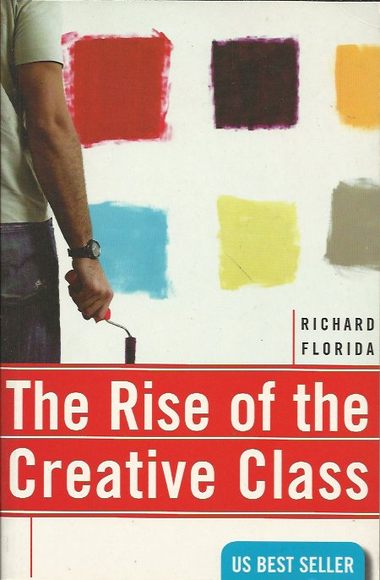
The Rise of the Creative Class by Richard Florida
I’m currently reading The rise of the creative class by Richard Florida, with The Cambridge handbook of creativity (eds James C. Kaufman and Robert J. Sternberg) waiting in the wings. Florida’s book is on a three day loan from the library so it had to take precedence. I’m enjoying it, I found his emphatic style off-putting to begin with, then started to appreciate him for his candour. Interestingly, he articulates profound changes to the way creative people live and work, stuff I’d been thinking about, but hadn’t really internalised that millions of other people were on exactly the same path. It’s a comforting realisation. Over the last five years I’ve been adapting my way of working so that I’m more often self employed than working for an employer; able to work from home (to accommodate motherhood); become much more selective about the work that I do and significantly more entrepreneurial; and consciously blurred the line between my personal and professional lives.
Here’s a couple of nice paragraphs from Florida’s book:
Creativity involves the ability to synthesise. Einstein captured it nicely when he called his own work ‘combinatory play’. It is a matter of sifting through data, perceptions and materials to come up with combinations that are new and useful. A creative synthesis is useful in such varied ways as producing a practical device, or a theory or insight that can be applied to solve a problem, or a work of art that can be appreciated.
Creativity requires self-assurance and the ability to take risks. In her comprehensive review of the field, The Creative Mind, Margaret Boden writes that creativity
‘involves not only a passionate interest but self-confidence too. A person needs a healthy self-respect to pursue novel ideas, and to make mistakes, despite criticism from others. Self-doubt there may be, but it cannot always win the day. Breaking generally accepted rules, or even stretching them, takes confidence. Continuing to do so, in the face of scepticism and scorn, takes even more’.
Speaking of self-doubt, today I painted for the first time in months. I’ve pretty much given up on the idea of renting a studio, I’m on a waiting list at a community art space, so I’ve cleaned out the back shed at home and I’m working there. I figure that I can get quite a bit done after my daughter is in bed, during her afternoon nap or when Aaron is looking after her; Mum is visiting next week, so potentially that’s more time in the studio.
Over the years I’ve noticed a series of quite predictable emotions and behaviours before I start painting, especially if there has been a longish break. First is this general feeling that life is black and white, not colour, and that everything is sort of crappy and second rate. This eventually segues into grumpiness and bitchy intolerance. Next is frantic procrastination, usually accompanied by house cleaning, dish washing, furniture moving, weed pulling and floor washing. The dominant emotion during the frantic activity phase is nameless dread. Finally, when self-doubt and internal negativity have become overwhelmingly pervasive, I go into the studio, wipe off the glass pallete so it’s nice and clean, and line my brushes up in a grid formation. Once I start I’m fine. There’s this quiet tidal wave of relief, pleasure, fulfilment. I find at the beginning of a painting cycle, which is where I am now, I see things really clearly: my eyes measure angles and tiny marks quite accurately. It’s only when I’m in the middle of a cycle (I’m talking in terms of months, if not years) that I tend to lose some visual clarity. Towards the end it sharpens up again.
I want to end this blog entry by quoting a great response I got to the last entry ‘A literary diet’ by my cousin’s partner KG. They live in Darwin and she writes:
‘Subject: Place and its influence
Hi Helen
Just read your ‘literary diet’. I remember visiting Venice after I’d been living in the Territory for a few years. The contrast was amazingly diverse. At complete opposite ends of the spectrum. Venice was full of beauty, art and opulence. A city that has been enduring dedicated to the zenith of man’s artistic and cultural achievements. I absolutely loved it. But in comparison to the Indigenous landscape of the Top End it seemed somehow inconsequential, a mere folly perhaps of humanity (perhaps that’s a little extreme). Here life, art, landscape, is ephemeral, transient yet infinitely enduring. ‘Art’ per se, and its practice almost seems trivial alongside day to day and cultural survival. Like so much of Aboriginal life, art is not a seperate entity but a deeply entwined component of social and cultural meaning. Having been born into a Weternised concept of life and art, I’m finding the landscape here challenges my core concepts and beliefs.
And on a very practical level, I don’t take on projects that I would ‘down south’. The weather conditions here simply mean that things don’t last. Dry weather and humidity mean that most objects deteriorate rapidly (such as books, paintings, textiles). And then cyclones obliterate written histories and urban community continuity! I think “Thank goodness the digital age is here”, but then we probably won’t be able to read any of our antiquated computer systems in twenty years either.
Well … that’s my initial response to reading your article’.
 Helen Hopcroft: an artist's life