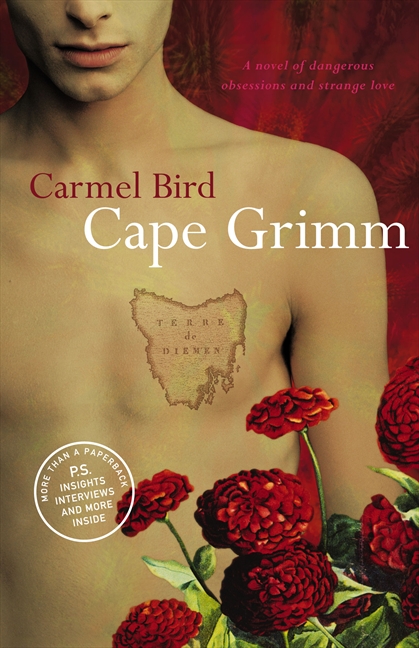
Carmel Bird's Cape Grimm- http://www.harpercollins.com/harperimages/isbn/large/7/9780732269937.jpg
It’s interesting to speculate how what you read effects what you do in your life, how you live, what you think. For me, books and conversations often trigger a whole new way of thinking about something; but quite often it takes some time for their impact to manifest itself in real life. I thought I’d briefly blog about books, current and recent past, that have had some kind of influence on my painting and/or life. I’m one of those people who either read a lot or not at all, right now I’m gorging- this tends to happen before a new series of paintings. (The last series of paintings owed a debt to Chloe Hoopers’s A child’s book of true crime and Carmel Bird’s Cape Grimm. Bird’s image of married, red-haired twins continues to haunt my imagination: they’ve got under my skin).

Chloe Hooper's A child's book of true crime- http://www.boomerangbooks.com.au/bookImages/LARGE/084/9781740512084.jpg
I’ve just finished reading Donna Meehan’s It’s no secret: the story of a stolen child. I interviewed Donna, a member of the Stolen Generations, as part of the 100 women book I was working on for the University of Newcastle, late last year. I was impressed by her and overwhelmed by the history that she represents. As a Mum, I’m still struggling to get my head around the fact that this happened to people in living memory. Interestingly, it was Carmel Bird who helped Meehan find a publisher for this, her first novel.
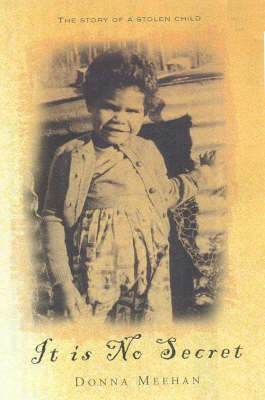
Donna Meehan's It's no secret: the story of a stolen child- http://www.boomerangbooks.com.au/bookImages/LARGE/949/9780091839949.jpg
I’m currently reading Angela Carter’s The Bloody Chamber and Contemporary fiction and the fairy tale, edited by Stephen Benson. My Aunty Pam recommended Carter’s book, and once I opened it I realised that I’ve already read it, maybe fifteen or twenty years ago. Certain phrases clanged in my memory: the mother’s ‘irreproachable’ bullet when she shoots her murderous son in law in the head; the key entering the lock of the secret chamber ‘like a hot knife through butter’; the visual image of the female horserider riding a horse at break neck speed along a shoreline, racing a flood tide; the bride’s husband closing her legs ‘like a book’. Benson’s book is handy because it includes an analysis of Carter’s re-telling of the Bluebeard tale, The Bloody Chamber, I hadn’t realised it was so controversial. Apparently she was working on a non-fiction study of the Marquis de Sade at the time she wrote Chamber, developing the idea of a moral pornographer, an oddly attractive concept but one that seems to disintegrate when you try and substantiate it via definition or example.
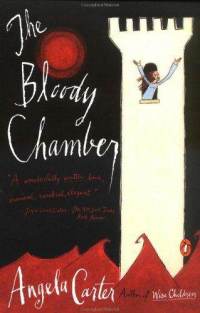
The Bloody Chamber by Angela Carter
I’m in the process of organising, with Newcastle artist Caelli Jo Booker, a group exhibition of artists’ books, to be held at the John Paynter Gallery, June 10– 26th 2011. The exhibition is titled Happily Ever After: alternative destinies in contemporary feminine narrative so I’m rapidly finding out more about the fairy tale genre. The John Paynter Gallery is part of the Lock Up, an old police station that houses a museum, artists residency and the Hunter Writers Centre. Alongside the gallery are cells (one padded) and a prisoner exercise yard, both of which are used as alternative exhibition spaces. Click here if you’d like more information about the exhibition.
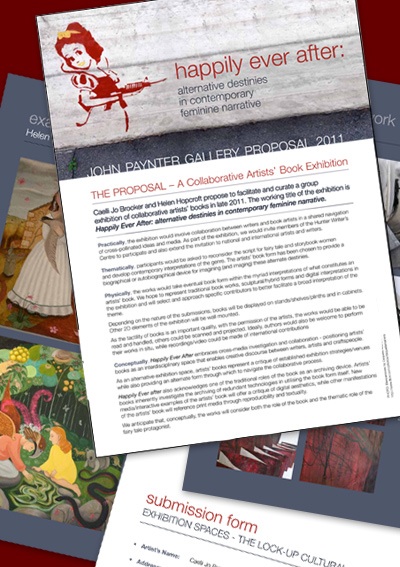
Happily Ever After montage- Caelli Jo Booker
Before Meehan’s book, I skimmed The Fate of Place: a Philosophical History by Edward S. Casey, much of which went over my head: it seems that place is a much slipperier concept than I’d given it credit for. I’d written an article about the work of Helen Dunkerley, a Newcastle based ceramic artist, and needed to give my instinctive reading of her work some kind of definite theoretical basis. Not sure how that went. The closest I could come to it was Deleuze and Guattari’s idea of ‘smooth space’, a theory of nomadic travel, particularly how different this kind of movement is to the Western concept of a journey, with its defined beginning and destination, and specifically how nomadic travel involves a very different way of thinking about the trinity of place, self and space.
Dunkerley travels a lot, migrating between jobs in Newcastle, upstate New York and the Virgin Islands. I wanted to explore how each of these places marked her work, whether she was conscious of them doing so, and if she deliberately incorporated any local or regional references into her work. I got interested in her work, and the idea of place, when she told me about digging some red clay out of her host’s garden in the Virgin Islands. The clay was made into ceramic sculptures which she exhibited in Newcastle.
Prior to that, I re-read the Patrick O’Brian’s Aubrey/Maturin series, a collection of rather brilliant historical novels set during the Napoleonic Wars. I earlier blogged that my daughter was named after one of the British ships involved in these battles: The Sophie. Since then I have read O’Brian’s final unfinished novel, including a thoughtful introduction that identified which boats and naval actions were real, which were invented, and which were a combination of fact and fiction. I discovered The Sophie belonged to the latter category. So there you go: my daughter owes her name to a literary invention!
 Helen Hopcroft: an artist's life


