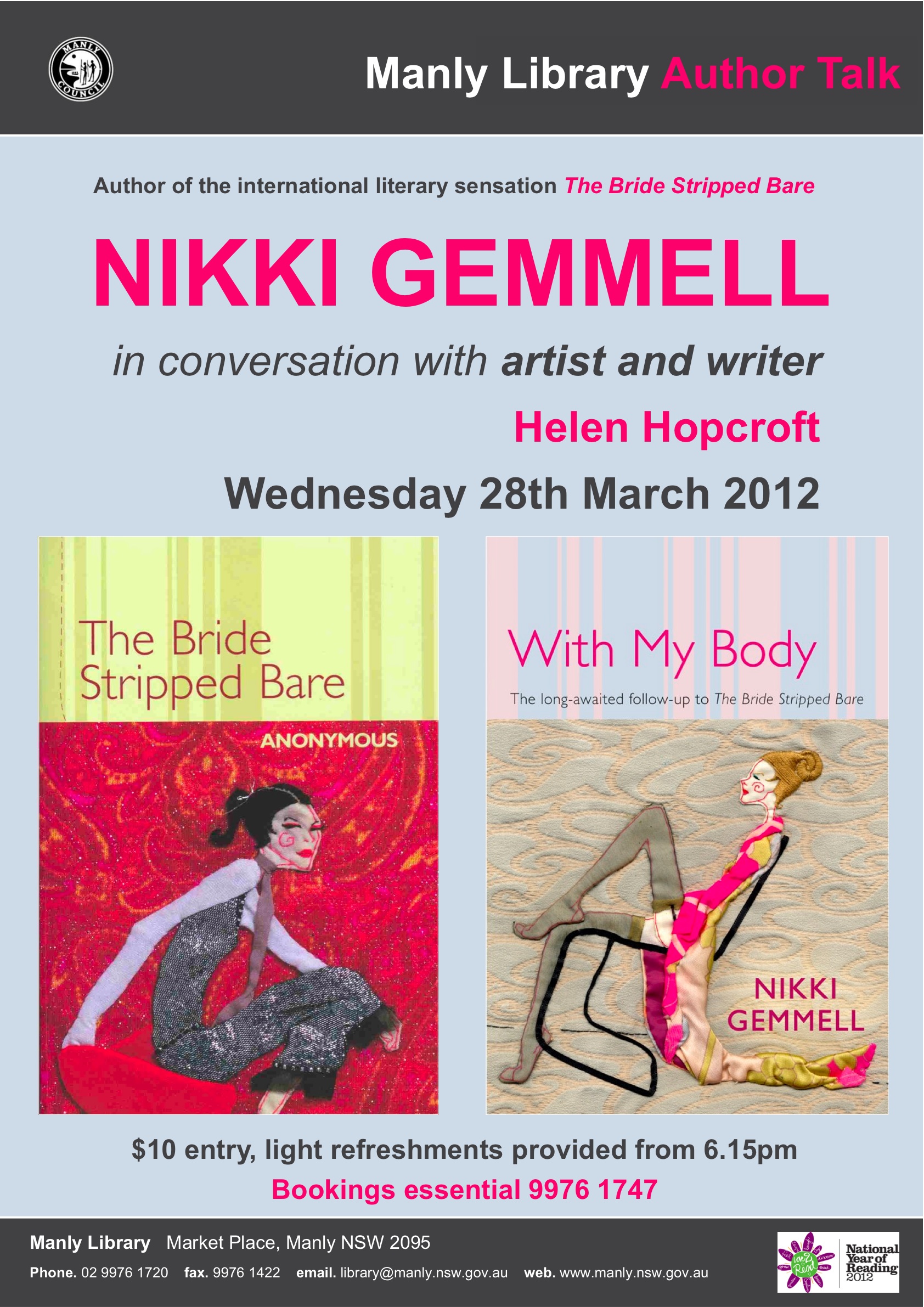
A quick reminder about tonight’s Nikki Gemmell author talk at Manly Library. I’ll be interviewing Nikki about her latest book, With my Body, and talking about her previous novels including the hit bestseller The Bride Stripped Bare. The event starts at about 6.15pm, there’s a cost of $10, light refreshments will be served and bookings are essential. For more info please contact the library on 02 9976 1747.
In about a week’s time I’m interviewing the writer Nikki Gemell, author of the international bestseller The Bride Stripped Bare, at Manly Library. Nikki is an engaging speaker, I interviewed her for a public event at Hunter Writers Centre (Newcastle) a few months back, and she is generous with her time. We spoke about her journey into writing, early life in Woollongong, how becoming a mother impacted on her writing practice, the media frenzy that accompanied the publication of Bride, and her family’s recent move back to Australia after fourteen years in London. We also chatted about the new book, With my Body, and her previous novels Shiver, Cleave and Lovesong.
After the talk was over she signed books for people and chatted to them about writing. I remember being impressed by the amount of effort she put into the signings: intricate curly cord cursive with flourishes, nice messages.
The Manly Library event is on Wednesday 28th March from about 6.15pm. Bookings are essential, light refreshments will be served and entry is $10. Please phone 02 9976 1747.
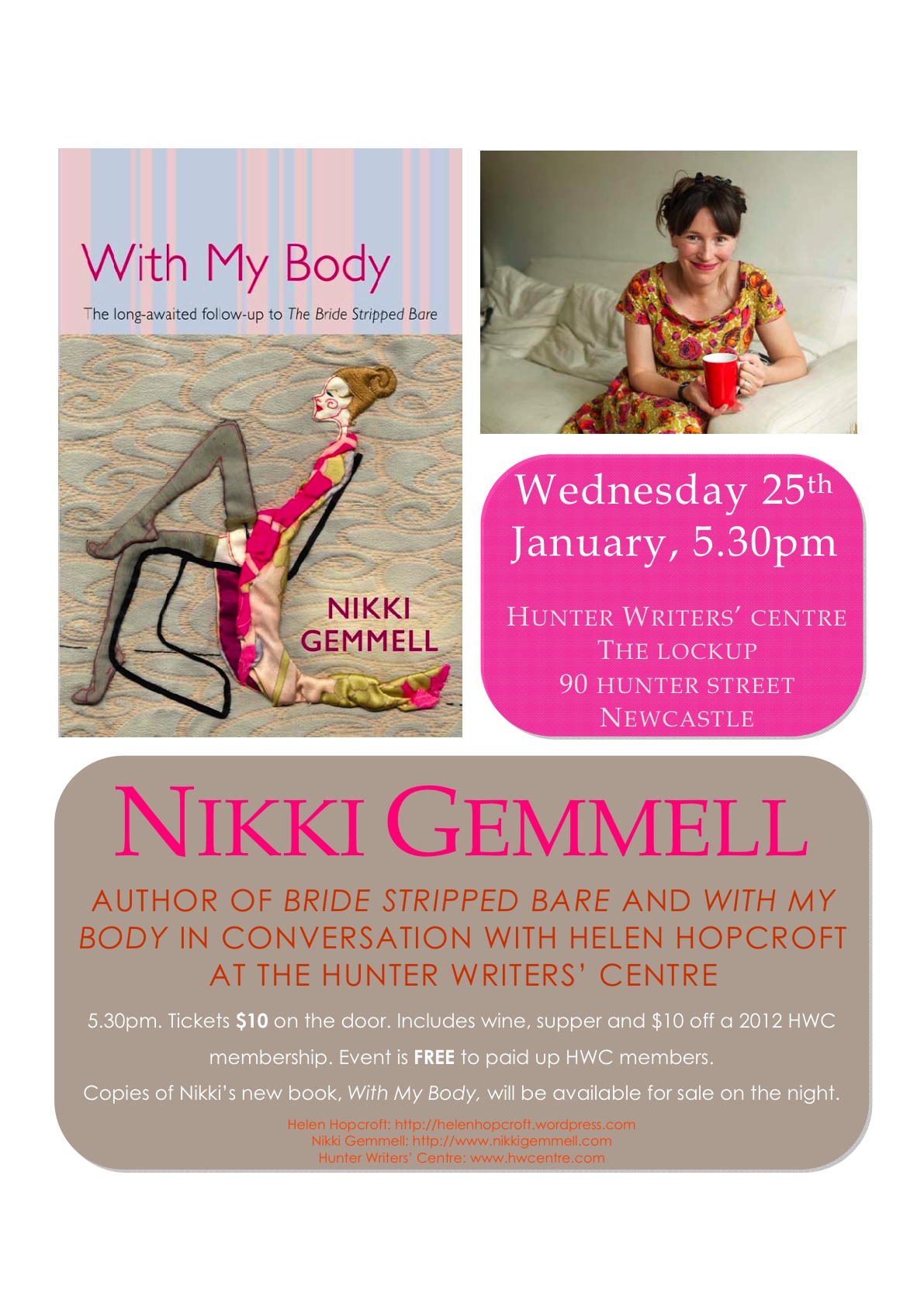
A funny example of life turning full cycle: on 5.30pm Wednesday night I’ll be interviewing the writer Nikki Gemmell at the Hunter Writers Centre. I’ve previously blogged about Gemmell’s writing, particularly the erotic best seller The Bride Stripped Bare, and have just finished reading her latest: With My Body. Bride was one of the reasons I started my experiment with erotic literature, and the inspiration for my 1001 nights novella. Another driver was the memory of reading The Story of O while an art student in London. Co-incidentally, With My Body mentions The Story of O (something of an erotic classic) and the main character is a sun-starved Australian living in London. I can vividly recall this feeling that there was never enough light. At the height of one particularly dreary winter I remember staggering into a South Kensington solarium and spending a happy hour zapping myself with carcinogenic rays.
Anyway, if you’re in Newcastle on Wednesday afternoon, I might see you at the Hunter Writers Centre.
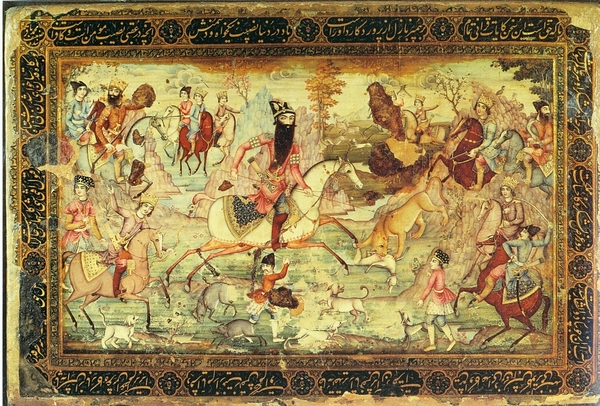
I woke up on Wednesday night at 3am, unable to sleep, and proceeded to write the introduction to the artist’s book, the project I’m working on with KRS, Caelli and Aunty Pam. KRS is doing the illustrations, Caelli is the designer and Aunty Pam the bookbinder. My story is a re-telling of the 1001 nights. Why I chose to link it to this famous tale is a story in itself. In a previous post, I mentioned keeping a private diary and its connection to a vague interest in someday writing erotic literature (probably inspired in part by Nikki Gemmell’s barn storming sequences in The Bride Stripped Bare, a lingering fascination for Lady Chatterley’s Lover and art student memories of The Story of O).
I knew that I wanted to use my diaries as reference material, and as I started keeping a diary when my marriage went (sound of plane crashing) perhaps link the Scheherazade narrative to a very modern tale of marital breakdown. I felt that 1001 nights would allow for a slightly fragmented, diary style narrative, written from the perspective of the female main character, with this constant atmosphere of anxiety pervading her stories and giving them intensity. I also liked the idea of people in times of stress taking refuge in fantasy, albeit in this case, erotic fantasy.
When I told her about using the Scheherazade character, KS made the excellent point that 1001 nights is art about art: the seductive powers of literature, the role of the author and their relationship with the reader etc. I liked these ideas too, and thought that they’d blend well with a slightly self-conscious, literary narrator.
Anyway, it didn’t happen. Maybe because it’s all too close to home, or perhaps just because I knew it wouldn’t make good literature, I ended up abandoning that idea. Instead I decided to write a version of 1001 nights that retained the Scheherzade character and setting (a vague somewhere on the Arabian Peninsula a long time ago) but which foregrounded the erotic potential of the story. Which is not entirely without precedent: in the original tale, by the end of the 1001 nights of ‘story-telling’, Scheherazade and the Sultan had three sons, and some versions apparently contain erotica.
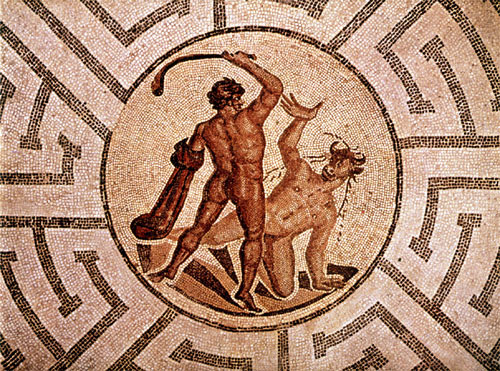
And it’s going ok (well, it’s going well actually, I just don’t want to jinx it). I’m at 10,000 words and I think that in the end it will be somewhere in the range of 15-20,000. Other than the general stuff you need to do to function and care for a kid, I’ve done very little this week except write. Like all pieces of writing, it only started to flow once I had the first sentence. I’m currently following the narrative as it unravels, like the myth of Ariadne’s lover, obsessively chasing her ball of red wool in the minotaur’s maze.
Sometimes, often when I’m driving or half asleep, I’ll think of the perfect sentence for a piece of writing. Then it’s a struggle to either find something to write with, memorise it, or just think bugger it, and go back to sleep. I’ve lost a lot of good stuff (or at least I remember it as being good: a bit like the fish that got away) by choosing to snooze. It was the middle of the night when the first sentence for 1001 nights arrived: ‘Soon the night will come, and to save my life, I must tell another story’. I sat up in bed, grabbed my trusty laptop, and wrote the first five pages. I was surprised at how easily the writing flowed in the middle of the night. I often think that writing when you’re half conscious is a good idea as it effectively suspends the critical mind.
The next morning, still dazed from my broken sleep, Sophie came rushing into my room to announce that she had wet her pull up: pool of urine on the floor, off comes the pull up. Then she dashed off to get some grapes out of the fridge, and brought them back into my bed for a snack and a cuddle. Being a kind toddler, she offered to share her grapes, and I politely took one. By the time I got up and was in the car, I was still in this half-crazed dream state.
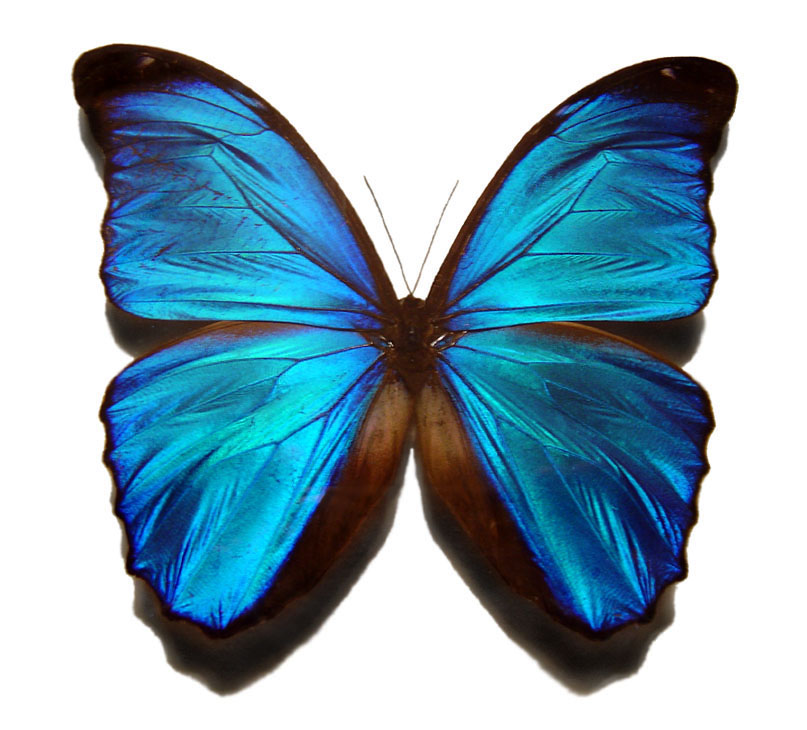
Twenty minutes later I was stuck in traffic, musing about the illustrations for 1001 nights: how many we needed, the etiquette of asking a friend to illustrate a book for you, whether I’d piss the friend off by being overly prescriptive with my suggestions for imagery, the sort of style that would work with the text. I was thinking about butterflies (yesterday Sophie was given her first butterfly net) and musing that as a metaphorical image, butterflies tied in nicely with ideas about female eroticism. Both species being difficult to define, hard to capture, glorious, uplifting, beauty destroyed by any attempt to preserve, exotic and fleeting. If I was being cynical, I’d say that they’re both something that animate life, but don’t stay around very long.
I was musing on the sad fact that women rarely trust their partners with the full extent of their erotic imagination, considering the reasons for, who responsible, strategies to negate, historical and cultural antecedents, impact of religious thinking upon, whether widespread phenomenon or fairly narrow, and if there was a great deal of difference in the degrees of erotic imagination amongst individuals (I mean, you’d expect there to be, but how can you tell?) Bang. Had to slam on the brakes as realized that I was about to rear end a four wheel drive with, wait for it, blue butterflies plastered across its spare wheel cover. Apologised to Sophie and made a mental note to email KRS with the butterfly suggestion.
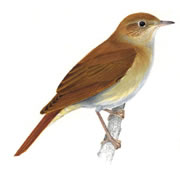
Another funny little co-incidence: in the draft of 1001 nights, I’ve used a nightingale to signify a portal to another world. It marks the line between the everyday mind and the erotic imagination, conscious and unconscious. I’ve been daydreaming about how, once we’ve finished this book, I’d like to have it professionally published with a cover illustration by Del Kathryn Barton. Yes, I can dream. Anyway, I was flicking through a magazine in the hairdressers today, two things I rarely do, and I found an article about DKB. Apparantely she is busily illustrating Oscar Wilde’s fairytale The Nightingale and the Rose, with the book published later this year. Gosh! I almost dropped my cup of you-paid-too-much-for-this-haircut mule urine herbal tea that fashionable saloons feel compelled to serve, and which suckers like me feel compelled to drink.
It’s funny, and I know other people feel this too, but it’s amazing how much more life makes sense if you just do what you want to do and let things take their own shape. Versus doing what you think you should be doing. It’s the blessing of following some kind of instinctive guidance or understanding. Or perhaps just bloody mindedness paying dividends.
This week’s cute toddler moment: Sophie dragging her clickety clack wooden crocodile toy across the floor yelling, with Lleyton Hewitt style fervour, ‘C’mon!’
When I decided to start a blog, I did a brief tour of other people’s to see how to go about it. I discovered great stuff out there in cyberspace, very talented people generously sharing their ideas, but also noticed that some writers seemed to censor themselves, choose bland over bold, only include stuff that made them look good. I decided that blogging boiled down a to a simple decision: either write a polite blog and use it as a quasi publicity tool, or write the kind of blog that I’d like to read, and deal with any embarrassment or humiliation as it arose.
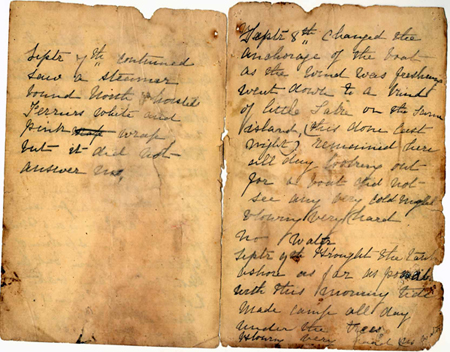
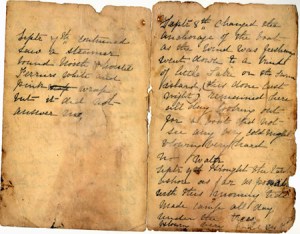
I like the blog format, the way it represents the continuation of the tradition of journal or diary keeping. I like how this kind of writing can be immediate, raw, uncensored, rough as guts, but sometimes contain such honesty and humour that you forgive it for all the crappy bits: the misunderstandings, vanity and relentless egotism. It can be as fascinating as a good letter, a drunken email, a bitter postcard.
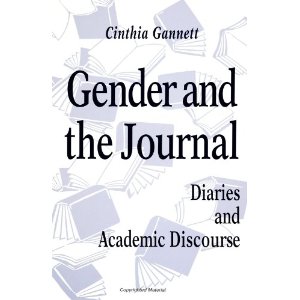
Last year I read Gender and the Journal: diaries and academic discourse by Cinthia Gannett. Loved it. Tracing the gendered nature of diary keeping, and therefore its tenuous status in the academy, the writer picked her way through the semantic difference between ‘diary’ and ‘journal’; examined the controversy surrounding the use of journals as an educational tool (when students start writing the unthinkable, or of the terrible things that have happened to them); cited various famous women’s diaries; and explored the idea of the journal as a ‘wild zone’ of creativity where people could unaffectedly be themselves or explore new identities.
Here are some quotes that I particularly liked:
What would happen if one woman told the truth about her life? The world would split open. (page 81, Muriel Rukeyser, Kathe Kollwitz).
Could I write all, the world would turn to stone. (Catharine Sforzal 1462-1509)
Everyone knows that a place exists which is not economically or politically indebted to all the vileness and compromise. That is not obliged to reproduce the system. That is writing. If there is a somewhere else that can escape the infernal repetition, it lies in that direction, where it writes itself, where it dreams, where it invents new worlds. (Helene Cixous The Newly Born Woman, in Harriet Blodgett: Centuries of Female Days- English Women’s Private Diaries 1989).
The best of our writing is entangled with the messiness of our experience. (Nina Auerbach- Bauer 1990, 385).
It’s interesting because when I started this blog, just about no-one read it, so I was quite happy tap tap tapping away with whatever came into my head. Over time, however, I got better at working out how to link it with other social media and search engines, or perhaps word just spread, because now about a hundred people read it each week. In internet terms, this isn’t even a drop in the ocean, but for me it’s meaningful.
For some reason, though I’ve had stuff published in newspapers and magazines, I always thought about the reader in a generic sense (‘mustn’t bore the poor bastards…’) not as a collection of individuals and never in a numerical sense. Having an editor acting as a kind of filter gave me a sense that somehow I was less responsible for what I wrote. (Incidentally, I always like the story about the Tasmanian poet, Gwen Harwood, publishing a literary poem in a major national newspaper. It wasn’t until weeks later that people worked out that if you took the first letter of each stanza it spelt out ‘f**k all editors’).
I mention it purely because I’m currently battling self-consciousness. My ex-husband was helping me shift some furniture the other day, and when we put the heavy cabinet down, and were standing there puffing, he cracked ‘are you going to run off to the studio now and do some painting?’ He’d clearly read the blog entry where I’d described getting stuck into non-essential housework as a way of putting off making art.
At other times friends act as though we’ve had a conversation that we haven’t. They assume that I’ve read something, or done something, because I’ve blogged about it, not because I’ve discussed it with them. So that’s kind of weird too. I get emails that respond to the blog without mentioning it; people bringing up books I’ve just read or places I’ve recently visited; my Mum just waves her eyebrows at me. AP, speaking for all, and sounding guilty and interested, like he’d found my diary, reluctantly admitted ‘I read your blog…’
Although this blog is supposed to be about art and life, and how your life effects your creative work (and vice versa) it does sometimes stumble into quasi diary territory. I used to keep a diary, I started it a few months before my marriage hit the rocks, it was my place to pour out all the fear, pain and anger. But because I’m a writer, after a while I started looking at the diary’s contents objectively and musing ‘I could use this…’
At around this time I read The Bride Stripped Bare, a rather messy narrative adorned with some superb fragments of erotic literature. It started me daydreaming about the erotic genre. I’d read the Story of O years before (a library copy, thin with greasy pages) and had always meant to get around to writing, well, hardcore filth. So I decided to use my diary as the place where I could play with the idea of the erotic. And I wrote, and I wrote, and I wrote.
I tangled the whole thing up so it became a seamless piece of faction, named names, let my imagination off the leash, explored wordless cravings, subverted various provisions of the Crimes Act and generally had myself a high old time. Unfortunately I left the thing so badly hidden that at the height of the marriage breakdown, the raving, paranoid, jealous, half-crazed ex found it. You can’t imagine how well that went. Not. It was the worst possible combination of person, text and time. It reminded me of a quip from the diary of Jane Carlyle (wife of essayist Thomas Carlyle) who wrote that ‘I remember Charles Buller saying of the Duchess of Praslin’s murder, “What could a poor fellow do with a wife who kept a journal but murder her”’.
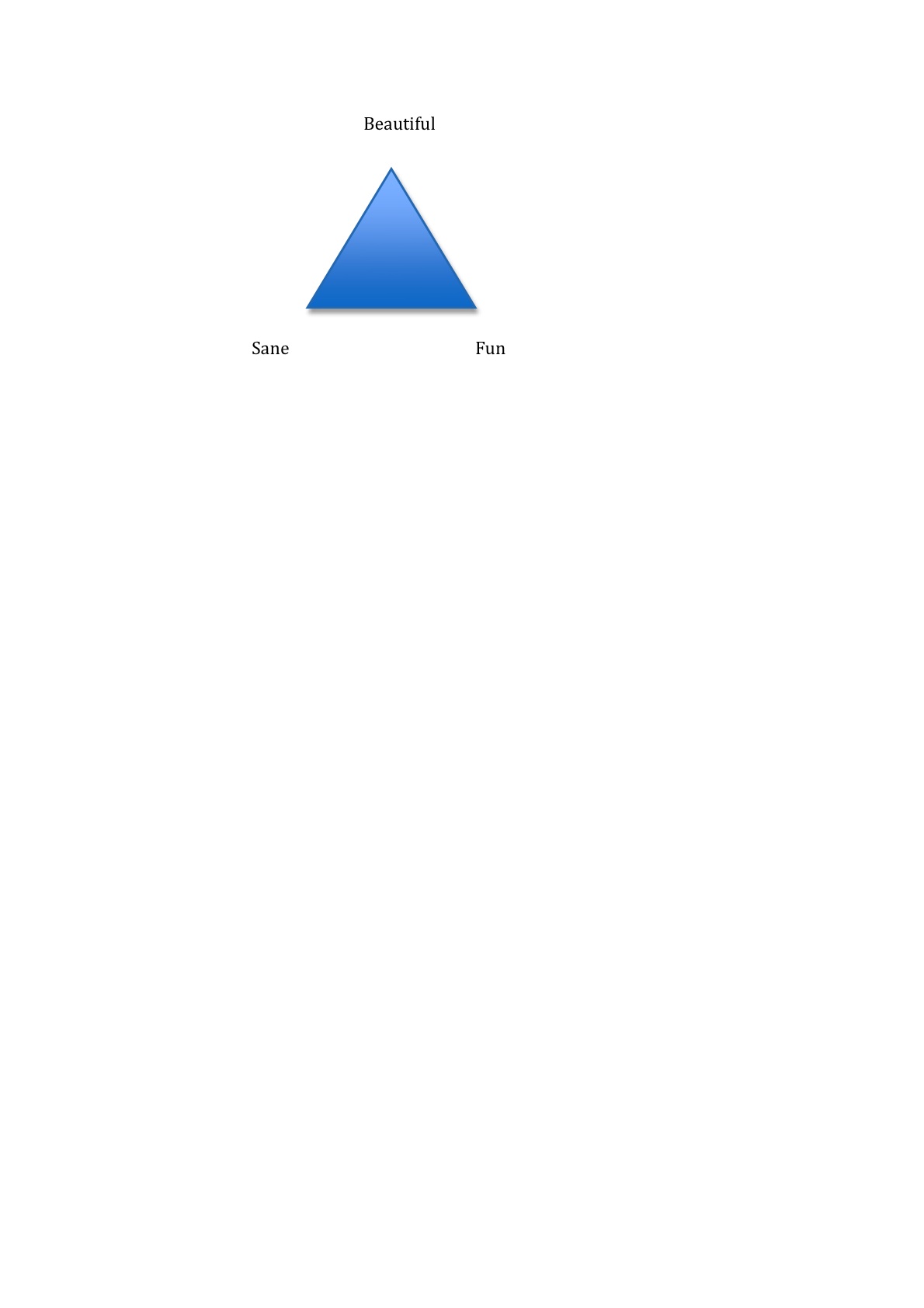
I’m finishing this entry with a triangle that AP sent me that represents his search for the perfect woman. In AP’s opinion, it’s not possible to have all three corners, you only ever get two at once. Enjoy.