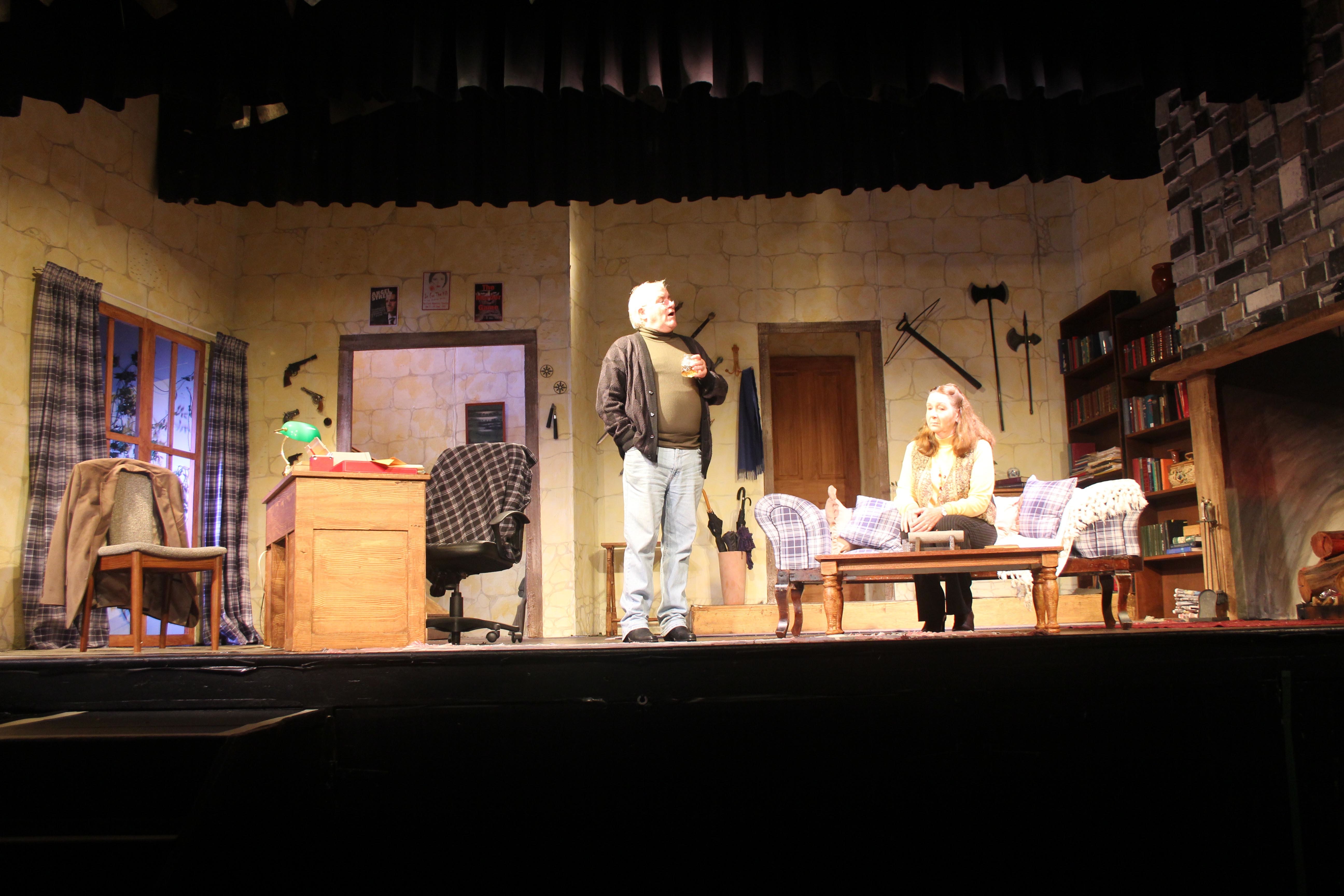
I recently painted the set for a Maitland Repertory Theatre production of Deathtrap, directed by Letitia Plume, which opened last Wednesday. Written by Ira Levin, Deathtrap holds the record as Broadway’s longest running comedy-thriller. And it’s not difficult to see why.
Deathtrap is intelligently written, with plots nestling inside plots, like sinister Russian dolls. At the end of each act, you think to yourself ‘ah ha! I’ve cracked it!’ but then it spins off into further machinations. Like any good thriller, nothing is as it seems.
In a nutshell, Deathtrap is the tale of Sidney Bruhl, an aging playwright, famous for a couple of early hits, but now living off his wife’s money. He’s sitting at his desk, desperately trying to pen another decent play, when a letter from one of his former students arrives. The letter contains a manuscript, and as he reads it, Sidney realises that the young man, Clifford Anderson, has written a perfect play. Sensing the commercial potential of the manuscript, Sidney jokes to his wife that he’d happily kill to have written this play. Then he invites young Clifford to his house.
What I like most about the play is that it’s a self fulfilling prophecy in action. A playwright writes a play about a playwright who writes a great play which, in the real world, gets turned into a Broadway blockbuster that runs for years. If you happen to be anywhere near Maitland, this production is worth checking out: the cast chuck themselves gleefully into their roles and the script itself is a thing of evil beauty.
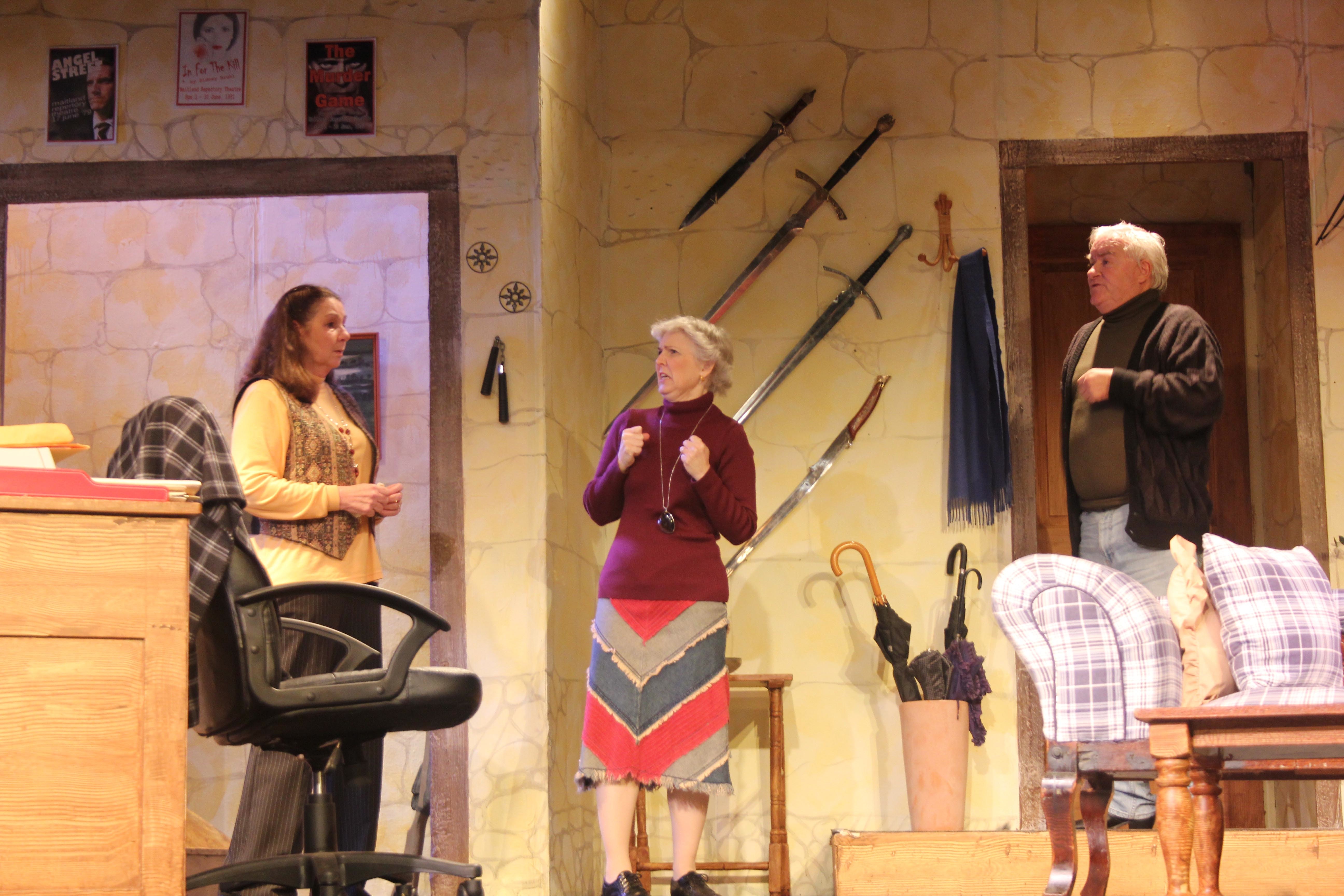
Deathtrap is set in a converted barn, circa late 1970s, hung with Sidney’s weapon collection and props from his previous thrillers. It’s a dangerous looking space, with swords, knives, guns, handcuffs and daggers all on display. At one point Sidney quips “what’s the good of owning a mace if you don’t get to use it occasionally?’ On one side of the stage is a large fireplace; antiques, bookshelves and a writing desk furnish the room.
The sets for this production proved a little trickier than the last lot, largely because I was having difficulty making the walls look like rendered stone. This is relatively easy if you can use an impasto effect, but the flats need to remain, well, flat so it was 2D trying to look 3D. In the end, I stuck a linear stone effect over the walls, hoping that this would relate to the patterns in the fireplace and furnishings. It’s completely different to what I’d originally pictured for the set, and although it’s rather busy, I quite like its butch, cartoony, over-the-top feel.
 Helen Hopcroft: an artist's life
Great stuff Helen – you are inspiring with all your art ventures and still manage to be a good mum! all the best Ileana
Ah! You obviously didn’t see what Sophie had for dinner…