Archives for category: Uncategorized

Strange Tales, my solo exhibition at Despard Gallery is coming up on the 10th May. It’s a weird blend of painting and literary references, with fairy tale and Tasmanian Gothic iconography, peculiar narratives, unsettling characters and haunting landscapes.

Any creative act is a little like a conjuring trick, you’re never entirely sure if it’s going to come off, and I’m probably too close to this body of work to see it clearly. However I can say that I’ve loved making this work, it’s been a blast and I’m really looking forward to the show. Oddly enough, these paintings are saturated with Tasmanian references: I find myself pawing over photographs of the island’s rugged coastline, early Colonial art, peculiar wildlife, literature, local Museum collections.

I’m also extremely pleased to announce that Danielle Wood, winner of the Australian/Vogel Literary Prize, will be opening the show. If you’re in Tasmania hopefully I’ll see you at the opening: 6pm Thursday 10th May. After the show I’m planning to take a month off and spend part of it traveling around the island. The aim is to visit and document all the lighthouses: can’t wait!

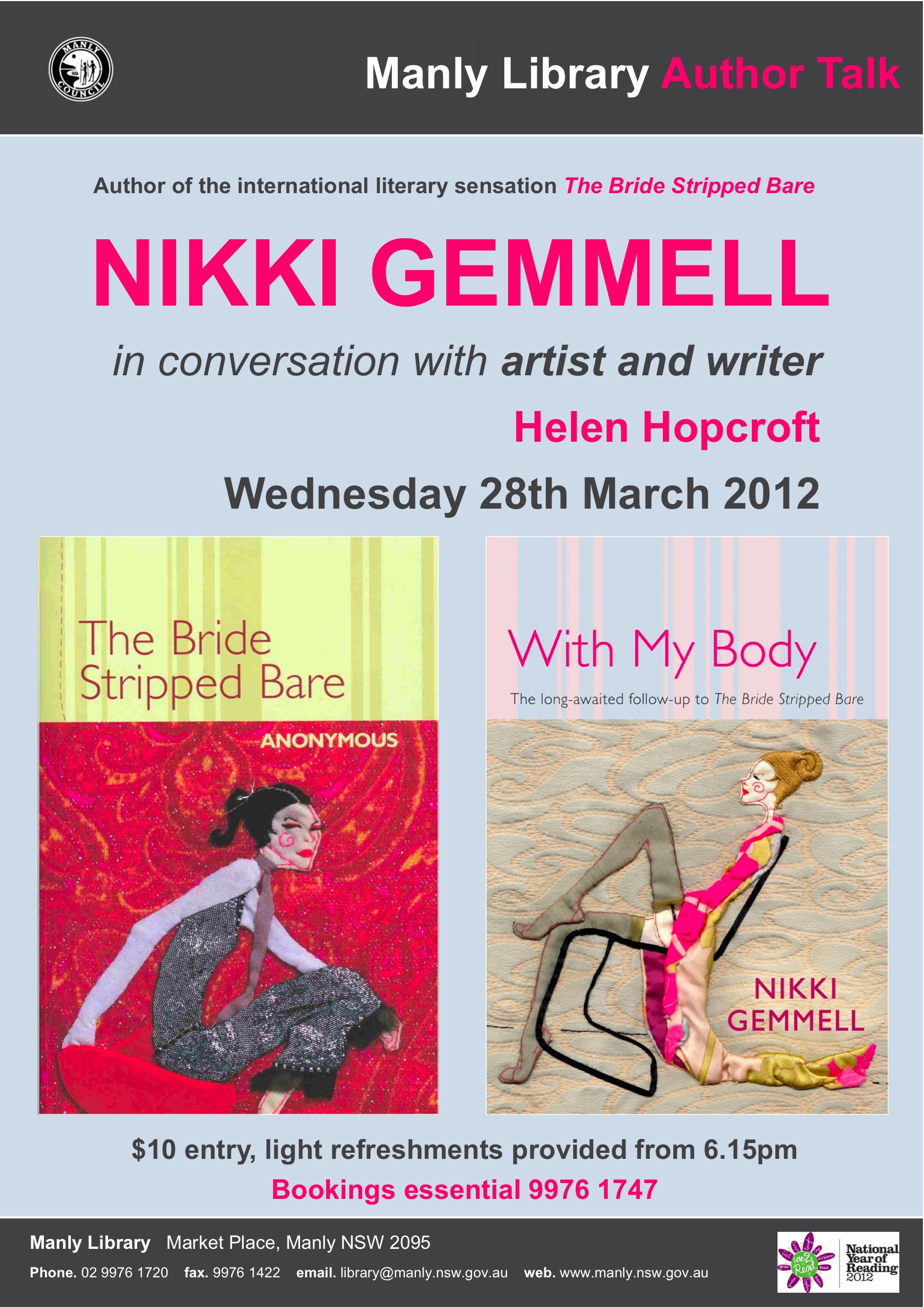
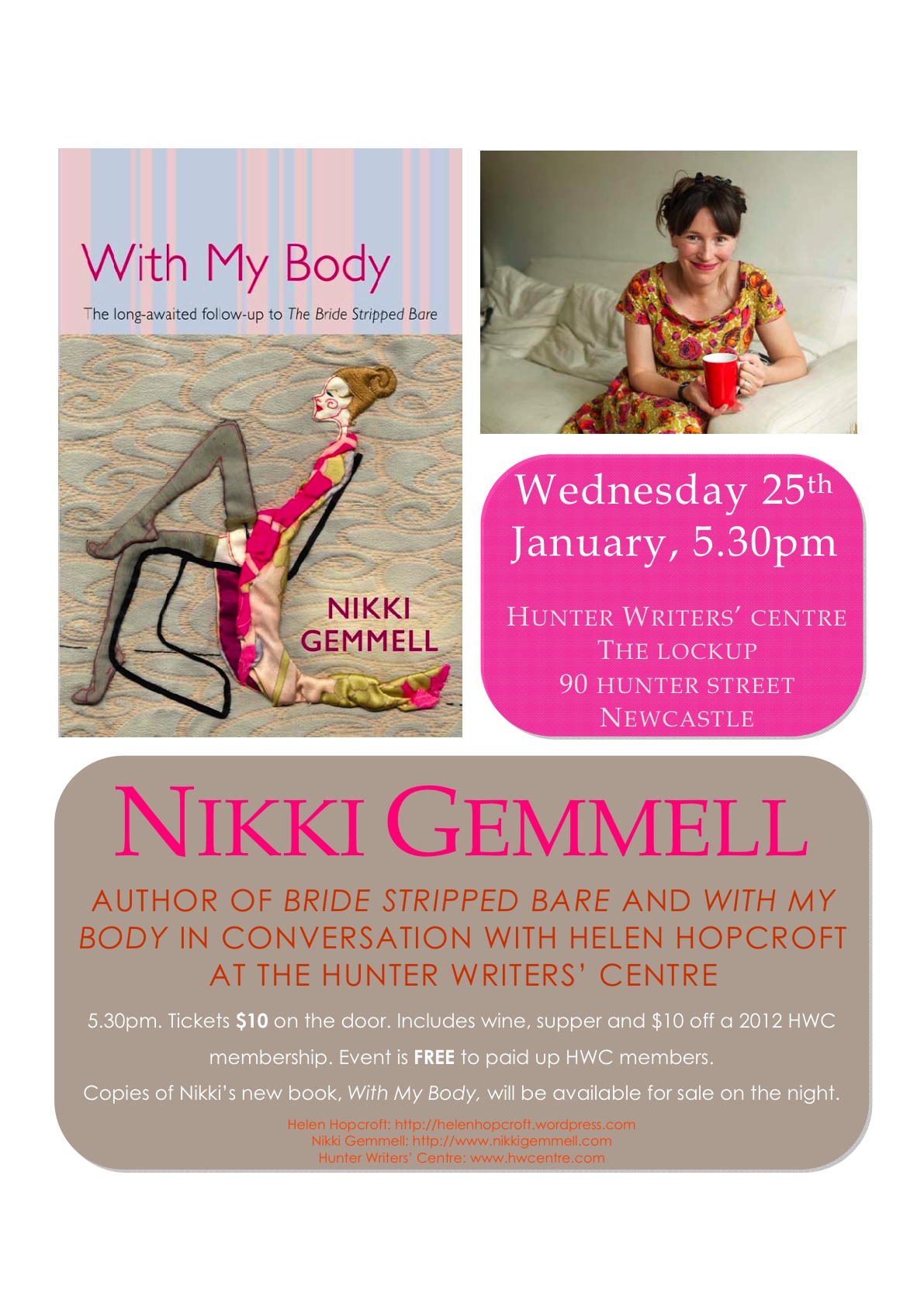
A quick reminder about tonight’s Nikki Gemmell author talk at Manly Library. I’ll be interviewing Nikki about her latest book, With my Body, and talking about her previous novels including the hit bestseller The Bride Stripped Bare. The event starts at about 6.15pm, there’s a cost of $10, light refreshments will be served and bookings are essential. For more info please contact the library on 02 9976 1747.

In about a week’s time I’m interviewing the writer Nikki Gemell, author of the international bestseller The Bride Stripped Bare, at Manly Library. Nikki is an engaging speaker, I interviewed her for a public event at Hunter Writers Centre (Newcastle) a few months back, and she is generous with her time. We spoke about her journey into writing, early life in Woollongong, how becoming a mother impacted on her writing practice, the media frenzy that accompanied the publication of Bride, and her family’s recent move back to Australia after fourteen years in London. We also chatted about the new book, With my Bodyand her previous novels Shiver, Cleave and Lovesong. 

After the talk was over she signed books for people and chatted to them about writing. I remember being impressed by the amount of effort she put into the signings: intricate curly cord cursive with flourishes, nice messages.

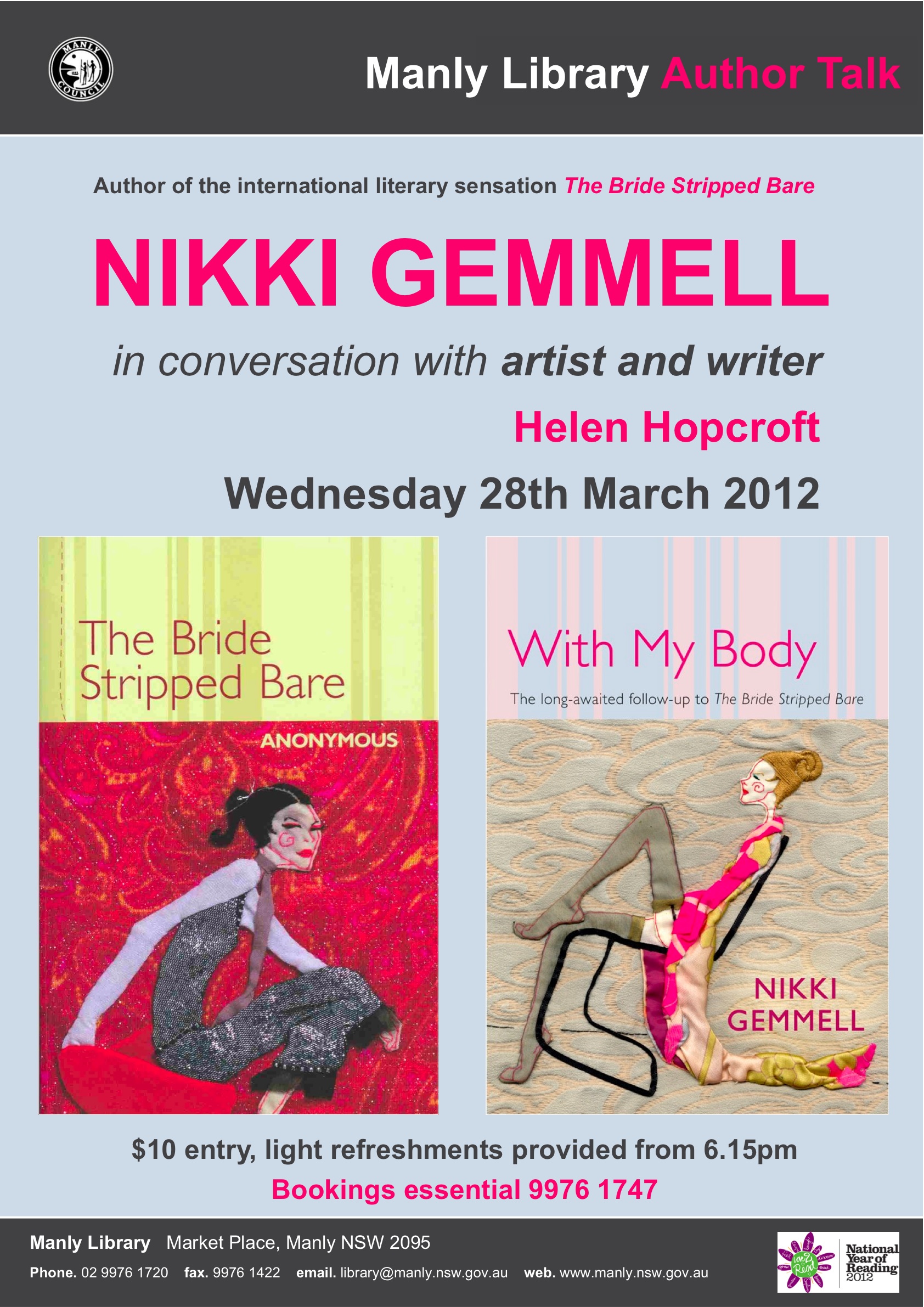
The Manly Library event is on Wednesday 28th March from about 6.15pm. Bookings are essential, light refreshments will be served and entry is $10. Please phone 02 9976 1747.

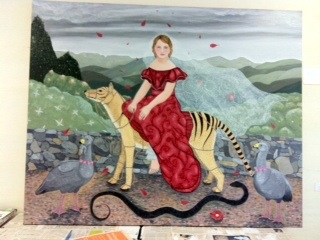
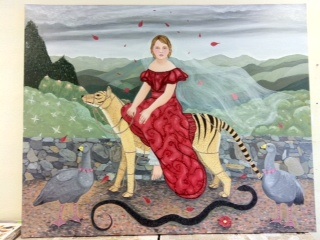
The Marriage Plot, 5 x 4, oil on canvas 2012

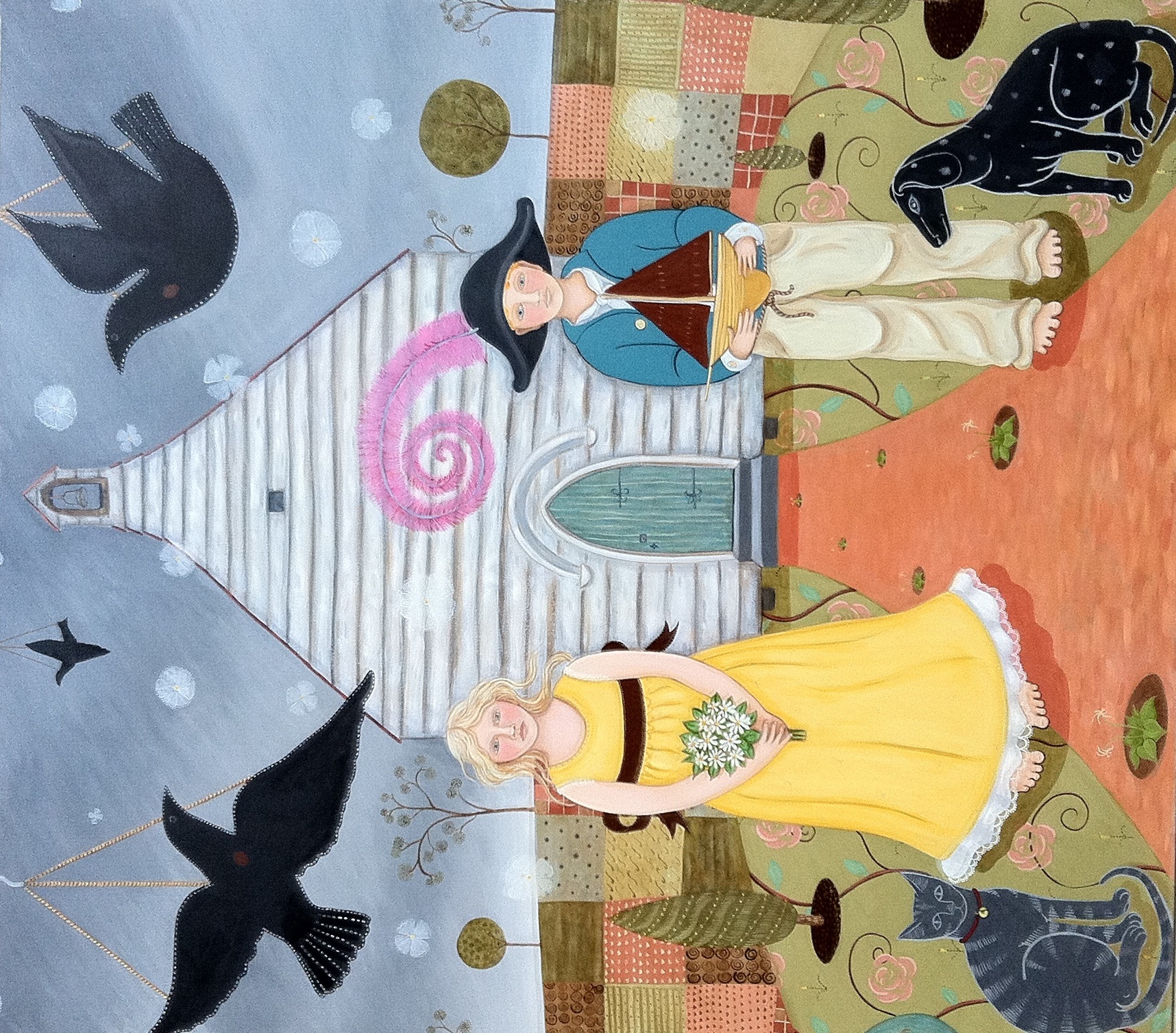
I’ve got a solo exhibition coming up at Despard Gallery, Hobart, and have been spending lots of time in the studio trying to get the paintings done. Strange Tales opens on the 10th May and will be on show until the 29th. The painting pictured above is ‘The Marriage Plot’ oil on canvas, about 5′ x 4′ (I haven’t measured them exactly yet so these number are a bit iffy), 2012. It’s named after Jeffrey Eugenides new novel of the same name.

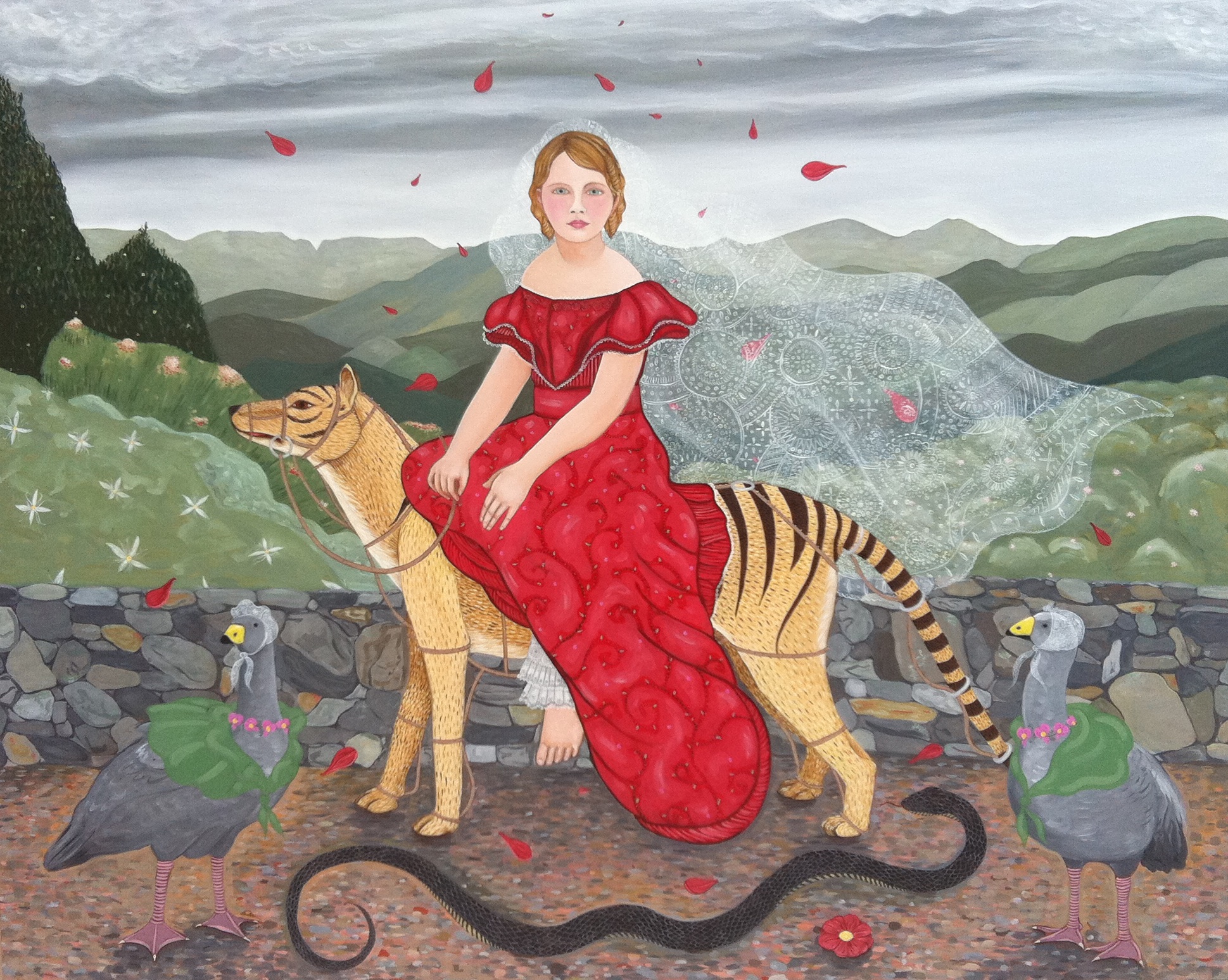
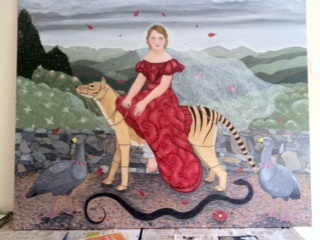
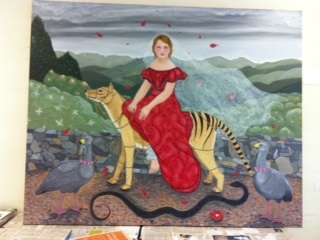
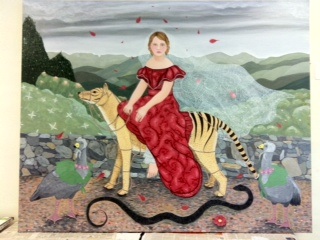
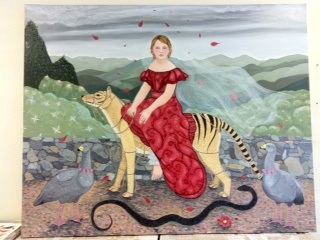
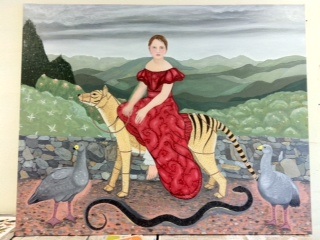
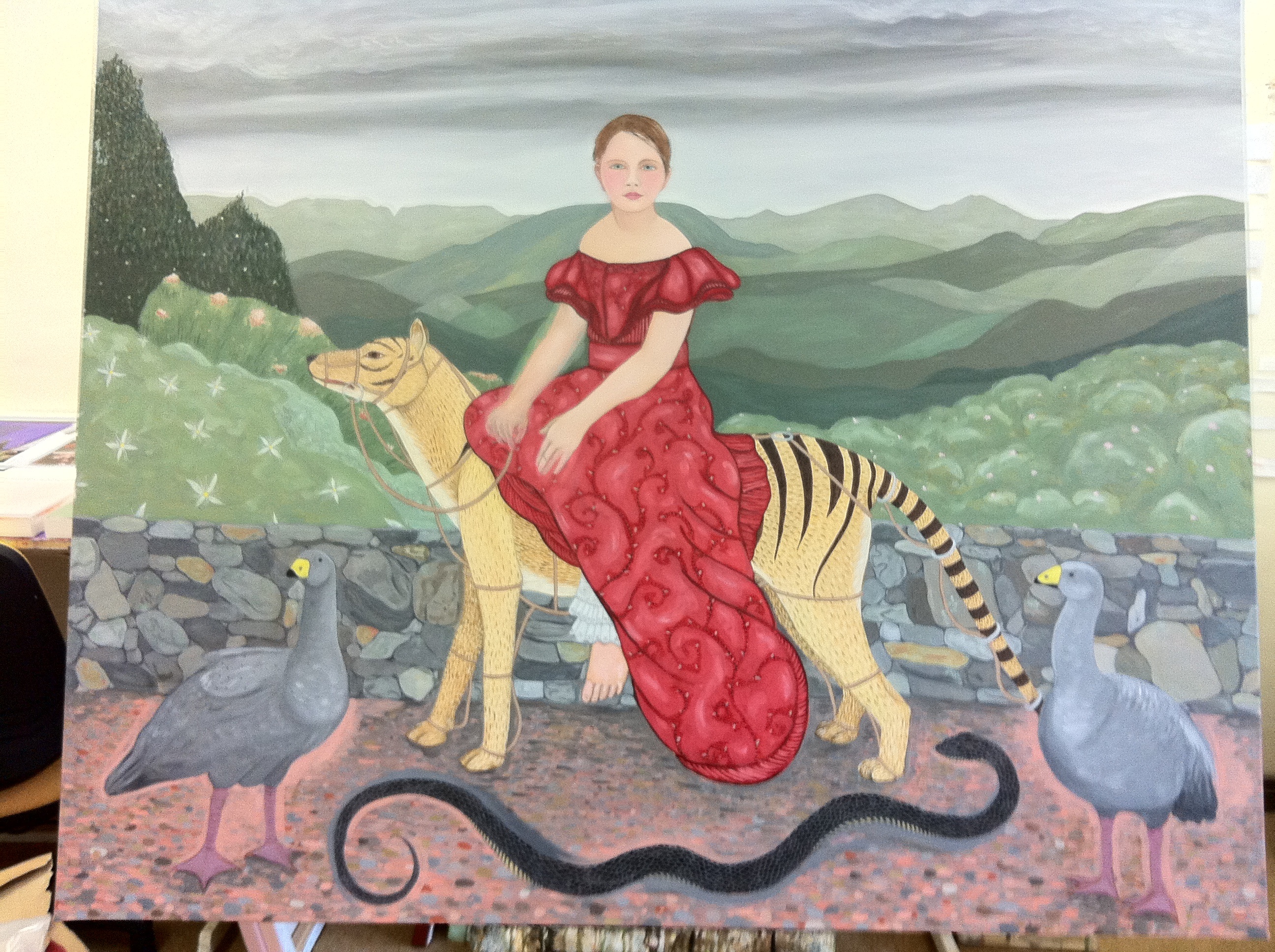
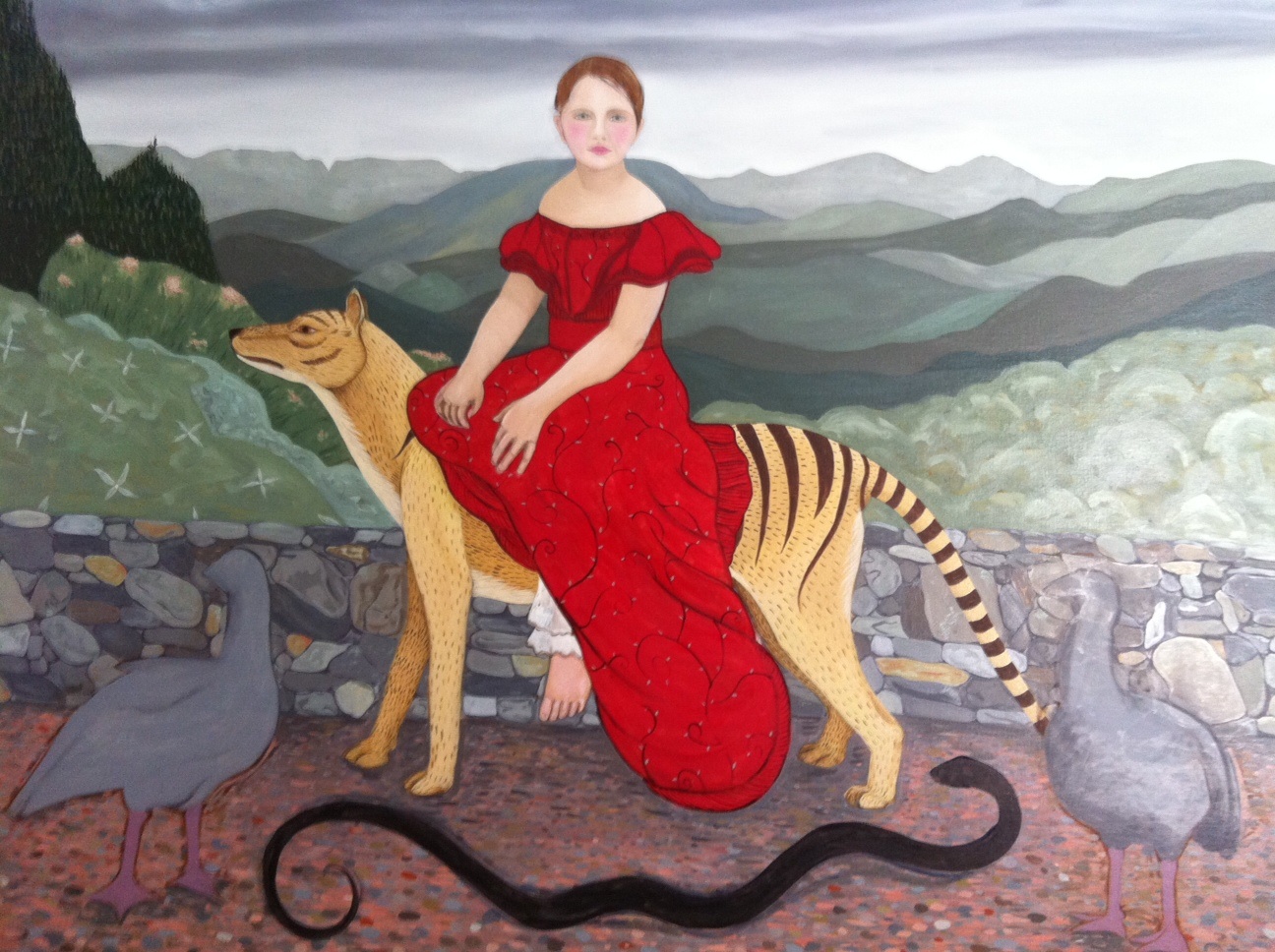
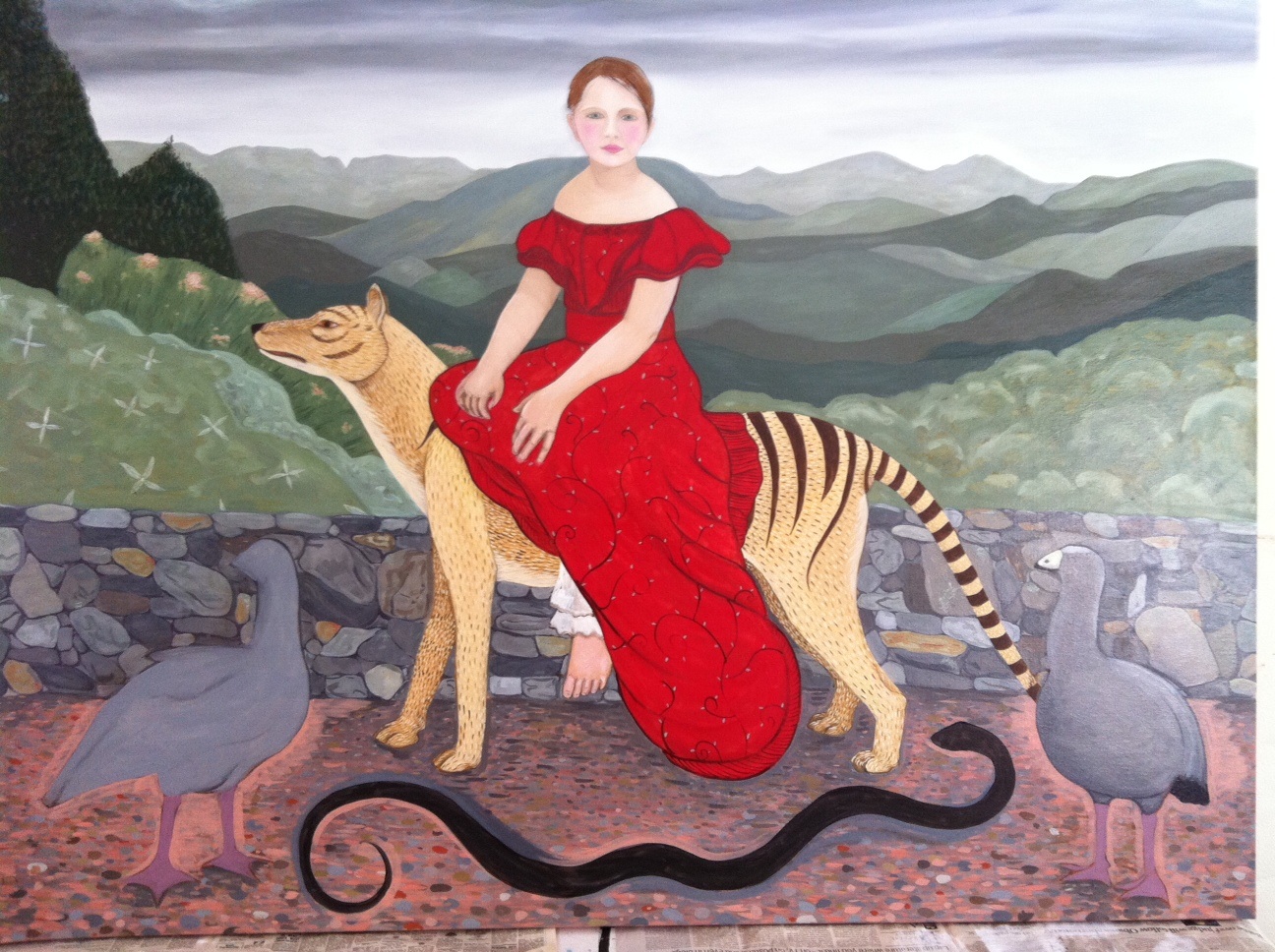
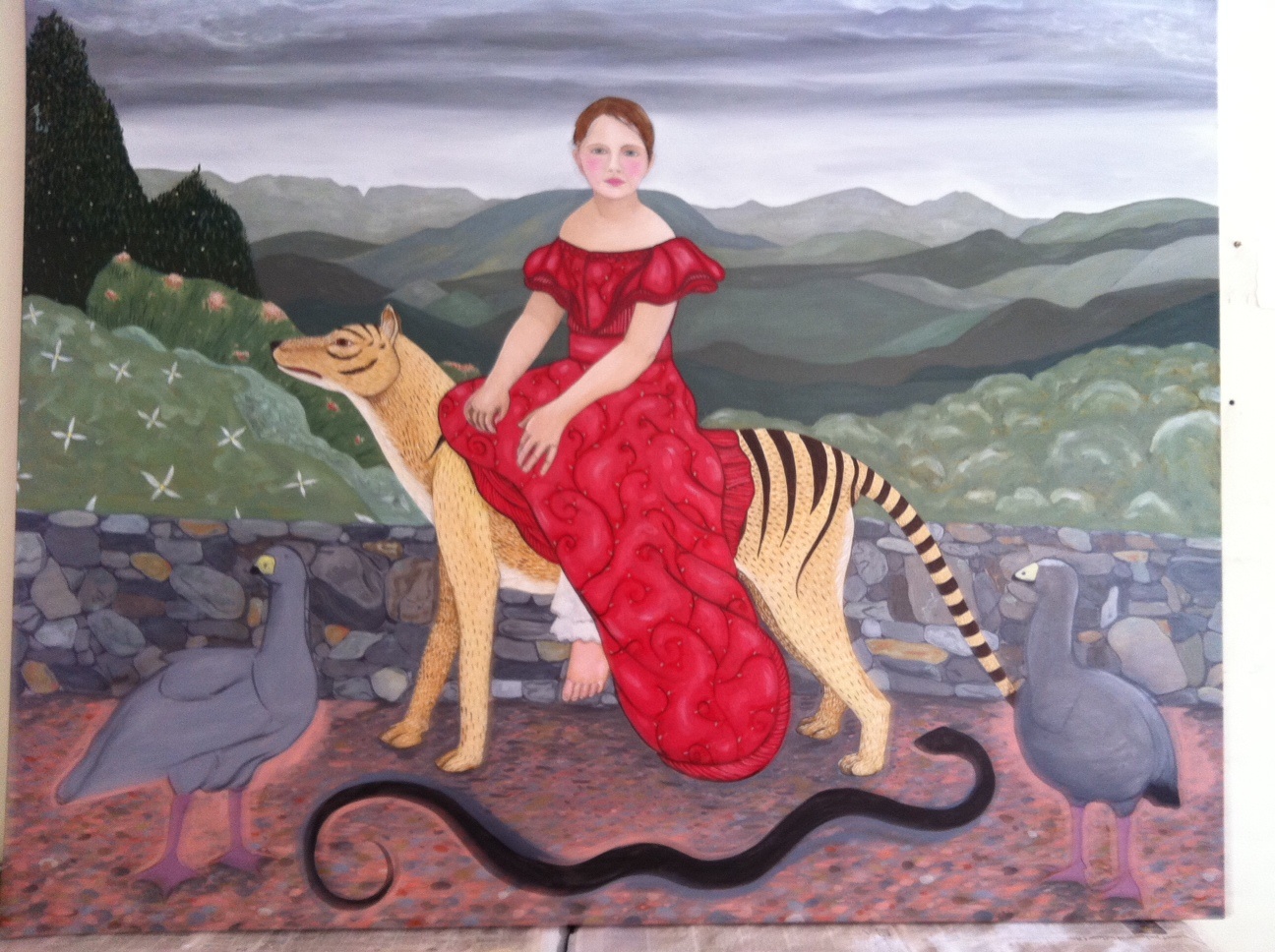
This one has already featured on this blog, I documented the stages of its creation; it’s ‘Tiger Bride’, again oil on canvas, 2012 and about the same dimensions as The Marriage Plot, but obviously landscape format instead of portrait. It owes debts to Australian colonial art, as well as Indian miniature painting and early religious art.

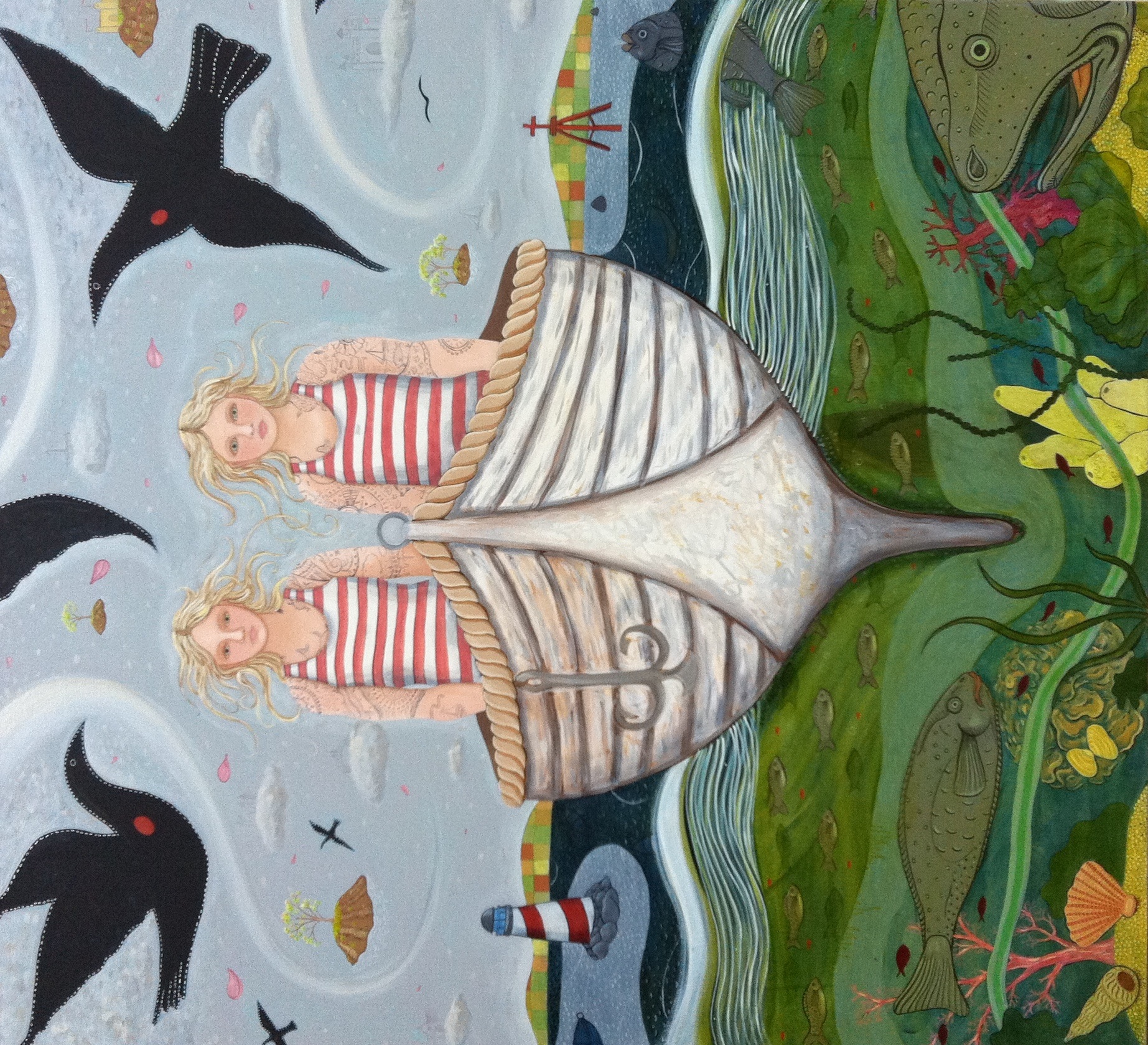
Another new painting created for Strange Tales. This is ‘Cloud Altas’, named after David Mitchell’s novel, if you look closely there are small cities and boats in the clouds. This is an image that continues to haunt, two girls side by side in a boat, sky overhead, sea underneath, the occasional shadow as a shark passes underneath, joy when a fish is caught. As children my cousin Rachel and I used to take to the seas around Dover in a leaking huon pine dinghy; it leaked so much that frequently the fish we caught would swim around our legs when we pulled them into the boat.

More soon…

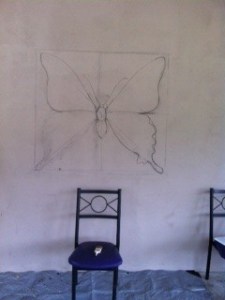
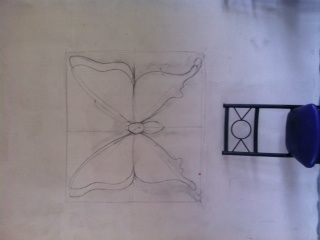
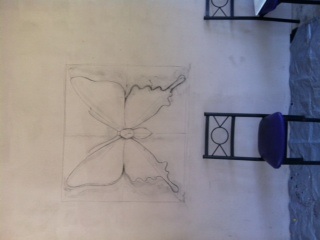
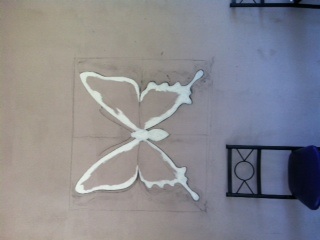
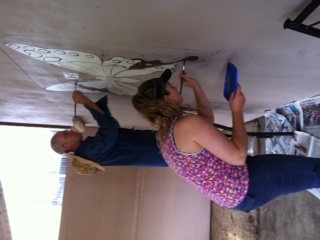
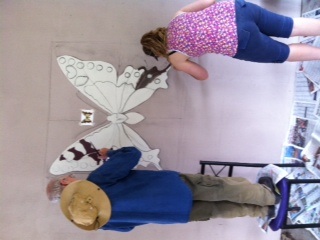
Last year, thanks to a Seedpod grant from the good people at Octapod, I kicked off ‘Seed’ a series of community art events at Fig Tree Community Garden. Trevor Horsnell and myself hosted a series of events that culminated in the painting of a butterfly mural on the wall of the rock steady Croatian Club, adjacent to the Garden.

Well the good news is that we’re back this year with more butterflies. How exciting is that! For all of you who have a burning desire to paint butterflies, or even just a mild hankering, come along to Fig Tree Community Garden this Sunday, 26th February. From 10am until about midday we’ll be painting on the wall and everyone is welcome to join in. Afterwards there will be a delicious lunch from Fig Tree’s wood fired pizza oven; these are yummo pizzas often topped with fresh produce and herbs from the Garden.

But if you’re thinking ‘nah, butterflies- not hardcore enough for me’ I quite sympathise: I too have wrestled with this vexed conundrum. Initially the prospect of painting multiple butterflies on a wall may seem rather girlish, light hearted, perhaps even effete. This is not what I’d imagined I’d be doing in the leather clad 1980s.

However now I am one of the converted and can reassure you that after the first butterfly, you’ll be gone baby gone. It’s highly likely that you’ll go home after the event and spray paint butterflies on your bedroom walls.

This time around I’ll be joined by the very talented artists Karen Robinson Smith and Tallulah Cunningham. Karen is a sculptor with a natural sense of design, so she’s responsible for butterfly placement. Or, as we like to say in the trade (please assume bad Cockney accent) ‘fly positioning.

The gifted natural history illustrator, and artist, Tallulah Cunningham has kindly offered to draw outlines of butterflies so that people can fill them in.

If you haven’t touched a paint brush for years, and can’t draw to save a stick figure, be reassured that we’ll have some fool proof stencils to get you started.

See you Sunday, come ‘fly with us!

A funny example of life turning full cycle: on 5.30pm Wednesday night I’ll be interviewing the writer Nikki Gemmell at the Hunter Writers Centre. I’ve previously blogged about Gemmell’s writing, particularly the erotic best seller The Bride Stripped Bare, and have just finished reading her latest: With My Body. Bride was one of the reasons I started my experiment with erotic literature, and the inspiration for my 1001 nights novella. Another driver was the memory of reading The Story of O while an art student in London. Co-incidentally, With My Body mentions The Story of O (something of an erotic classic) and the main character is a sun-starved Australian living in London. I can vividly recall this feeling that there was never enough light. At the height of one particularly dreary winter I remember staggering into a South Kensington solarium and spending a happy hour zapping myself with carcinogenic rays.

Anyway, if you’re in Newcastle on Wednesday afternoon, I might see you at the Hunter Writers Centre.


I did get a lot done this year, just not the things I had planned to do. I know this because at the back of my desk diary I keep a list of priorities, goals, daydreams, aspirations and plans. Some of these are the low level bottom feeder kind of tasks, for example ‘learn how to use Excel’, so I don’t have to endure the humiliation of submitting my tax information in a Word document to my accountant. Others are more lofty, vague and ambitious like ‘have a son’.

On a list titled ‘2011 Goals: big and small’ which features twenty-two items, I managed to achieve exactly two things: I didn’t pay for parking at the University where I periodically work (I’m too miserable to buy parking vouchers and prefer a long walk into campus from an outlying car park. Faced with a choice between torrential rain, and paying $3.40 for a car space, I’ll always opt for a drenching). And I brought myself a nice pair of new trainers. Things I failed to achieve included: selling my house, the proper management of paperwork, finishing my crime novel and, something of a perennial favourite, getting rid of my gut!

On a list of thirty-two things I’d planned to do to my house, before selling it, I managed to achieve exactly (drum roll, please) five items. And that’s actually being generous with the point scores. The problem with the house (I like to blame the house) is that it’s one of those little 1960s fisherman’s shacks, originally a one room place, that later had a kitchen and bathroom added. I like rich colours, so when we first moved in, I made the mistake of painting the walls deep reds and greens. Unfortunately, being a small, square box of a house, it ended up looking like a Rubrick’s Cube. I’ve just finished painting everything white.

Then there’s a problem with my interior design sense, which could be kindly described as problematic. I prefer a style of home furnishings that lives comfortably with notions of kitsch, tack and overkill. Merging bordello themes (a penchant for furry blankets and velvety red and shiny gold fabrics) with a love of brightly coloured Indian and Asian Art, I effortlessly manage to create something that looks like the worst kind of Gentleman’s Club. Imagine some kind of colonial era bounder, staggering from one budget opium den to another, pausing for relaxation at a B grade antique shop, and you’ve got the picture.

'coastal'

I’m currently trying to emiliorate my own lack of taste by re-branding the place as ‘coastal’. This involves painting everything white and sticking stuff in wicker baskets (though why the f**k people do this is beyond me. The baskets are too small to hold anything useful, you can’t see what’s in them, and if you have too many of them you create this creepy Ali Baba and the Fourty Thieves feel). I’m picking up paint charts and going ‘mmnnnn, beige’. However just when the thought of all this beige got too much, I told myself that the house didn’t have to be ‘coastal’ it could be ‘coastal eccentric‘. This, I rationalised, would allow me the freedom to celebrate my own interior design excesses within a soothing cocoon of pale walls and floors.

So far the path to coastal eccentric has not run smoothly. I’ve found that the combination of a hot pink sari, casually thrown over a soft green leather sofa, just looks weird against a white wall. It seems as if the turquoise kitchen tiles that I so lovingly selected will tend to jump out, even against the calming influence of a beige backdrop. Then there’s this irresistable inclination to dot the bare expanses of white walls with LOTS of pictures. Frankly, it looks as if two different people live in the house and couldn’t decide what they liked.

Similarly my Arts career ran this year like it was being managed by a job sharing genius and idiot. For every resounding success there was an equally prattish custard-pie-in-face failure. The days the genius was on board, I managed to win just under $50k worth of grants, published a book and a journal article, participated in ten group art exhibitions, co-curated a successful touring artists’ books exhibition, published an article in an international art mag, and ran a couple of pretty cool community art projects. When the idiot took over, however, I couldn’t do a thing right. The list of knock backs, failed funding applications, refused opportunities, and politely phrased  rejection letters (ranging from the polite ‘oh, we just had so many great applicants’ to a hissy subtext of ‘are you kidding?’) was monumental. Unfortunately as if so often the case, as everyone tries to clear their desk before the holidays, most of these missives arrived just before Christmas, leaving me wondering why on earth the idiot had been rostered on at this important time of year.

The good news is that my latest painting, the Tiger Bride, is almost finished. The bad news is that the human propensity to fiddle is potentially endless. And so it is that I have been hovering over the canvas with a tiny brush, making minute changes that no-one is likely to notice. Or even if they did notice, it’s doubtful whether it would make any difference to their reading of the image. Still, one is compelled to fiddle, even though there has to be a point where you say ‘enough! the bloody thing is finished’.
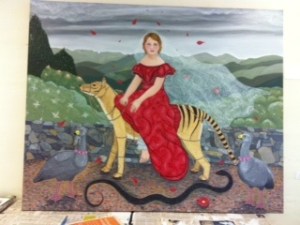
So why all the last minute angsting over trivial details of virtually nil visual impact? A good question! It’s partly a desire to make the painting as whole as it can be. When I get to this point in a painting, the big decisions are no longer clear (such as where the large forms go and what they look like). It’s just thousands of tiny little decisions that could go one way or the other. For example, does the veil need some ribbons blowing around it to increase the sense of dynamism? It’s essentially quite a static image, painted with small, tight brushstrokes, and the ribbons could help add movement. Or flow.
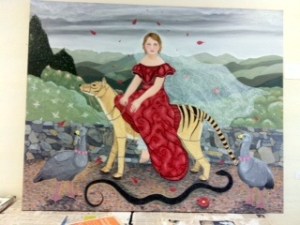
And if I add more detail to the Cape Barren Geese, will this help jump them forward into the foreground? At the moment they’re hovering tonally on the same plane as the stone wall. If I do add detail, what do I add? I had this idea of dressing them in natty little green velvet capes with lace bonnets. But if I do this, will it look incorrigibly naff? More specifically, will it take the image too far down the road towards children’s book illustration, bringing a kind of Wind in the Willows tendency into something that is supposed to be pretty but also ambiguous and hopefully potent.
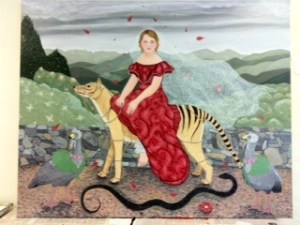
As you can see, the green velvet capes, complete with frilly neck-lines, made the cut. Their colour (chromium oxide) is too buzzy, much too high a key for the rest of the painting, so next time I’m in the studio I’ll calm them down with a pale tint.
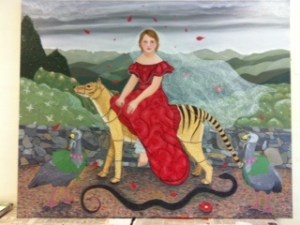
The other reason why it’s sometimes hard to finish paintings is more oblique. One gets so fond of them, they dominate your thoughts for a period of time, and it’s hard to let go. I’m visually monogamous: I like working intensely on just one image at a time. I find that flicking between images, though productive, dilutes the intensity required to make anything good. But this is just me, everyone works differently.
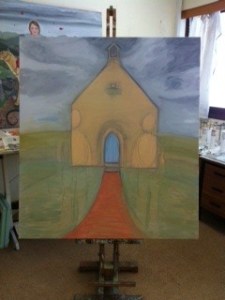
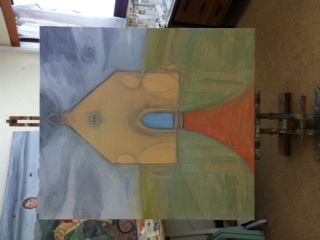
I am however fine with working up the underpainting layers of other canvases while I’m concentrating on one main image. This is a shot of a painting, I’ve nicknamed it church, that will eventually show a small, squat colonial era church with two children at the front, possibly holding animals. I return to this image, again and again, which is odd as I don’t even particularly like American Gothic. 
In a moment of clarity in the studio yesterday, I worked out that most of my images talk about female power. I was musing about the church image, and thinking that I may try painting a 3/4 view of the building, showing some nice sandstone details along the side. But for some reason I couldn’t break away from the image of the church, with a centrally placed door, and a curving path leading up to the entrance. Eventually I decided that the door acts as a kind of female phallic symbol, both a literal and a metaphorical gateway.
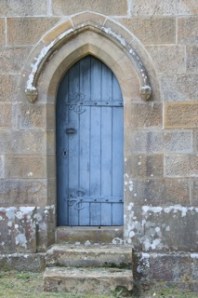
This is the photograph, of a Tasmanian church, that I’m using as reference. There’s something terribly mawish about this door.
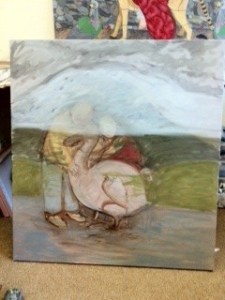
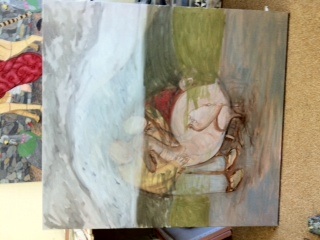
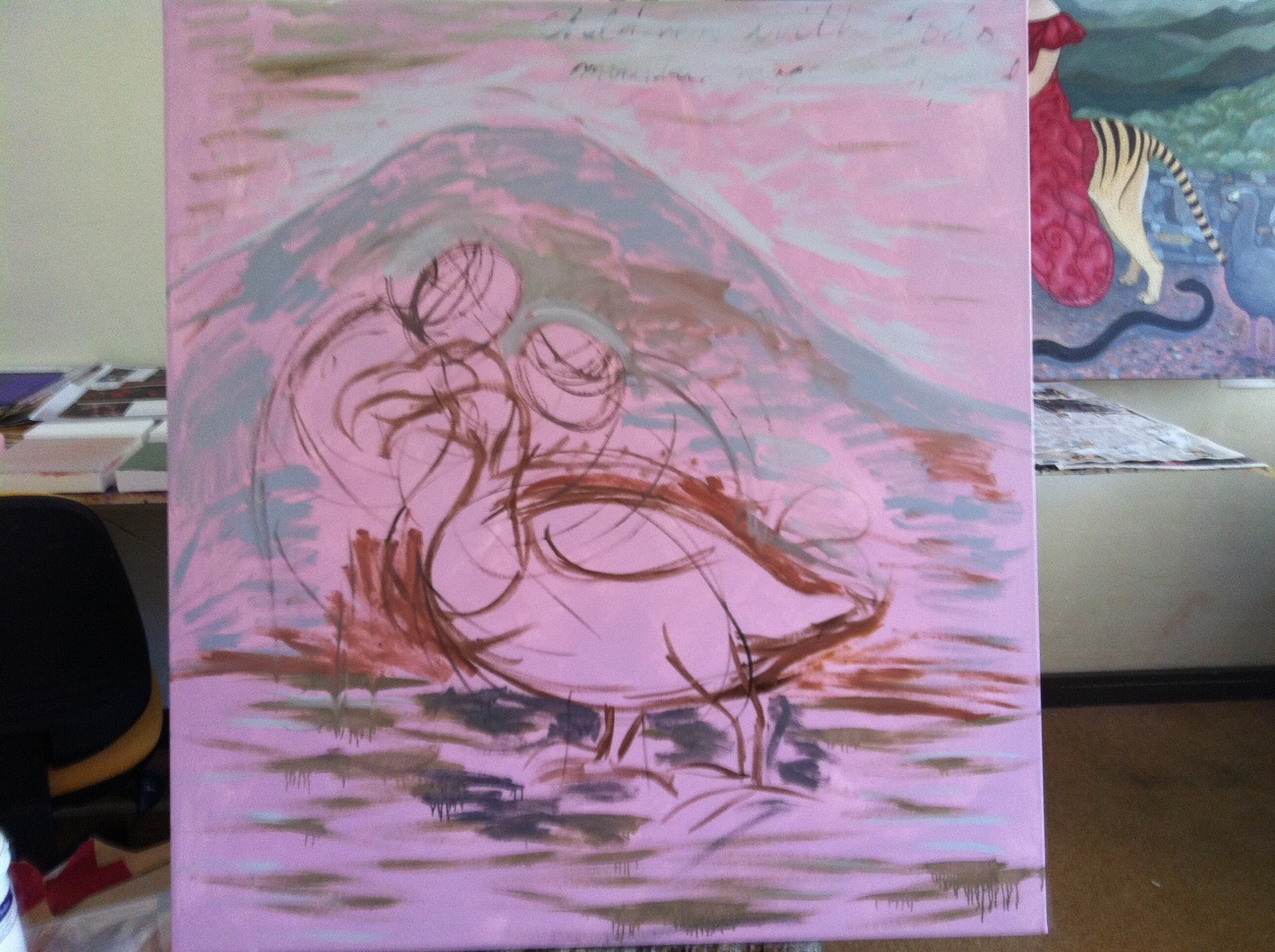
In other news, I’ve repainted the background to the Dodo with children in snowstorm image (it will probably have a better title eventually, but that’s its working name). I wanted the three figures to form a triangle, and visually operate as a pieta, with the human figures a descending series of forms curved over the dodo, the solid base of the triangle. Anyway, the whole group was off centre, and it wasn’t working.

I also abandoned my plan to paint a mountain, Hobart’s Mount Wellington, in the background. Firstly because I didn’t have decent reference material (despite my many trips to Tasmania to gather reference material, I had somehow forgotten to photograph the mountain that looms over the small city). And secondly because it would have closed in the pictorial space at a time when I’m trying to open it up and play with depth.
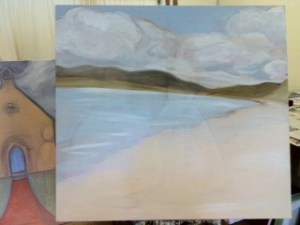
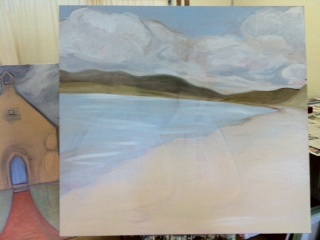
Here’s the underpainting of another image, it will eventually depict two girls standing on a beach, wearing colonial era ball gowns and animal masks. One will have her hands raised, pushing the mask off her face (perceiving the history of the place), a pose that dates back, at least in my imagination, to Les Demoiselles d’Avignon. I’m looking forward to this painting, imagining it as gelato coloured, all light pink, olive green, white and pale grey.
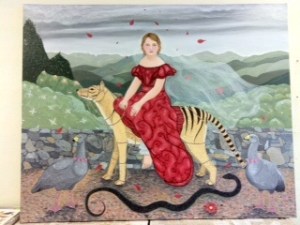
Surprisingly, one of my favourite parts of Tiger Bride was painting the lace. If you get up close, there’s some quite odd symbols and patterns woven into the pattern, including Pacific tribal motifs and things that look like crop circles. In retrospect, the lace looked better when parts of it were left sheer, as opposed to covered with ’embroidery’, but I went a bit OCD and didn’t notice this until I’d finished. At this stage I thinking that I can use lace as the visual motif that ties this exhibition together: I like the way it both obscures and consolidates forms. Incidentally the exhibition that these paintings are for, Strange Tales, has been moved back a couple of months. It will now open at Despard Gallery, Tasmania, in late April 2012.
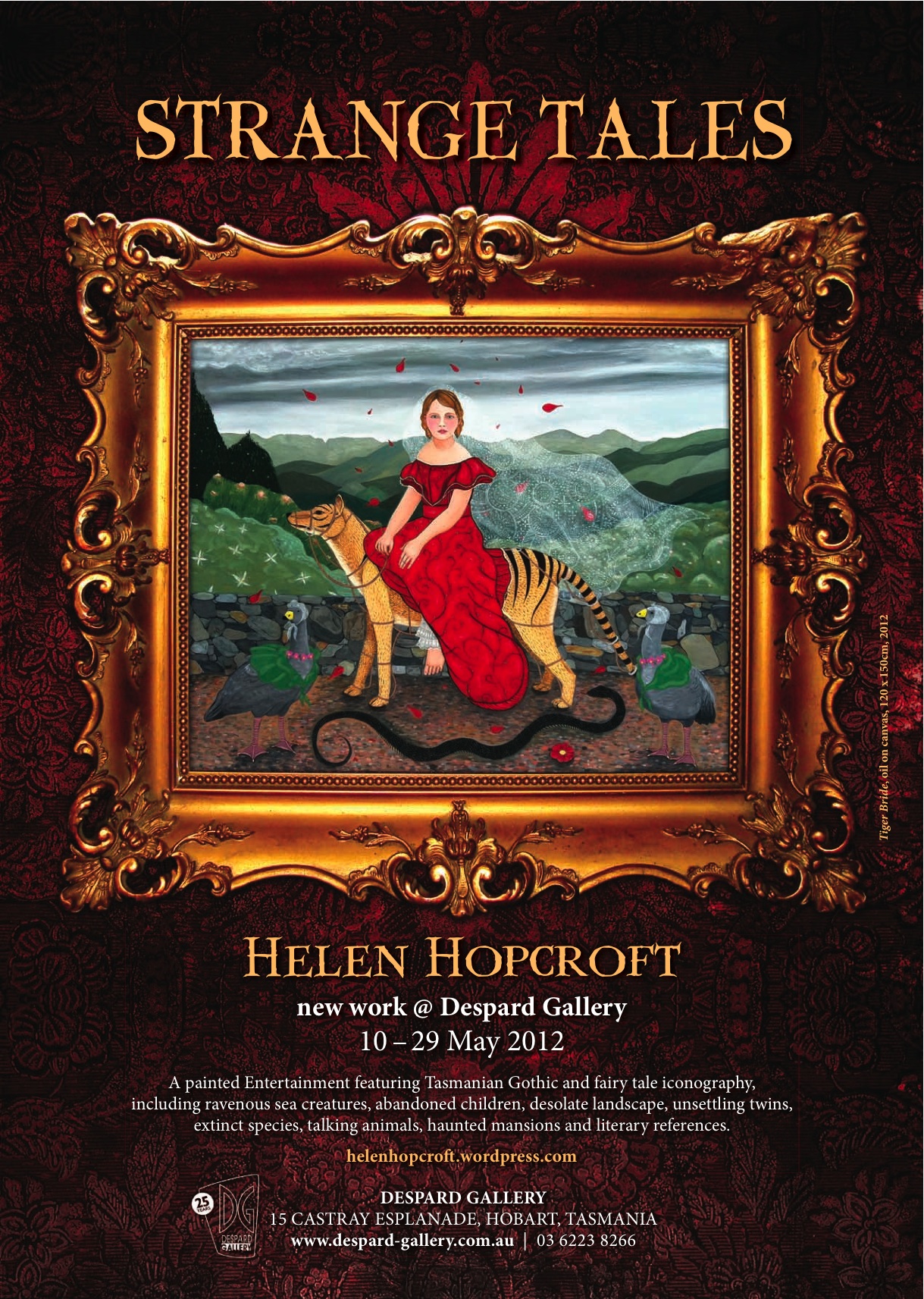
For those of you have been following the progress of my latest painting, Tiger Bride, you’ll be relieved to hear that the damned thing is nearly finished. Today was spent fiddling with minor details such as a the rose petal shower (the petals themselves, up close, look a bit like autopsy tissue samples), the girl’s hands and the tiger’s peculiar harness. I also painted the first layer of the bride’s veil, trying to use the translucent layer of paint to ‘free up’ some of the rather stiff brushwork that characterises the rest of the image.
After fiddling with the painting for most of the morning, I began work on another three canvases, all more or less the same size as Tiger, about 4 foot or 5 foot squarish. One is a funny image of a couple of Victorian looking children cuddling a dodo in a snowstorm (just can’t get enough of those extinct species!) Then there’s a seascape with two girls on a beach, one reaching her arms up to push an animal mask off her face. And the final image is a recurring obsession, a lot like Grant Wood’s famous American Gothic, of two figures standing outside an old church. I’ve painted this latter image so many times that today, when I was drawing it up on the canvas, it literally felt like I was tracing the image.

The process of painting extinct species is oddly unsettling. First of all I trawled through old photographs, and representations, of thylacines to try and work out what the Tasmanian Tiger really looked like. As I mentioned in a previous post, the discovery of their ‘stiff, unwaggable tail’ was strangely exciting, as was an old memoir written by an Englishwoman living on the island during the colonial era. It was moving experience to read, though described in dismissive terms, about the sight of a female Tiger hunting with her pups, nose to the ground as she tracked  prey. “A pretty picture” noted the writer with a sniff, unaware that she was documenting a dying breed.

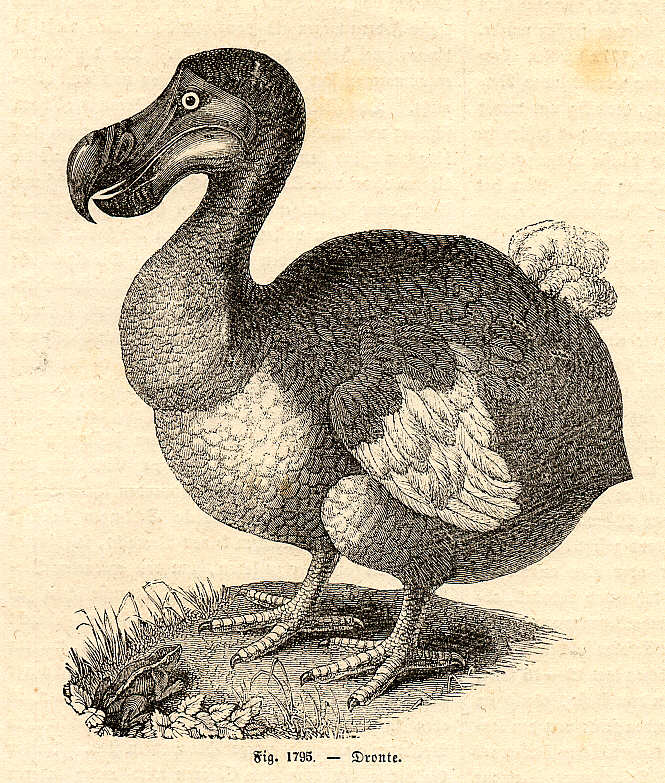
Similarly the Dodo representations tell you as much about the human artist as they do about the animal. Some dodo images are butterball fat, with enviably chunky drumsticks and squat little legs. These images scream “I am food: eat me!” to the viewer. One look at chubby birdy and you can tell in a flash why they went extinct. They’re the Colonel Sanders icons of the Age of Discovery. Hmmnnn…. that advertising jingle springs to mind, “I feel like Dodo tonight, like Dodo tonight”.

Other images show a more graceful elongated duck. One memorable etching depicts a stretched duck-like bird with legs firmly anchored under its bottom, making it unlikely that the bird could ever walk, let alone run away from potential predators. Dodos are variously imagined as deformed pelicans, bulked up macaws or as an exotic version of the Christmas turkey.


The Tiger Bride is gradually being completed, or as it so often feels with a painting, finishing itself. Like the cycle of a typical love affair, images hit the stage where there is nothing more to be learned/nothing left to discover/nothing more to give, and this is usually when you decide the painting is finished.

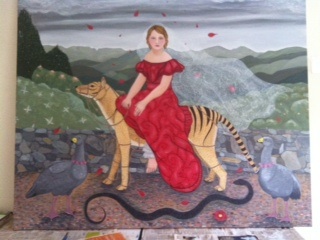
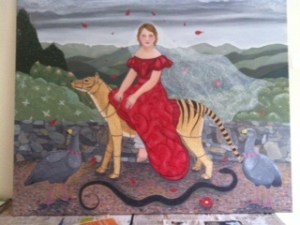
These photographs were taken over a period of at least two weeks, possibly three, I’ve lost count. And to complicate things, they’re not necessarily in order…

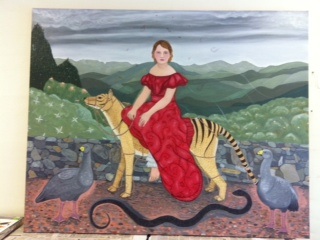
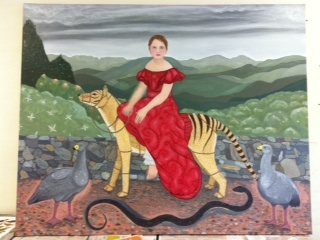
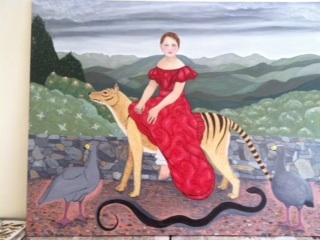
The snake resembles the scroll at the bottom of a medieval manuscript, it was re-drawn to fix the weird flattish angle on the last curve from the left. I had intended for the snake to be facing the other way, as nearly every other creature is pointing left, but it wasn’t to be.

Deciding that the red of the dress was too flat a colour, and rather cliched, I moved it towards a rose pink. It now looks uncomfortably like bubbling lava or a river of blood.

The tiger sporting his bridle and natty harness.

I’m currently using reference material, for the dress and hairstyle, from Tasmanian colonial paintings. My favourite era was early on, before more skilled painters began to emigrate to the new colony. There’s a kind of freshness about the early stuff, an earnestly naive attempt to ‘get it right’ and follow the fashions of far away Europe, a well intentioned dislocation. In the early paintings, sleek racehorses float a few inches off impossibly green grass; a salon painter labours over the painting of a glass, a piece of lace, in a desperate attempt to show that he can ‘do it’; family portraits show each person from a slightly different perspective; and native animals are this weird concoction of familiar species: a kangaroo typically has the ears of a rabbit and the legs of a hound.