Archives for posts with tag: art

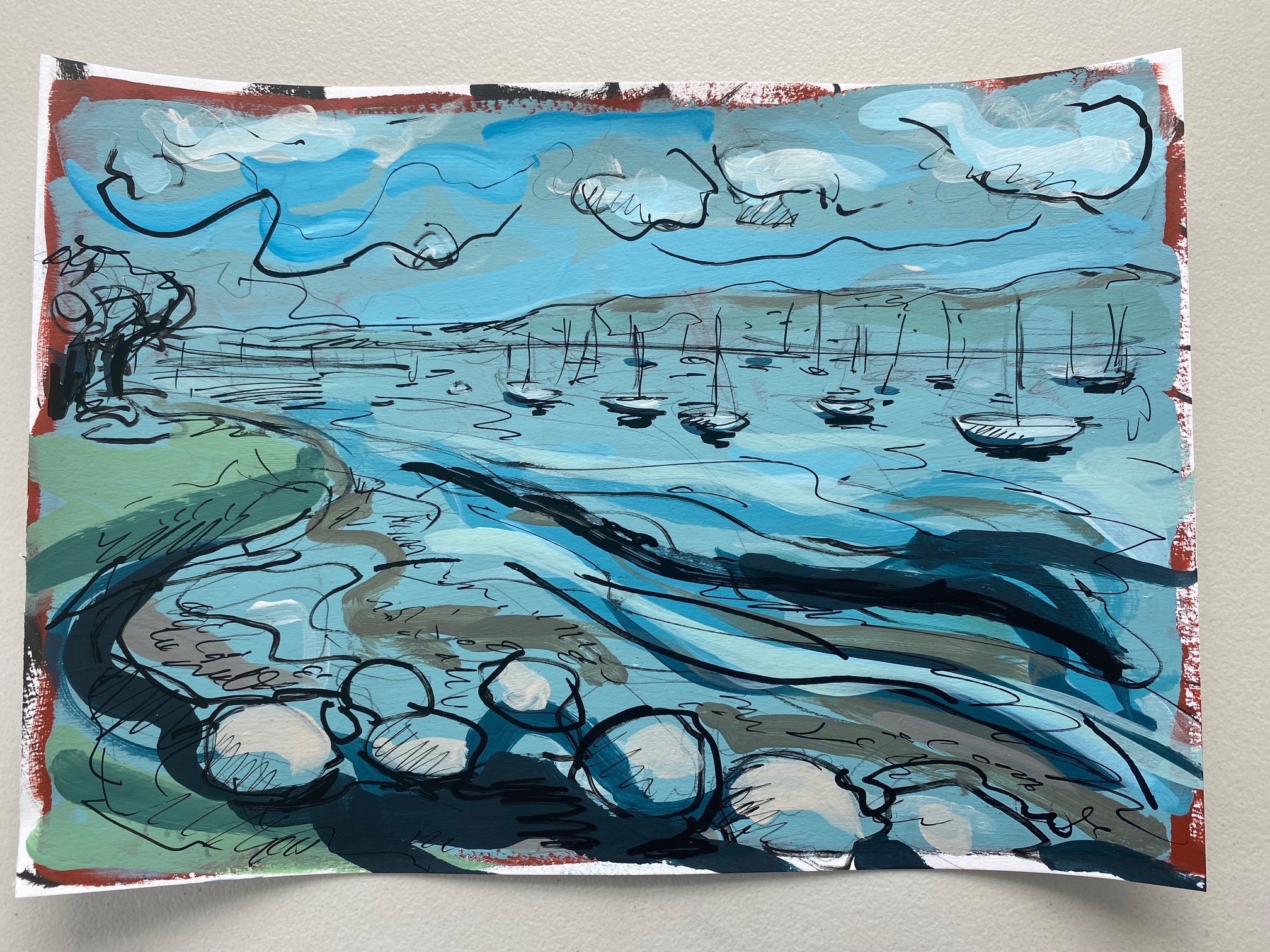
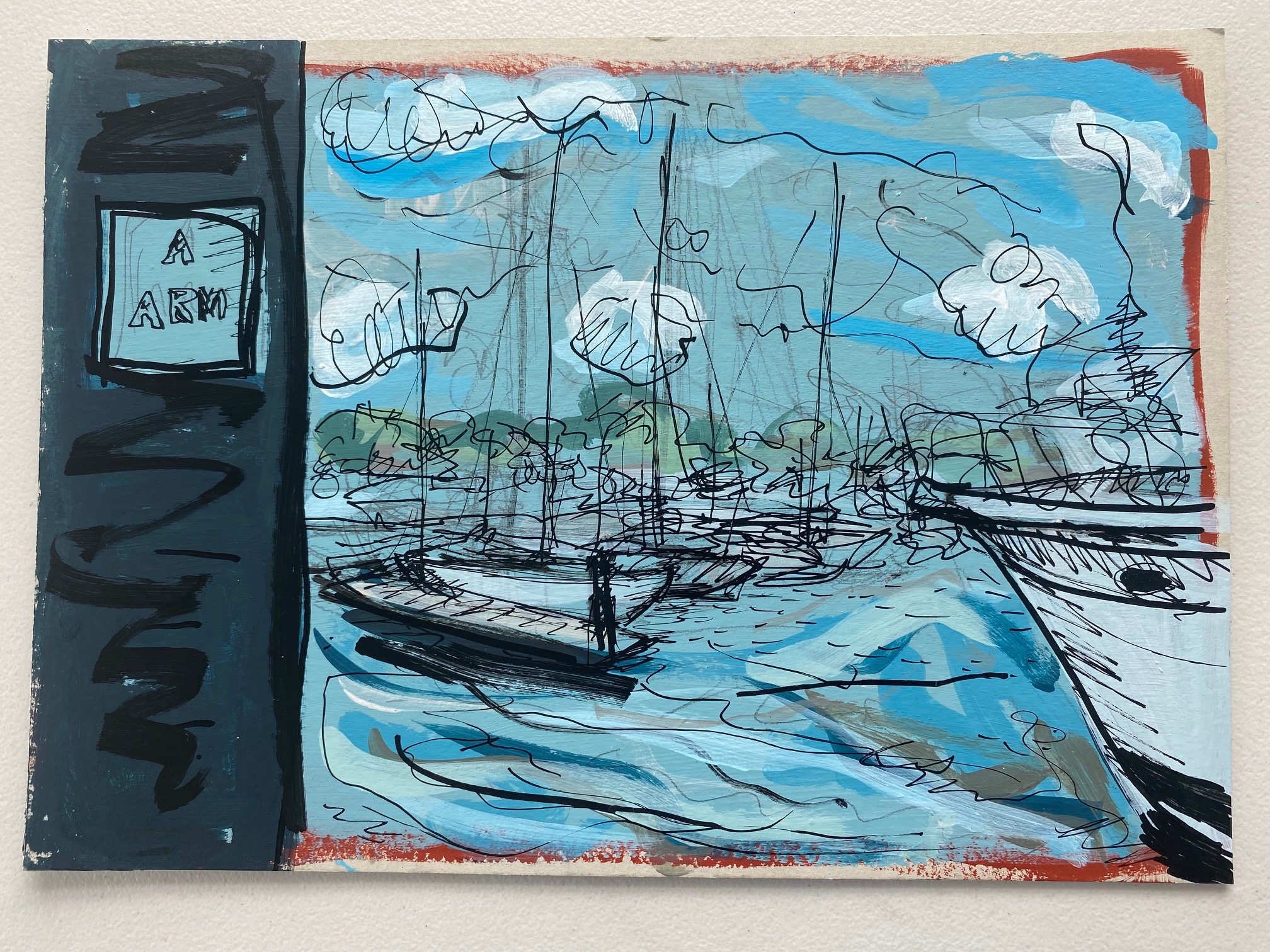
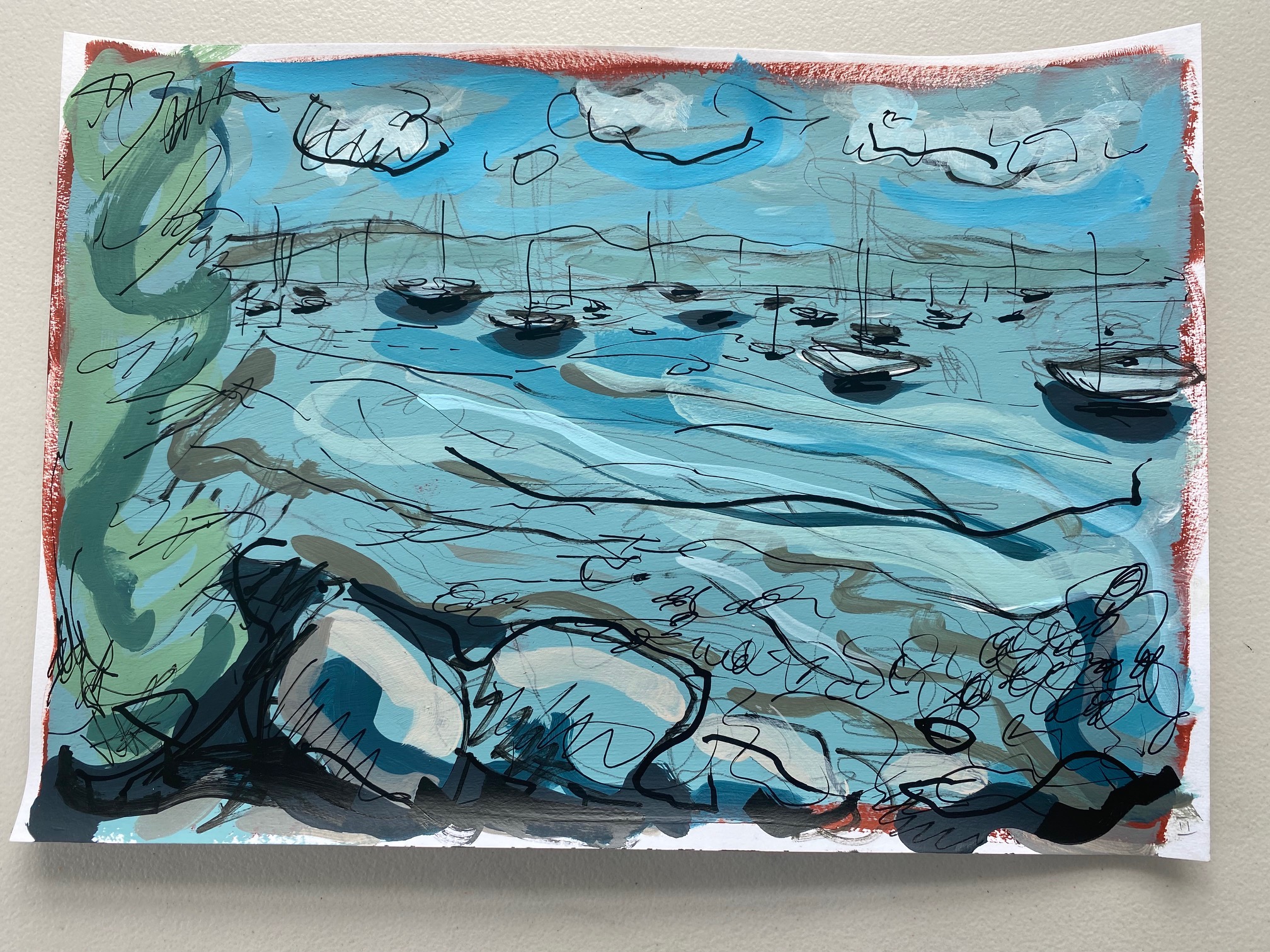
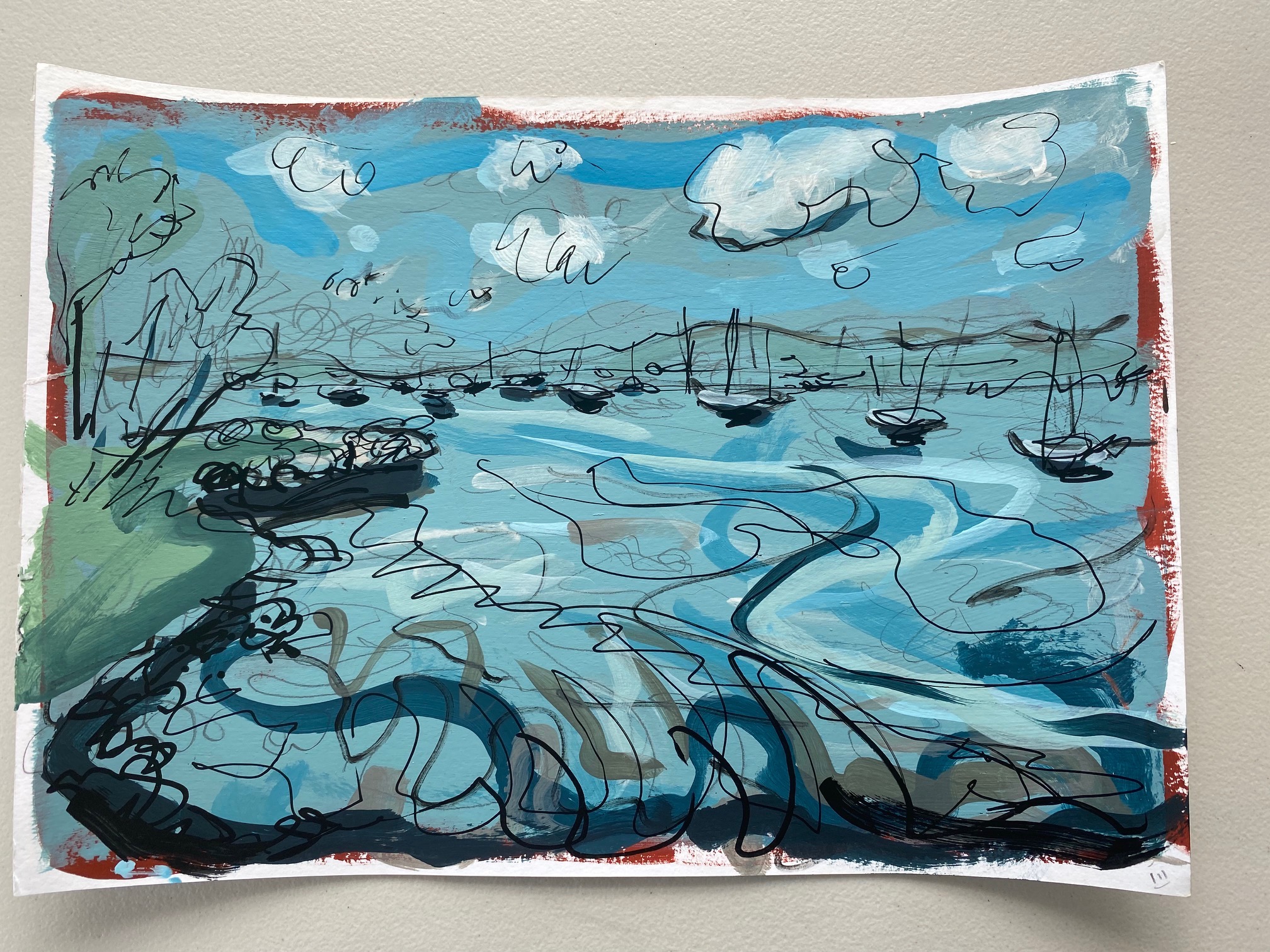
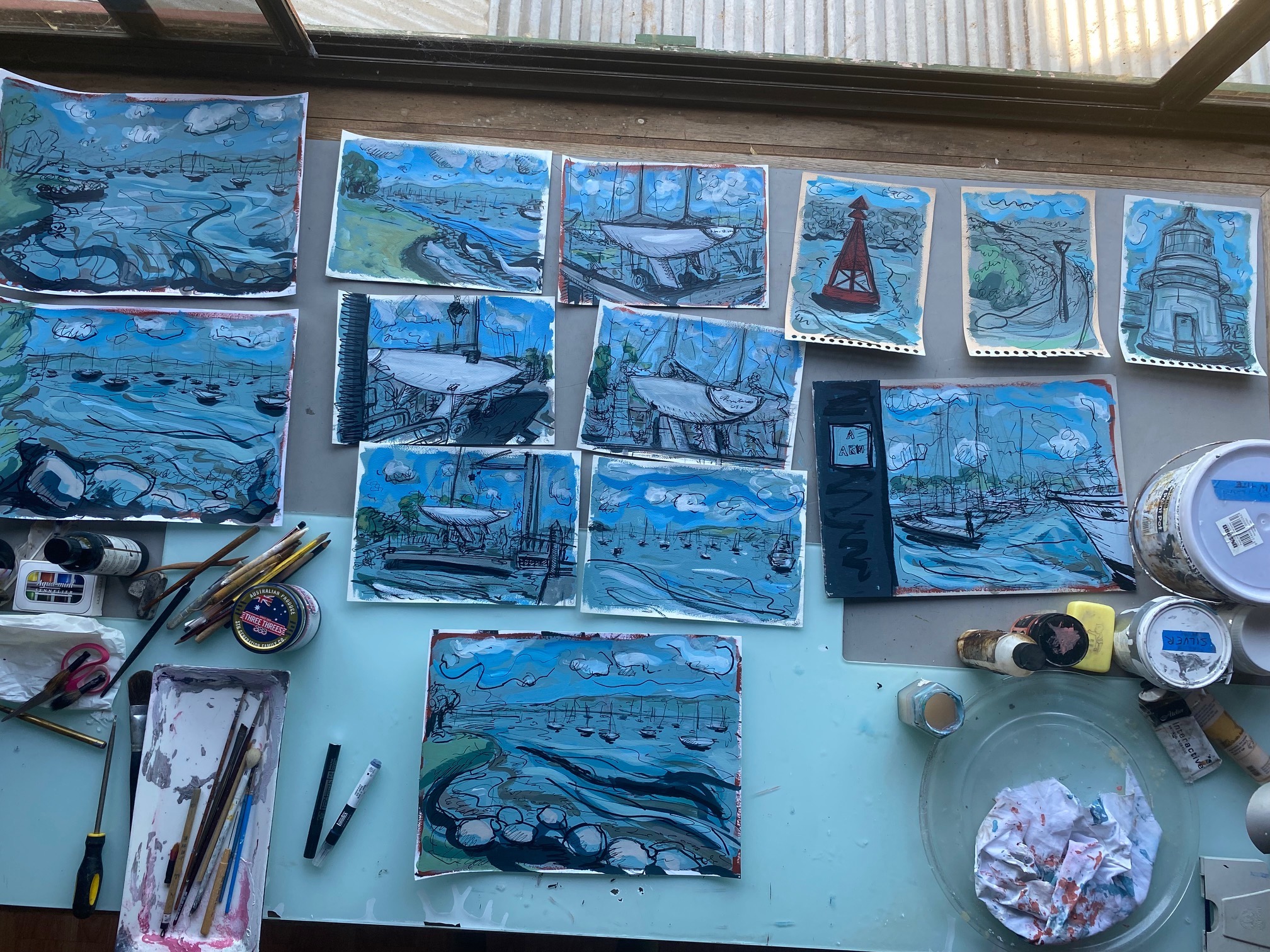
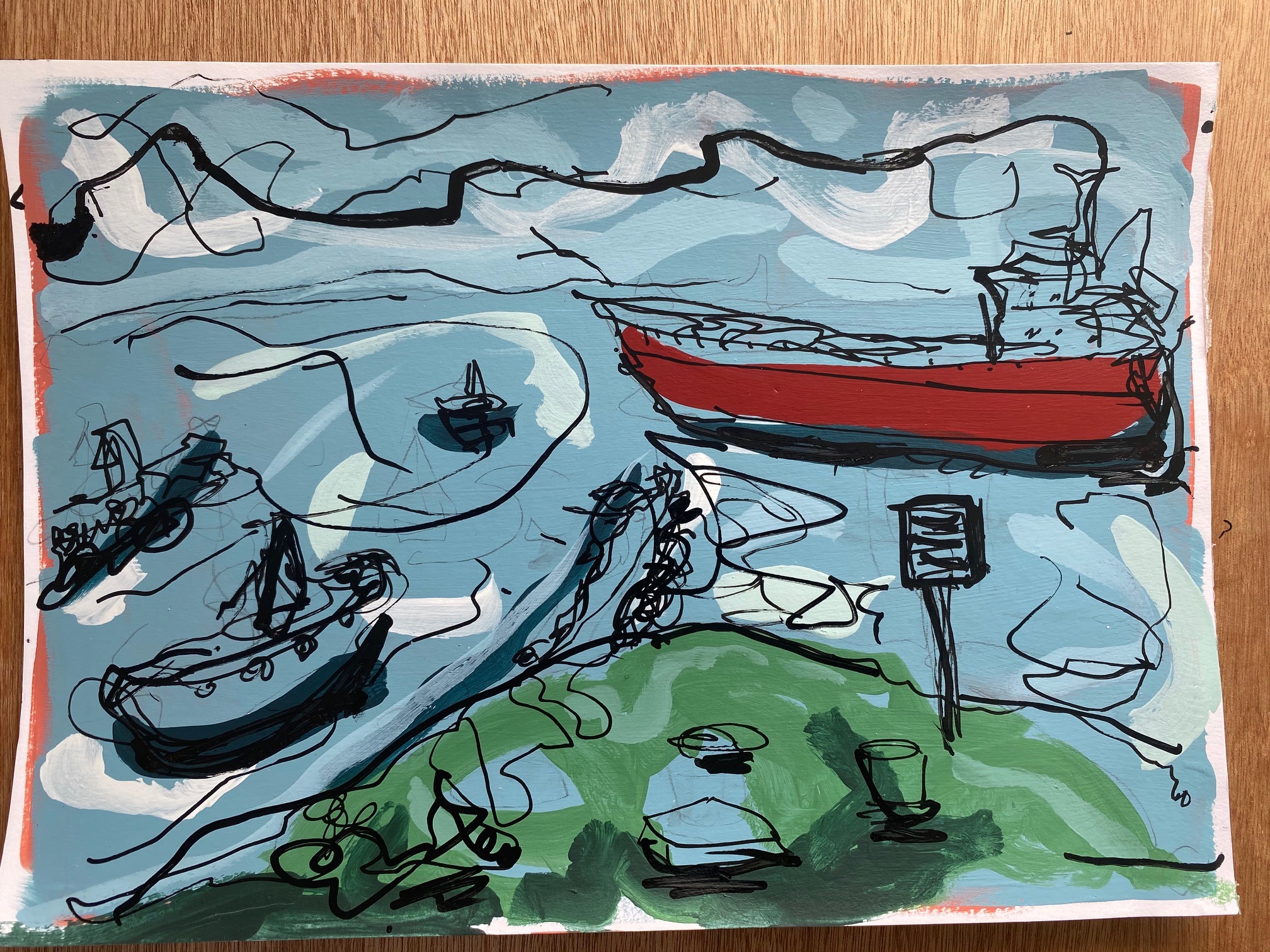
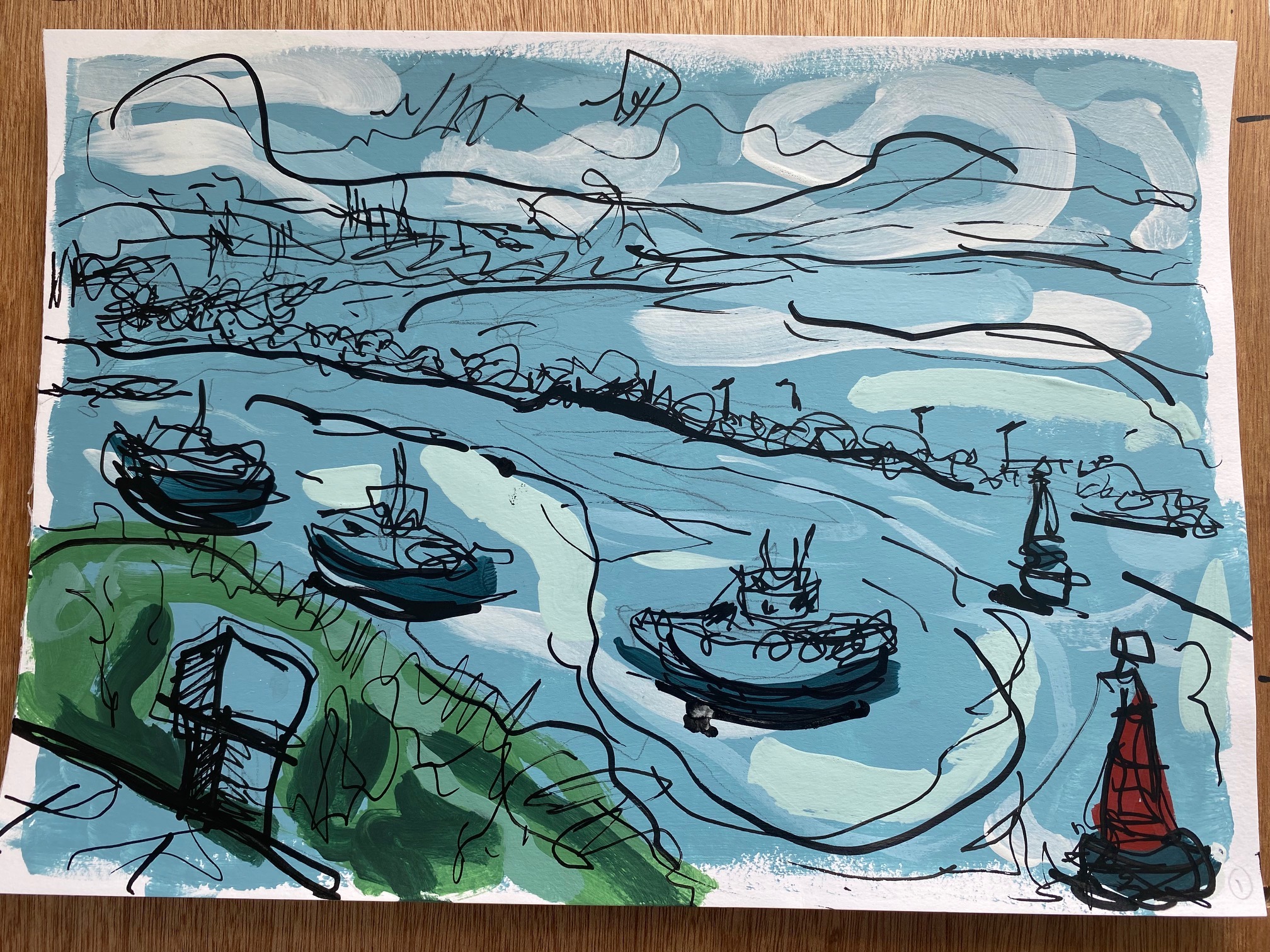
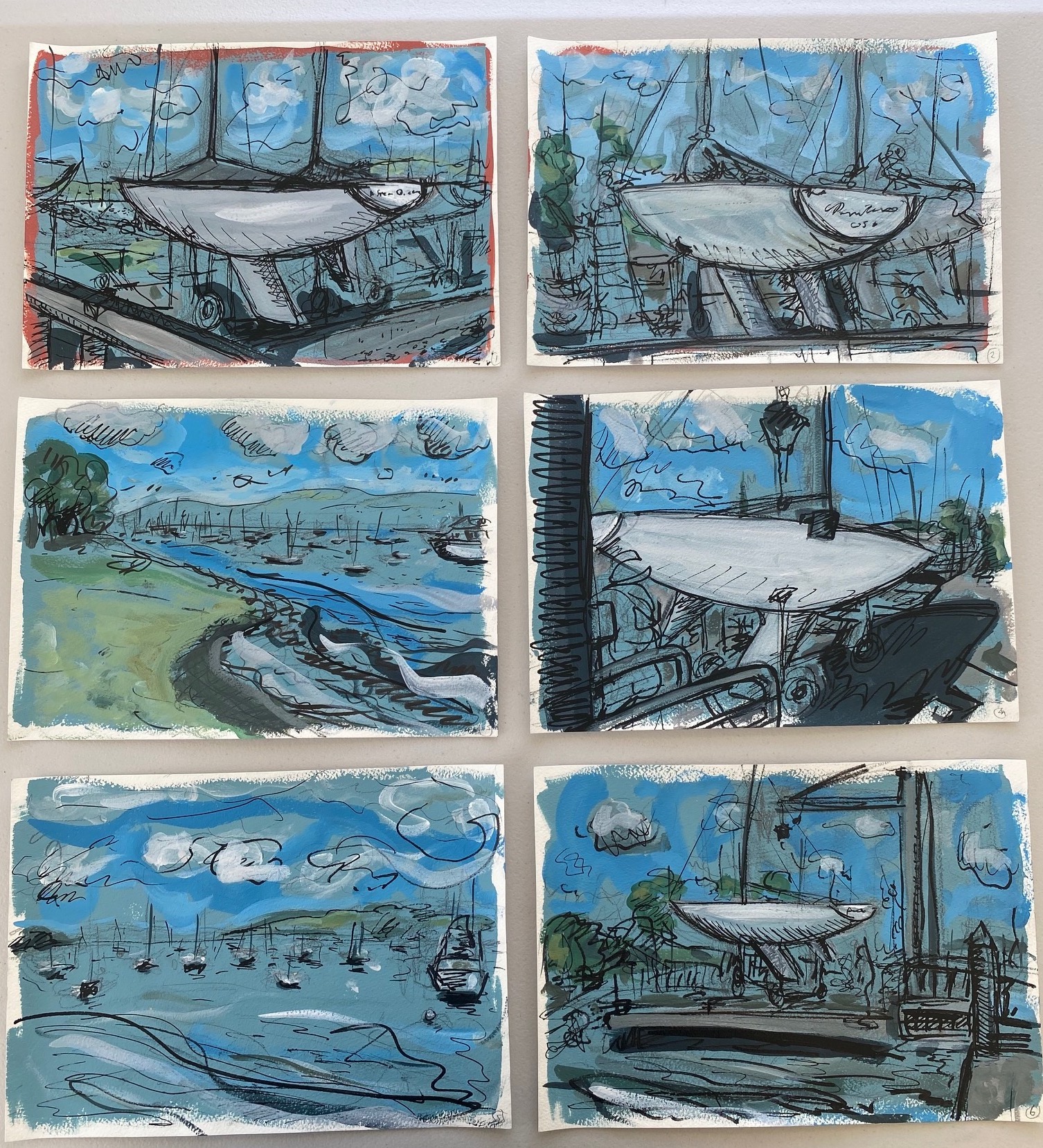
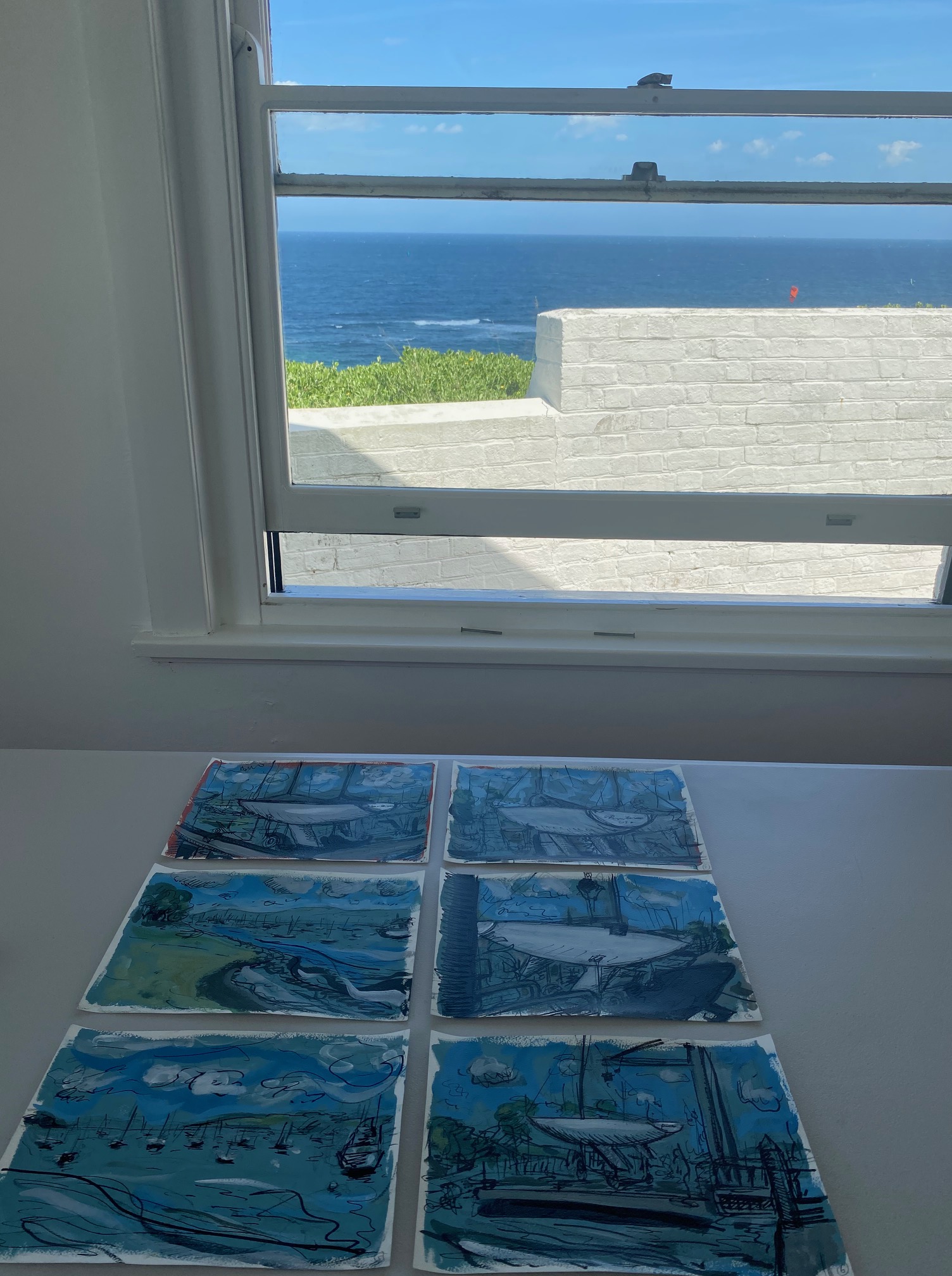
Last day of my residency at Lighthouse Arts in Newcastle yesterday. One of those days when you try to finish things, in this case some drawings I’d begun at Gosford Sailing Club the weekend before.

Normally it’s a bit of a chore trying to finish stuff in an environment that’s different to where you begun it (I once heard a painter talk about how she’d finished paintings started during her artist’s residency in Antarctica at home in the Northern Territory, and felt a mild sense of amazement: they were detailed images of ice layers).

Anyway, the Lighthouse residency made it easy. Whenever I needed to mix a particular shade of blue, I just needed to look out the window! And fortunately, just like the weekend beside the water at Gosford, yesterday was a lovely bright day.

One of the nifty things about working quickly is that it forces you to trust your instincts and commit to a mark. Just like a jazz musician improvising, there’s the exhilarating experience of a creative free fall. And, just like the musician, sometimes you play a wrong note.

Then, of course, when you look at the image afterwards it’s a question of whether you change the thing that you’re not happy with or just live with it. For example, yesterday I forgot to pack any yellow paint and I needed to mix a warm honey-coloured sandstone colour for some rocks. Stuffed around mixing some burnt umber, blues, whites and a naples yellow (reddish tint) but couldn’t get what I wanted. And one of the yachts had a lovely aqua coloured hull that I forgot to paint. So whenever I look at these images, I’m seeing some rocks that are too fleshy and a boat that would be that much better if it were green…

One of the nice things I’ve found about being an older painter is that I’ve learned to live with my mistakes. I used to destroy a lot of work – some of it quite good – in the interests of the illusive, slippery eel of perfection. Nowadays, I let the paintings have their own way.

Thoroughly enjoying my artist’s residency at Lighthouse Arts in Newcastle! The residency is located at the top of a headland at the entrance to Newcastle Harbour, in one of a number of white-walled heritage cottages clustered around the base of a stone lighthouse. It’s an incredibly peaceful place to work, with something of the feel of an old monastery. You can watch squat little tugs guide huge tankers into port.

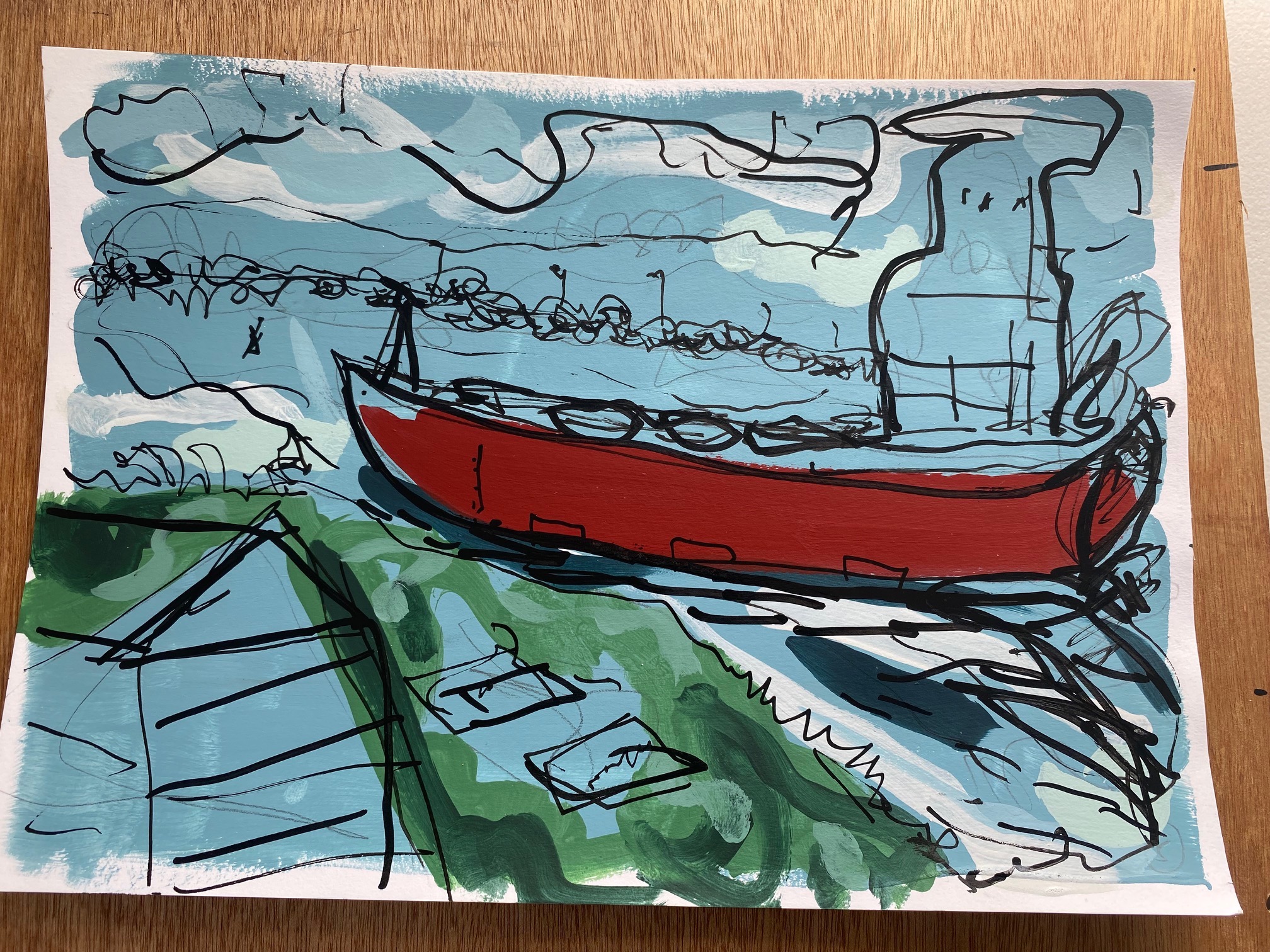
Before my residency, I’d planned a series of nice, dreamlike images: ships flying against a cerulean blue sky, delicate flourishes of white wake on the water, the occasional flight of a seagull. All very picturesque. I painted my paper sky blue in anticipation, and looked forward to a nice day of sun sparkling on cobalt blue sea. The kind of day where you pack sunscreen and bottled water…

But nature has a sense of humour…

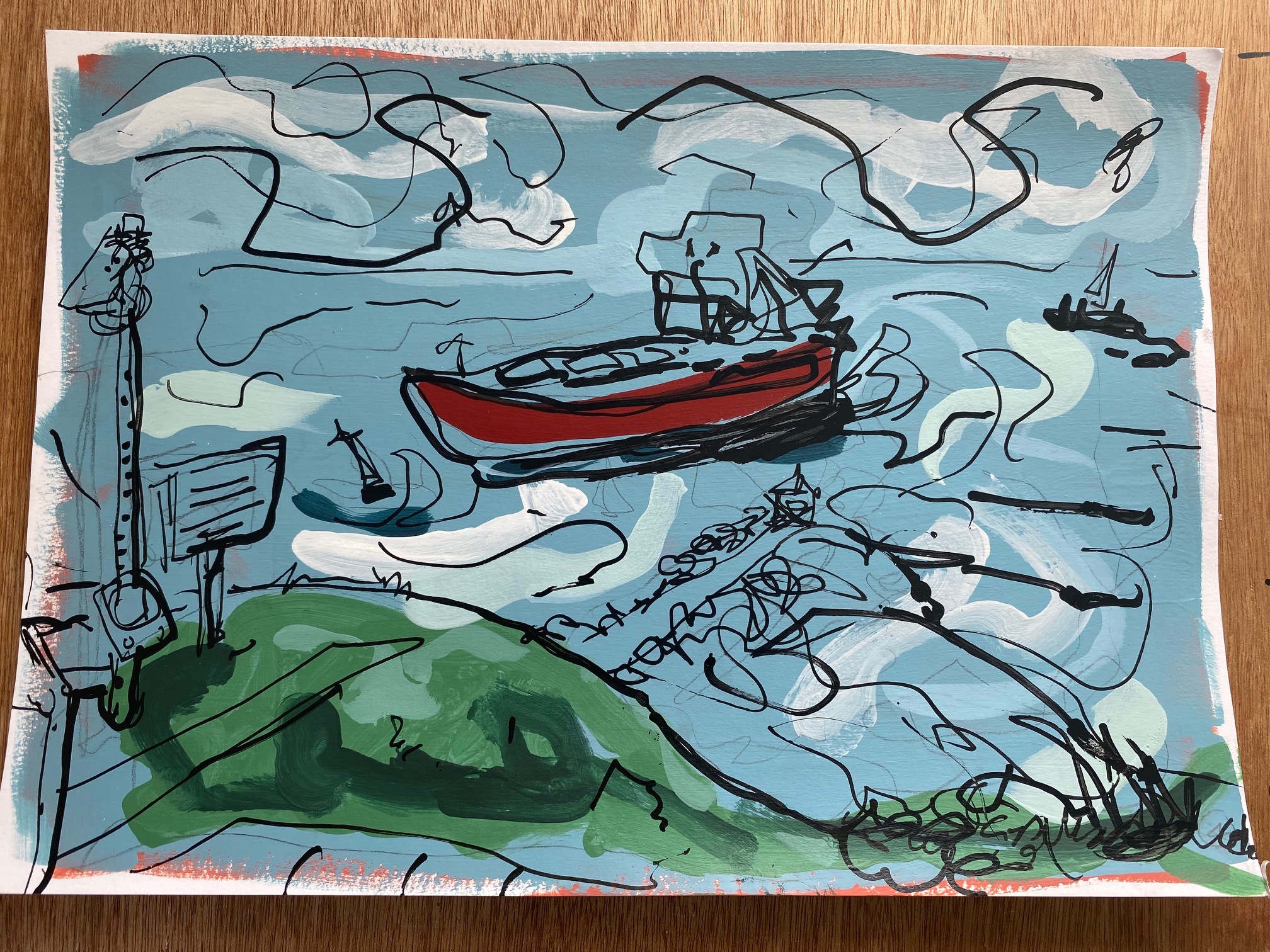
On the day I arrived, a strong wind blew rain sideways at the headland. Visibility was limited to the next grey cloud, and there was no way even the bravest gull was going to take off. The channel markers swung like metronomes. I watched as a massive tanker literally oscillated its way into port, huge deck lurching first one way and then the other.

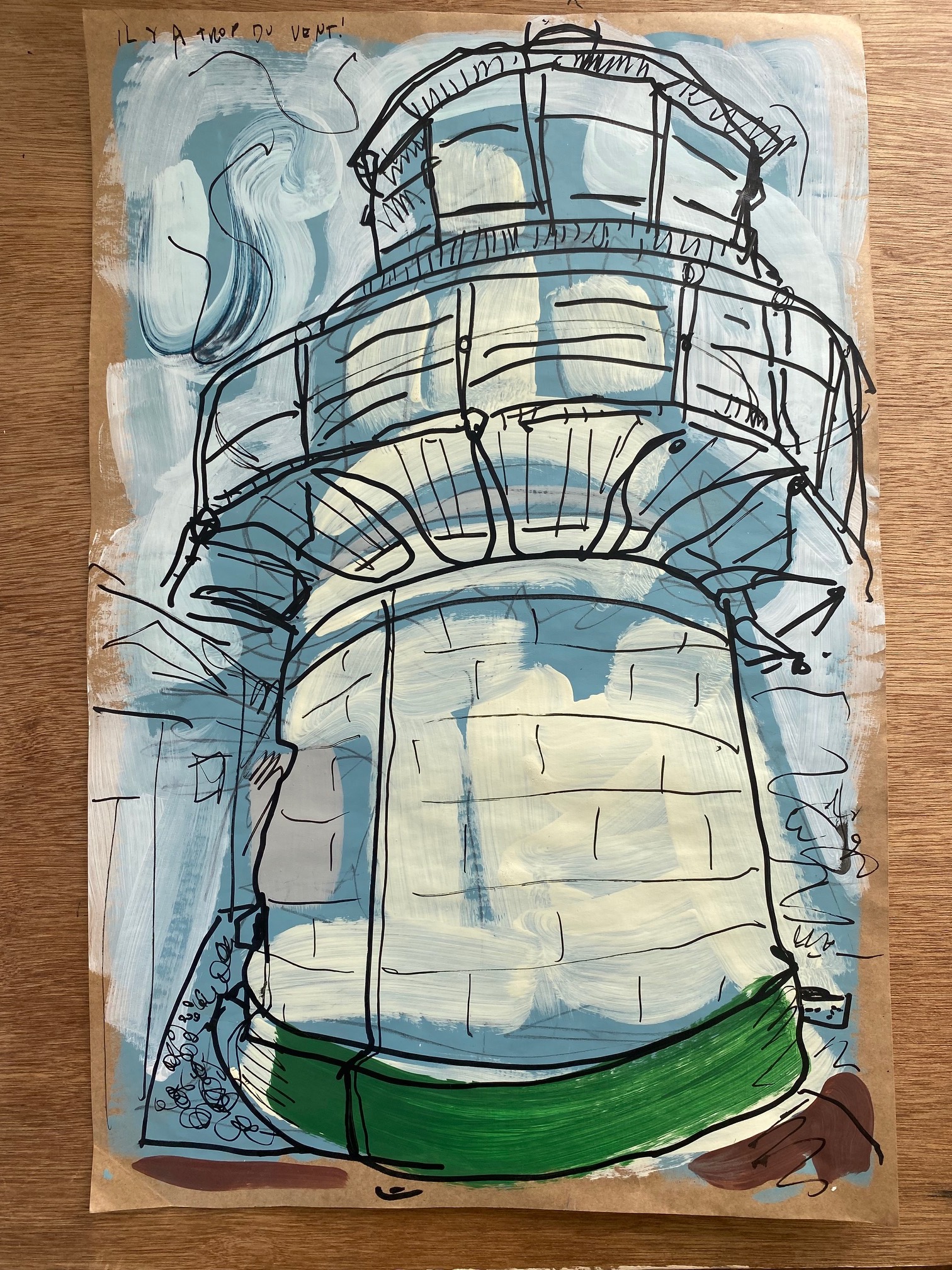
So instead of trying to draw something nice, safe and poetic, I thought I’d try to draw an invisible entity instead. I ran around the lighthouse, rain splashing the paper, drawing the wind. Trying to catch the elemental energy and wildness of the place. As soon as I’d finished a sketch, I’d pop the paper inside so it could dry out, grabbed another one and went out again.

And it was an incredible experience! I left the paintings at the lighthouse to dry and came back the next day to finish them off. (For the technically minded, I’m working on a coloured ground – mostly sky blue but some with reddish brown under this, too. The first layer is a pencil drawing, then acrylic paint and finally acrylic pen or decent quality black ink pens).

I enjoyed it so much I’m heading off to another harbour next weekend to draw some yachts.

http://www.uq.edu.au/news/ index.html?article=18844

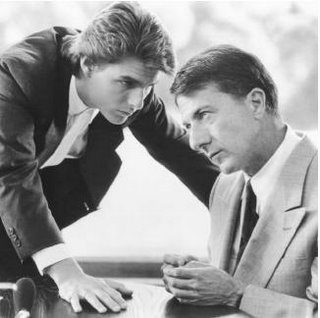
I’ve been thinking a lot about sustainability lately. The other day I left the car at home and caught the train into town with Sophie to do some shopping. For a toddler, a train is both exciting and frightening; her intense emotional reaction to an everyday experience changed it for me too. A bit like the scene in Rain Man, when the autistic Hoffman notes to the blinkered, urbane Cruise that the train is ‘shiny’. Cruise had not noticed, and he stops for a moment to consider, viewing the train with interest for the first time; it’s a small vignette of character transformation that tells you much about his changed inner life.

I suspect this is going to be a boring story, when people talk about their kids it often is, but bear with me. We arrive in town, walk to a second hand store where Sophie gets ‘new’ jeans and a nice pink top. Then head to the library to find that Sophie’s favourite Mr Chicken Goes to Paris book has been borrowed by another reader. We console ourselves with a Little Princess dvd. Then it’s off to the bank for cash, supermarket and back to Vinnies where I collect a massive iron candelabra that I’d left behind the counter earlier. By this time I’m carrying a heavy bag of shopping, a bag of second hand clothes, a candelabra, and dragging an increasingly fractious toddler by the hand.
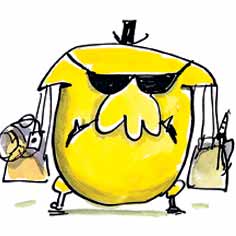
'Mr Chicken Goes to Paris' by Leigh Hobbs

We head towards the train station, miss our train by ten minutes, the conductor tells us the next one won’t go for another hour, and bitches at Sophie for walking in front of the yellow line. So we wander off to the nearest park, swing for a while, decamp to a café for milkshakes, and then stagger back to the station with all our stuff. Arriving home, Sophie goes to sleep without a peep and I luxuriate with a peaceful, sleeping child cup of tea. In all, a fairly simple shopping trip has taken about three hours.

When people talk about sustainability, and how it intersects with community, they often don’t articulate the human dimension. One of the reasons that church and community groups in my area have been so keen to embrace sustainability principles is they sense how closely related the two sets of ideas are.

Here’s a diagram of the saving money/reducing resource use/building community relationships trifecta.

It works best with a concrete example: I take a train, saving me money, keeping one more car off the road. We’re walking, so I notice stuff about my town that I don’t normally see because I’m travelling too fast or looking for a place to park. We buy second hand stuff, which also saves me money, while supporting a local charity and reducing the resources used to make new stuff. While we’re in the store, we talk to the lady behind the counter (her daughter in law is about to have a baby, and the lady’s worried because both mother and baby will be Aries. ‘Constantly butting heads?’ I ask. ‘Exactly’ she responds).

Missing the train means that I go and explore the park next to the station, a place I’ve never been before. While Sophie’s happily balancing on the park’s sole concrete lion, I start mentally kicking around ideas about community art projects that would work well in the space. Finally, to fill in time before the train, it’s off to a locally owned café, thus keeping money in my community. Sophie gets a chocolate milkshake, I get to sit on my butt and watch her drink it, it’s a win-win for us both.

What really struck me about the day was that, mundane as it was, how much I enjoyed it. In many ways everything was a hassle, a lot less easy than just jumping in the car and popping into the shops; it’s really not fun to carry heavy bags while trying to keep your grip on a squirmy toddler. It also struck me that because it’s not normally something I would have done (I’d only left the car at home because Sophie’s car seat was unavailable) sustainable living is something that most people need to be pushed into. It makes things slower and more difficult. But I expect it also has the potential to make people happier.
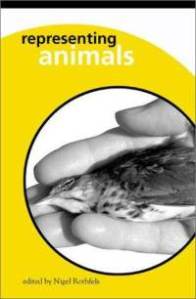
Other than a lingering chest infection, it’s been a good week. The university accepted my proposal for some RTS funding which means that I can go to the Australian Animal Studies Group conference in in July. One of the keynote speakers is Nigel Rothfels, a key thinker in the area of my PhD topic (The human animal: the evolving role(s) of the animal in contemporary art) so I’m looking forward to that.

I flipped into media tart overdrive earlier in the week during a spruiking drive for Caelli Jo Booker and my upcoming exhibition of artists’ books at the John Paynter Gallery, Newcastle, in June. Titled Happily Ever After: alternative destinies in contemporary feminine narrative (see, there, I’m doing it again) the exhibition brings together teams of artists and writers and invites them to re-tell fairy tales in a contemporary manner. We’re really excited because we’ve just confirmed that Tasmanian novelist Danielle Wood, winner of the Australian/Vogel Literary Prize, will be working with illustrator Tony Flowers to create a book. I can’t wait to see it!
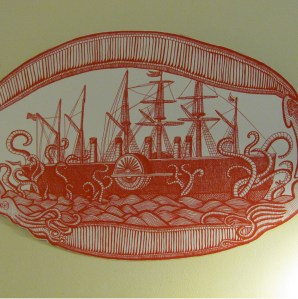
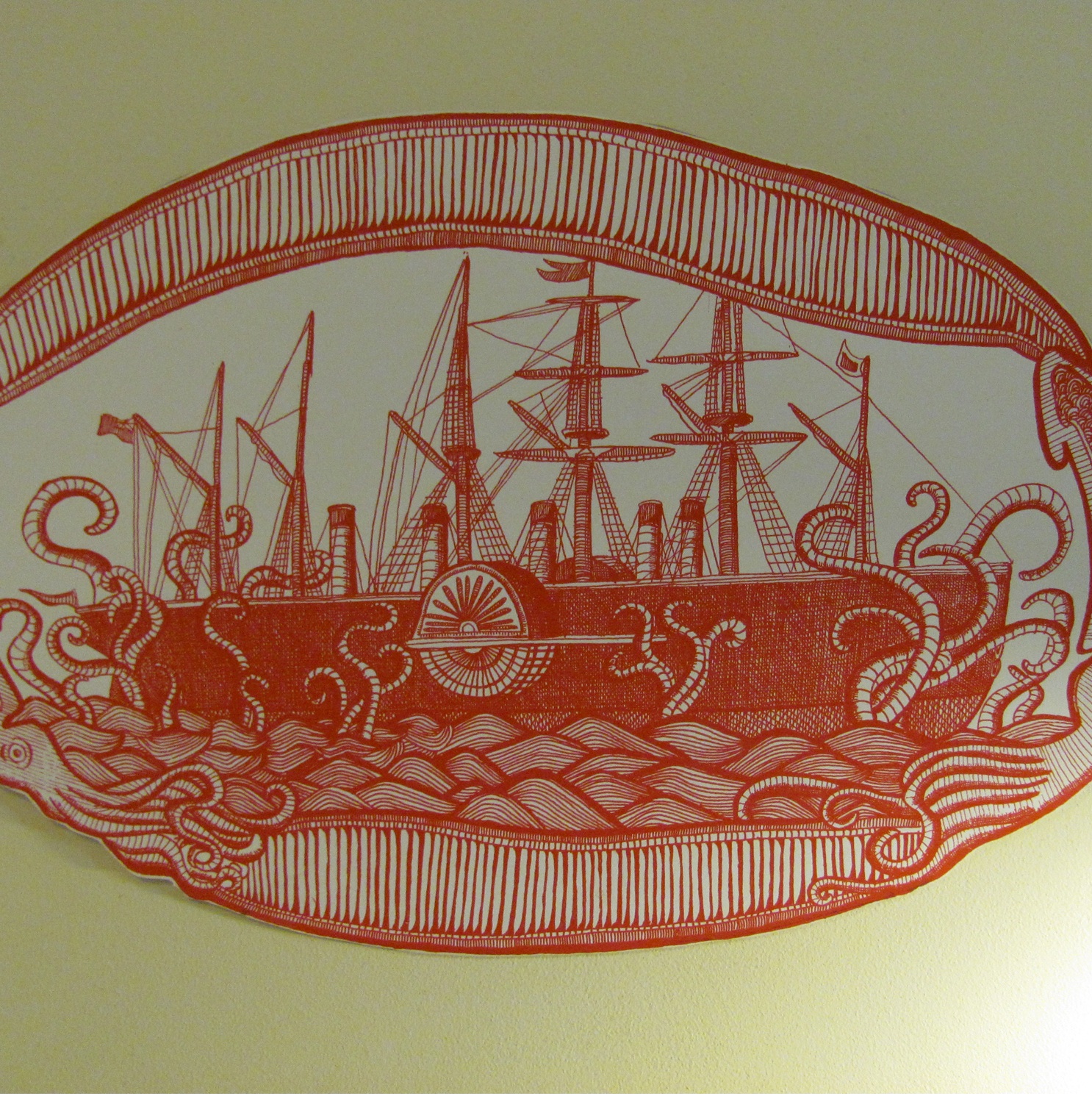
David Hampton's 'SS Great Eastern'

For the exhibition, I’ve written a short story that will be illustrated by Newcastle’s David Hampton and made into a book by my Aunty Pam. The story, Whalesong, is based on last year’s Ady Gil incident, where a New Zealand protest vessel and a Japanese whaler collided in Antarctic waters. It’s a kind of homage to Moby Dick, one of my formative texts, a book that still fills me with desire. My story is written in the first person from the whale’s perspective. I’m currently playing with this idea of writing the animal voice, trying to avoid the common slide into sentimentality or romanticism by making my main character a bit obnoxious and a little histrionic.
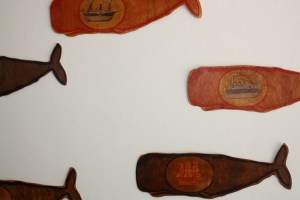
Another image by David Hampton

An odd coincidence: after I’d emailed the story draft through to David, he responded to say that he’d just finished watching a documentary account of the sinking of the whaling vessel Essex, the true story that inspired Moby Dick. A couple of days later I was in the country village of Wollombi, browsing in a small, second hand store, and picked up a novel with a picture of whale flukes on the cover. It was In the Heart of the Sea, an account of the Essex tragedy by Nathaniel Philbrick. I brought it because it had a pretty cover and a positive blurb by Annie Proulx, author of The Shipping News, on the back.

(A brief digression:  if you’re up that way, Café Wollombi does really nice food. Imagine the worst roast vegetable focaccia you’ve ever had: a few miserable pieces of eggplant, a scrape of rancid pesto, bread as stiff as stale cardboard, an anemically thin slice of grilled fetta, the alleged vegetables as brown and slimy as compost. You probably paid $7.50 for the thing, $10 at the airport, and when it was plonked down in front of you, the person rushed off in case you yelled at them. Later, you hear them yelling at the chef. Add bad air conditioning, a greasy napkin, plastic wrap and the sound of traffic and you’ve got your average vegie focaccia. As a vegetarian, I’ve chomped my way through many such travesties.

In Wollombi, you sit out on wooden verandah, the sun on your back, watching birds scoot past and a line of ants tackling the Everest of your chair leg. A trendy, funny girl with knee socks takes your order and returns with food in an admirably short time. Big fat foccacia, stuffed with roast vegetables and annoited with pesto so fresh that it hasn’t had time to oxidise. Why would you go anywhere else?)

Although I’m only a bit of the way through, In the Heart of the Sea is proving to be a fascinating read. Philbrick talks about the island of Nantucket: the way the society came to embrace Quakerism, what this meant to the island’s culture, economy and financial management. There’s a few scurrilous historical anecdotes about the Nantucket women, rumoured to be addicted to a morning dose of opium and marital aids, ‘he’s at home’ being the polite euphamism for the plaster cast dildos of the era. As the whaling industry expanded across the globe, Nantucket husbands were often away at sea for years, home for a few months, then gone again.
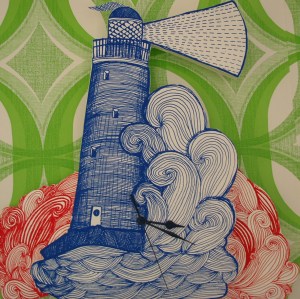
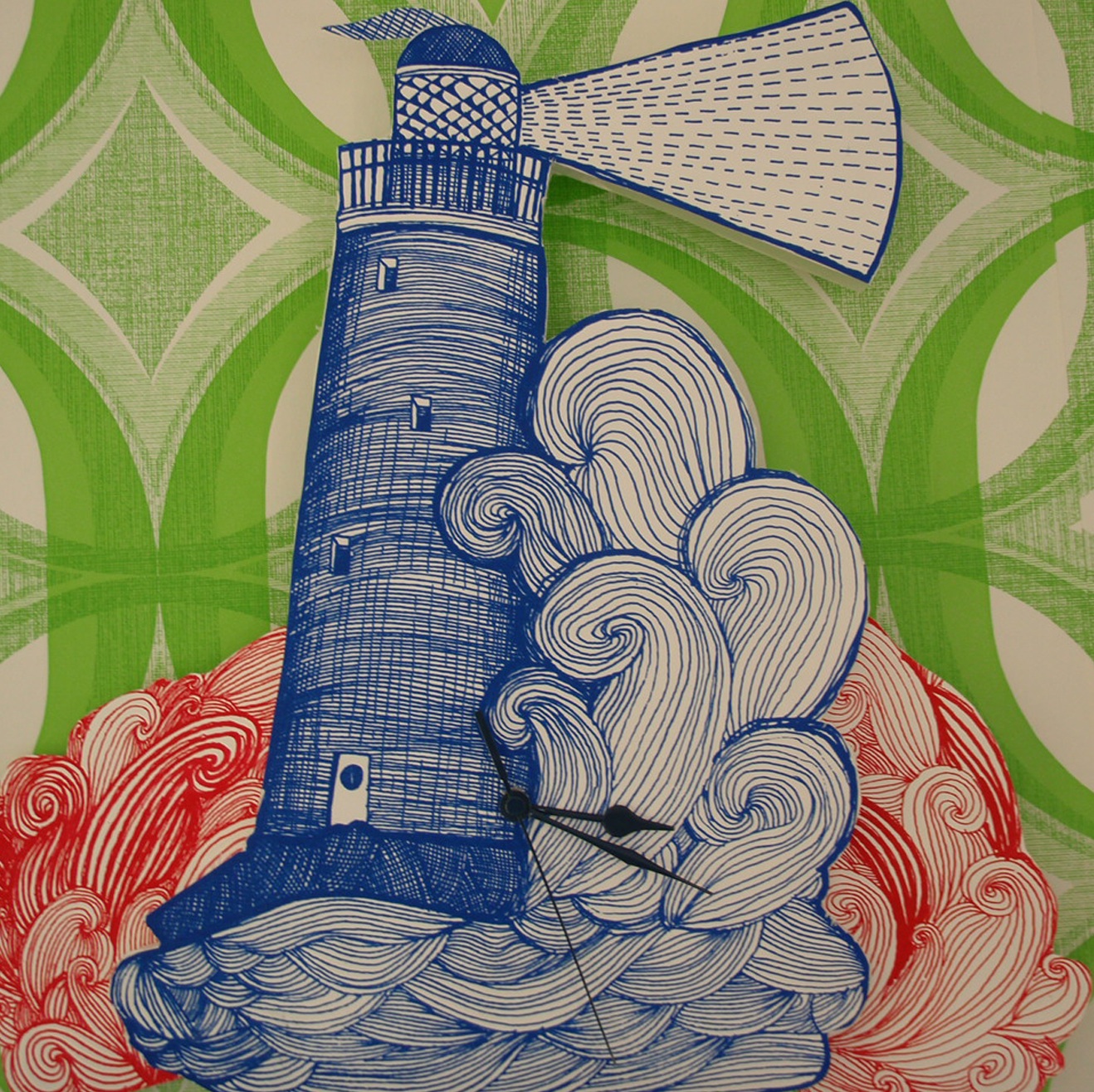
'Lighthouse' by David Hampton

It’s interesting to speculate about the social pressure, the sheer claustrophobia, of being left alone on an island in a close-knit society of Quaker women. The knowledge that, if rendered desperate by your cold lump of plaster, you f***ed another person, the news of it would be all over the village by morning, even before your sheets had time to dry. An ensuing trial of ostracism, bitter judgement and fraught female relationships. It’s the dark side of community, the thing that we were all running from when we left our villages and moved to the anonymous cities. And it’s probably one of the reasons why people like the connectedness that sustainability implies, but also shy away from it.

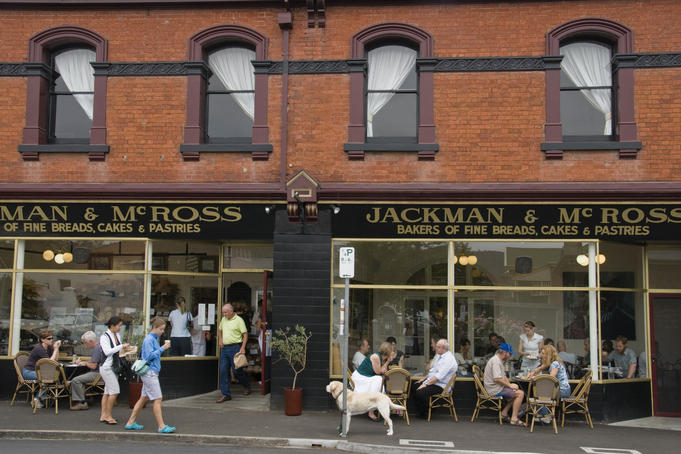
Jackman and McRoss: home of a damned fine cake (image source http://media.lonelyplanet.com)

A few months ago, my Aunty Pam, cousin Jules and I were sitting around talking. It was a cold Tasmanian night, we’d just eaten some very fine cake (Jules had brought it for his Mum) and were curled up in leather chairs, drinking hot cups of tea. Jules and I grew up in Hobart, Aunty Pam was born in New Zealand but the family moved to Tasmania when she was a little girl. They settled first in the northern industrial town of Burnie and then moved south to Hobart. I was blithering on about how I hadn’t decided where I wanted to bring Sophie up, the pros and cons of an urban existence versus a rural one, educational opportunities in different areas, my experience of growing up on an isolated island like Tasmania, and on and on. ‘Well, what do you want?’ asked Pam patiently. I thought about it for a minute and then replied: ‘what I want, doesn’t exist. I want to live in a village full of cultured, sophisticated and intelligent people… who mind their own business!’ We all howled with laughter.
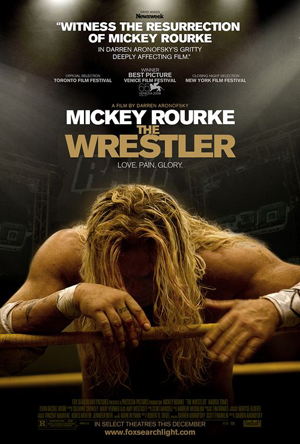
Like many leftie, university educated feminists, I have a secret penchant for the World Wrestling Federation. Unable to watch it in long bursts, I’m not that sick, I find the few illicit snatches I view thrilling. There’s something about the combination of steroids, bad acting, men in leotards, ripped torsos, comic book costumes and a blood hungry crowd. It’s Rocky Five crossed with The Dark Knight comic series, blended with some kind of primal Lord of the Flies kid’s game. I was catapulted even further into this delusional state by Mickey Rourke’s stupendous performance as an aging athlete in The Wrestler.
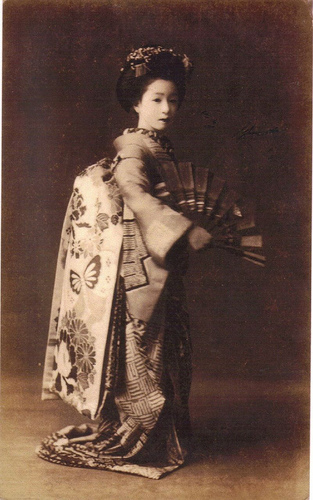
Anyway, if I had a million bucks, I would recruit a tall, kick ass, cross dressing Japanese wrestler and debut him in the WWF in full drag, hopefully somewhere deep in the American South (albeit with good personal protection and an efficient security team). Here’s his costume: silk kimono, white painted face, long black hair up in a bun with ornate clips, demure expression, dainty floral shoes.

Picture this: a dark stadium, a spotlight slicing down onto an empty ring, the swollen crowd pants with anticipation. In shuffles my man, head down, arms folded into the sleeves of his shining garment. He stands in silence in the middle of the ring. When the anthem to the Karate Kid blasts out, the six-foot geisha slowly unfolds his arms, revealing long red nails, and raises his hands like claws. Slowly lifting his painted face, he lets out a ghastly martial arts scream through rouged lips. The crowd goes crazy as the sound of shakahachi flutes trills the theme from High Noon. ‘Ladies and Gentlemen’ bawls the announcer over the loudspeaker, barely able to make himself heard, voice hoarse with emotion, ‘all the way from Toyko, please welcome….The Fascinator!’

It’s probably worth explaining why I want to do this. One of my former students, a quiet girl with flawless skin, had a passion for geisha. For her final assessment, she dressed her sister up in full geisha regalia and Photoshopped her into a range of different locations. I had tried, quite irresponsibly, to encourage this student to surrender to her obsession and spend a week going around Newcastle dressed up a like a geisha girl (this is only really funny if you know Newcastle). And document it: photographs of geisha in Burger King queue, kimino clad geisha at the beach playing volleyball with the bikini brigade, geisha attending lectures. ‘You could just refuse’ I suggested ‘to take the costume off: the anti-discrimination Act provides ample cover for this kind of thing’.

During the course of talking with this student about all things geisha, she enlightened me as to the meaning of the word ‘fascinator’. I had no idea that it meant a decorative hair clip with dangling bits and perhaps a jewel or feather or two. Very geisha (or rather very Western idea of geisha).  And so the dream of my Japanese WWF warrior was born. ‘The Fascinator: coming soon to a stadium near you!’

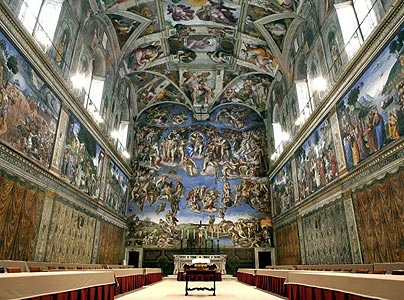
If another million bucks landed in my lap, I would be tempted to hire the Sistine Chapel for a night, empty it of people, and install a large, comfortable bed with immaculate white sheets. I would like to sleep in the chapel for a night, without any kind of electric light or other furnishings, and early in the morning wake to see the murals. I imagine light slowly coming in the arched windows, probably hitting the wall high up, and then gradually travelling down, the noise of Rome slowly building as the city wakes, the distant sounds of traffic and horns beeping. Cold air in the chapel, the smell of stone, old tiles under my bare feet.

I would like to be by myself. And in the morning I would like to stay in bed until about nine or ten oclock, and then have a beautiful Italian waiter bring me an exceptionally good cup of coffee in bed. No food, no sex, just waking up with divine art and fine caffeine. I would happily pay a million dollars for such a thing.

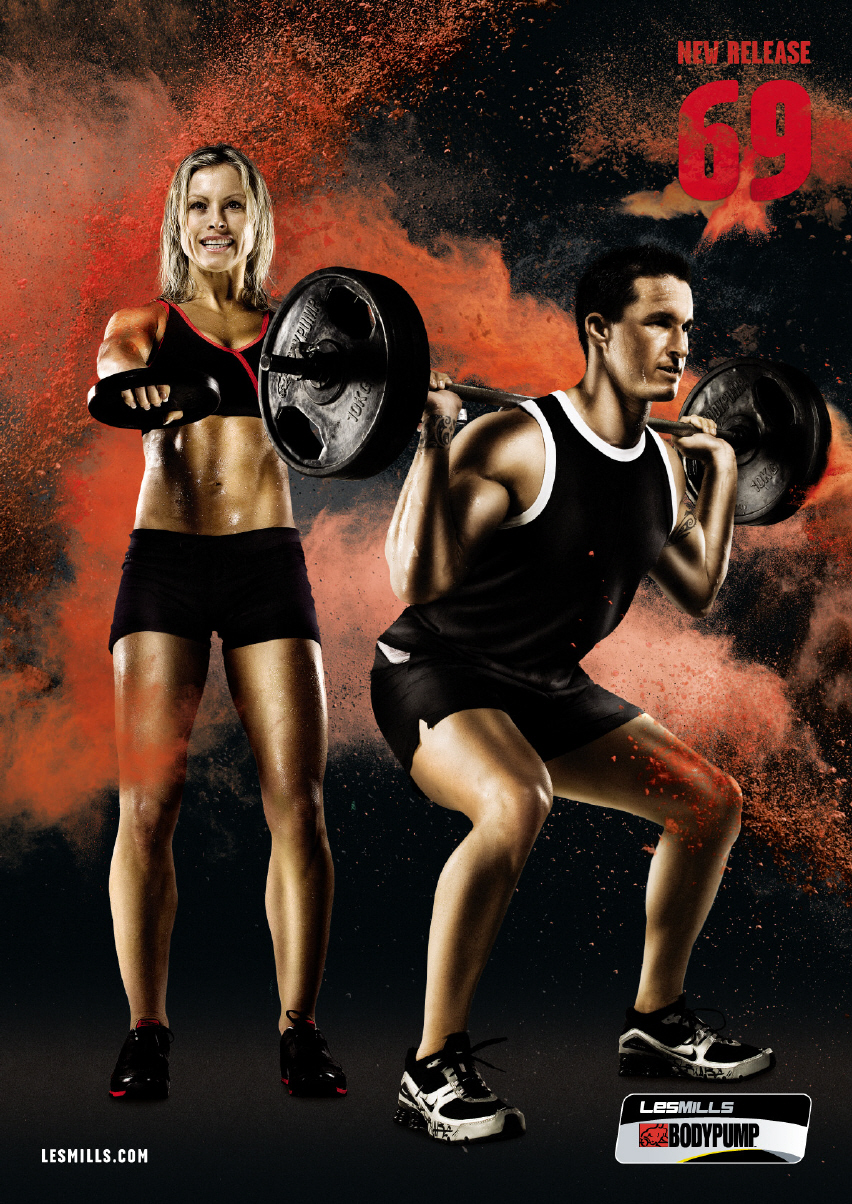
Another piece of art that will probably never get made, but something that I would like to do, is a short film set in a gym. Gyms are this weird cultural no-go zone where nothing interesting ever happens, it’s perhaps for this reason I have some of my best ideas while working out. The other day, I finished my Pump class, and like everyone else, staggered off to put my bar and weights back on the rack. Lifting weights causes this massive hormonal surge to tsunami through your system. Everyone’s body is different, but for me the effect is that I’m quite aggressive for the next hour or so: I’ve learnt to avoid conversations during this period.

I imagined this cute little film, which started just after the end of the class, when everyone politely smiles at each other, wipes their sweat off the floor and puts their gear away. What would happen, I mused, if someone shattered this fragile hormonal truce and started some kind of altercation with another person. Would everyone else join in? Would there be this sudden, Pump inspired crazy moment of communal violence? And wouldn’t it be even stranger if it happened in the weird sanitised environment of a gym?

I imagined this small Jerry Springer style dispute flaring into this beautiful choreographed martial arts session with people using their Pump bars like fighting sticks, a little bit Bruce Lee, a lot Kill Bill. Middle class girls in Lorna Jane apparel belting away at each other with gusto, screaming guys running at each other like pole volters, poles being hurled like javelins and sticking into the chipboard walls with a ‘twaaannnggg!’ Like all good martial arts movie sequences, no-one actually gets hurt, they fight to slow motion exhaustion, and the film ends with everyone at peace and passed out on the floor. I imagine the final shot panning directly upwards, up past the ceiling fan, right up to the ceiling, a pause, and then someone’s bottle of water falls over and the liquid spreads like a river amongst the bodies.
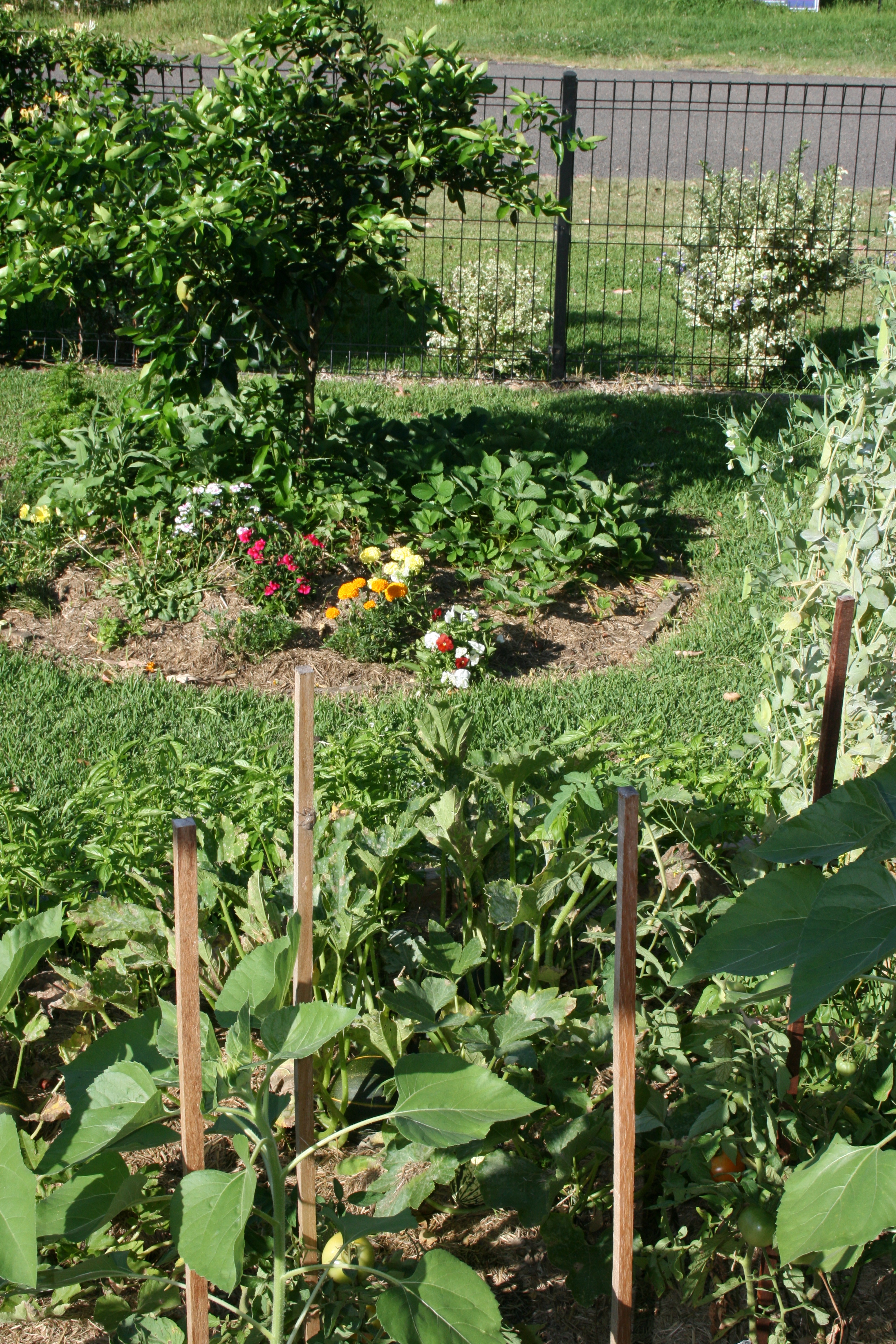
Back in the real world, I had some good news this week. I won a $2k grant to help make a piece of art in a local community garden. We’re going to do a public workshop to help generate ideas and imagery, and then paint a mural on a building next to the garden. I’m rather pleased about this as it brings together a number of things I like doing: gardening, art and doing stuff with teams of people. And it’s a pretty cool garden too.

As part of my ‘I’m-turning-fourty-so-it’s-best-to-freak-out-in-a-constructive-manner’ strategy, I’ve been pushing towards my ambition to earn a living solely from painting and writing (chorus of ‘she’s nuts!’) One of my targets is to try to write at least grant application and/or one published article per month. I started doing this in December, after I finished my book. So far I have three grant applications in the pipeline, one article that’s been accepted for publication by an American art magazine, and one article that I’m still trying to find a home for.

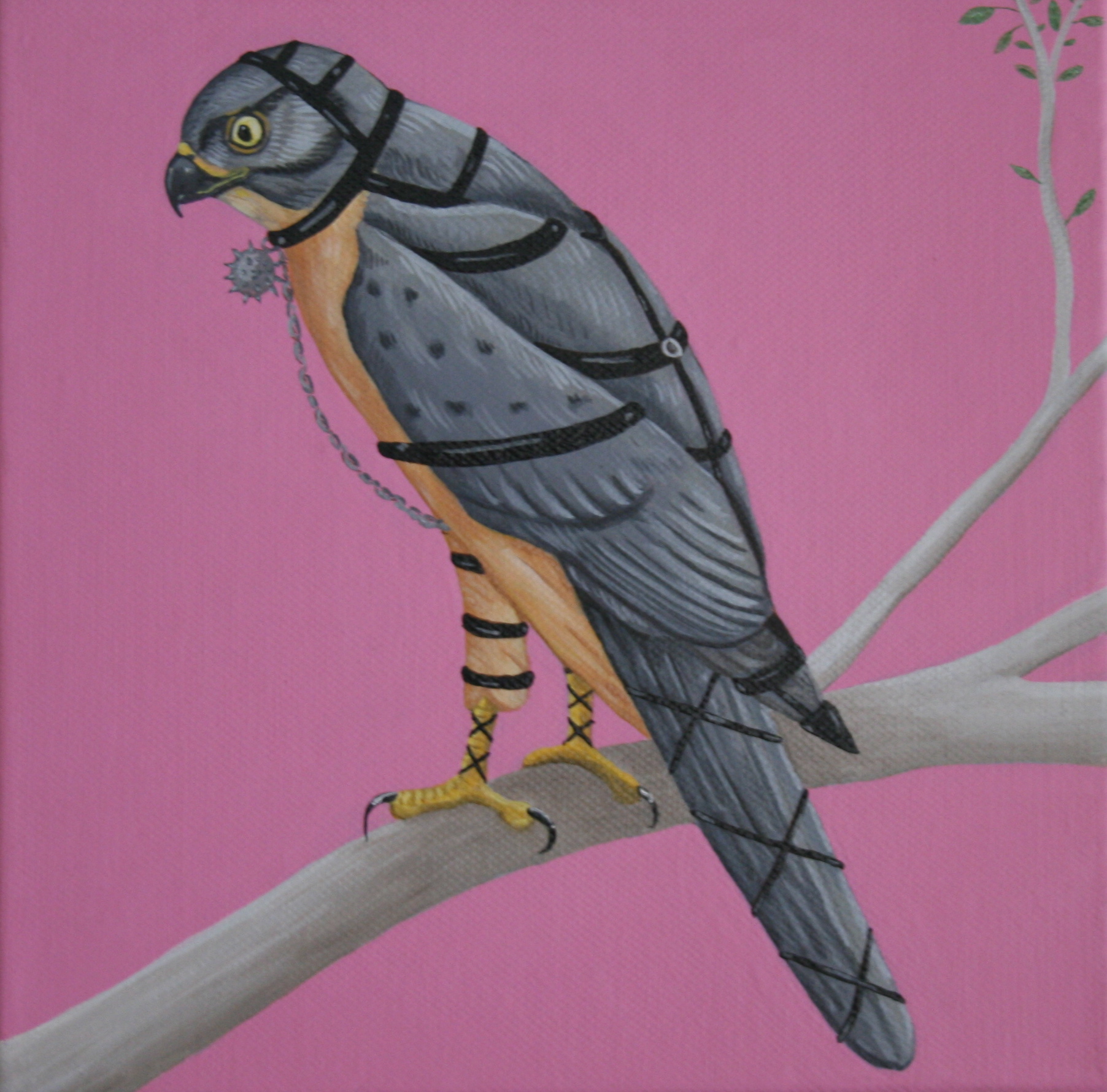
'sicko hawk', 20cm square, oil on canvas, 2011

Finally, the bird paintings I’ve used to illustrate this week’s blog are small paintings (eight inches square) from a series titled up against the bird wall. Eventually I hope to complete one hundred small canvases, and hang them in a grid formation on a large white wall, as part of the upcoming Year of the Bird group exhibition at Maitland Regional Art Gallery.

Initially I planned to paint all the birds on different shades of pink backgrounds, but I’ve since been thinking that this might look a bit sickly. Thematically, I was worried that the piece would read as being more about the colour pink, and it’s associations with cloying femininity and restrictive gender expectations, than the bird imagery itself. If anyone has any suggestions or thoughts on background colours, I’m happy to hear them.

I’m enjoying making this series. I’m trying to get sixteen finished by July (hoping to place them in an exhibition up in Queensland) so I’ll post images as they get done.

'wagtail with bound tail', oil on canvas, 20 cm square, 2011

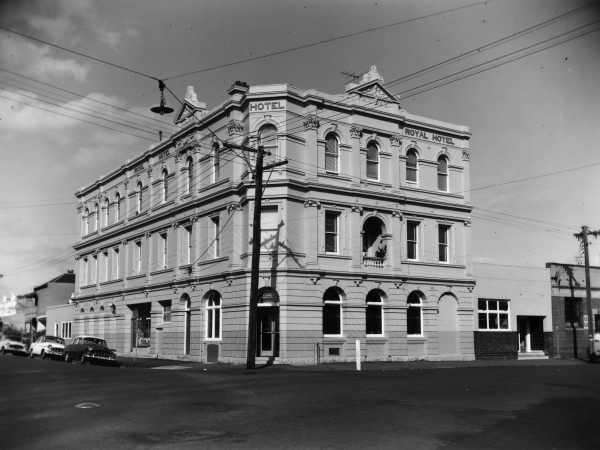
The Royal Hotel in 1964, courtesy of the State Library of Victoria


I have met two armed robbers. The first was an old Irish guy named Whitey who used to drink in a Clifton Hill (Melbourne) pub called the Royal Hotel. This was twenty years ago and Clifton Hill was just in the process of being gentrified; on every tree lined street, construction crews swarmed over the front of colonial era facades; trendy new European vehicles started to replace the beat up Fords and Holdens; local café’s stopped serving instant coffee in polystyreme mugs. Whitey was friendly, voluble, alcoholic, likeable and not at all sleazy. A guy with poor impulse control who had somehow learned to grow old gracefully.

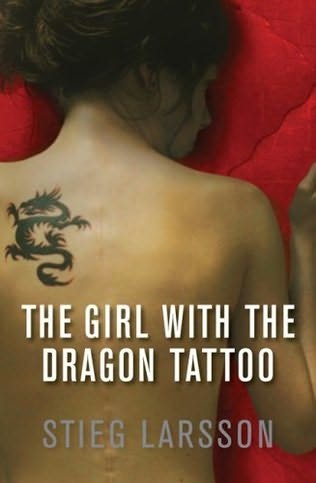
My cousin Rachel and I used to fly over to Melbourne from Tasmania each summer and work in bars, cafes and bakeries around the Fitzroy area. This particular summer we shared a cheap room in the Royal Hotel, survived on one meal of lasagne a day, and spent all our money on going out and dresses. I once blew $500 in one week, a fortune back then, on an extremely short gold sequinned frock and a dragon tattoo. The golden frock is long gone but the dragon still resides on my back. This amuses me because it’s almost identical to the cover of  Steig Larsson book The Girl with the Dragon Tattoo;  a magazine I found on a train tells me that lately young women across the world, inspired by Larsson’s heroine, are visiting tattoo parlours for the same dragon.

Despite my tattoo and my gold dress (the kind of frock that used to inspire spirited cries of ‘how much?’ from passing cars) I was quite naïve and my time in Melbourne was marked by a steep learning curve. Coming from a claustrophically small town like Hobart, I struggled to understand the defining characteristics of the city: anonymous, disconnected, viral, violent, addictive, meaningful, superficial, sleazy, mercenary, disloyal, interesting. One hot day, walking through the CBD and knocking on business doors, looking for work, I stumbled into an upmarket brothel, mistaking it for a restaurant, and asked for a waitressing job. The madame laughed then interviewed me for a receptionist’s position. Having discovered my blind ignorance, she’d obviously decided to have a bit of fun with me. I remember her explaining how the security shield in front of the receptionist’s cubby hole worked, stone eyes looking straight into my unlined face. She smirked and said something about getting the screen up quickly if someone had a gun to my head.

Part of the interview included a guided tour of the brothel. I still retain some strong impressions: pink towels folded into fans on the beds; the euphemistically titled party room; strategically placed mirrors; bored wise-cracking girls with strong Australian accents playing pool and a television blaring in an empty backroom; an immaculate blonde receptionist with straight hair and no emotion, none. A well dressed man bounced in, asked if Rebecca was in, and when the receptionist said no, bounded off again. It struck me as strange that in a city like Melbourne, an anonymous man could or would be loyal to a prostitute. I remember the madame saying that if a client was being given a freebie, the receptionist was not to tell the girls: apparently they wouldn’t talk to the guy if they knew he wasn’t paying.

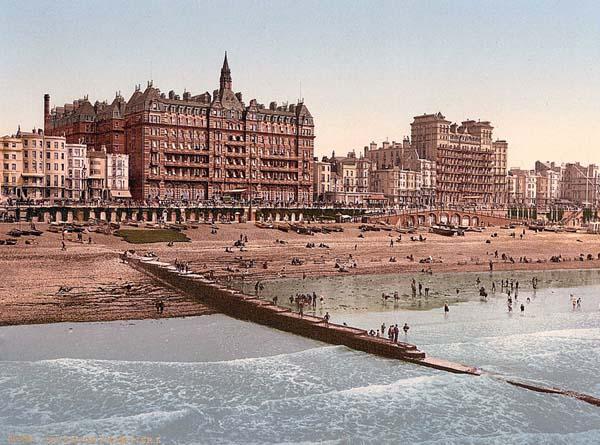
Brighton circa 1890

The second armed robber I met in the late 90s when I spent a year living in the seaside town of Brighton, south of London, in a depressing one bedroom apartment with my first husband. Tony was in his 50s and lived downstairs. In his youth he’d held up a Post Office, a crime that carries a heavy sentence in England, and they’d thrown the book at him. He’d been in prison for so long that he’d learned to cook really well and he could sew anything. He used to invite us around for extremely tasty marinated chicken wings. I can’t remember what he put in the marinade, I wish I’d written it down, because they were just delicious.

Tony was a tough guy. There are very few trees in Brighton, the area I was living was not that sort of neighbourhood, but for reasons known only to himself, Tony owned a chainsaw. His flat was always immaculately neat, everything squared to the corners and surfaces dusted, he also liked peace and quiet. Sometimes when there was too much noise on the street, usually drunk gangs fighting on a Saturday night, he used to rev up his chainsaw and run outside screaming. Generally after a shocked pause, while pale faced yobs contemplated the chainsaw’s horribly whirring blade, the street cleared quite quickly. Everyone sobered up and went home.

Tony was an asthmatic but that didn’t go with his image (tattoes, black t-shirt, cigarettes, women, booze) so he usually left his ventalin at home. A couple of times while I was his neighbour an ambulance brought him home because he’d had an asthma attack. I’d sometimes nag him about taking his puffer with him when he went out drinking, but he never listened. The ambulance drivers got to know him pretty well. Interestingly, Tony used to refer to the impulse to commit armed hold ups as ‘robbery fever’.

***

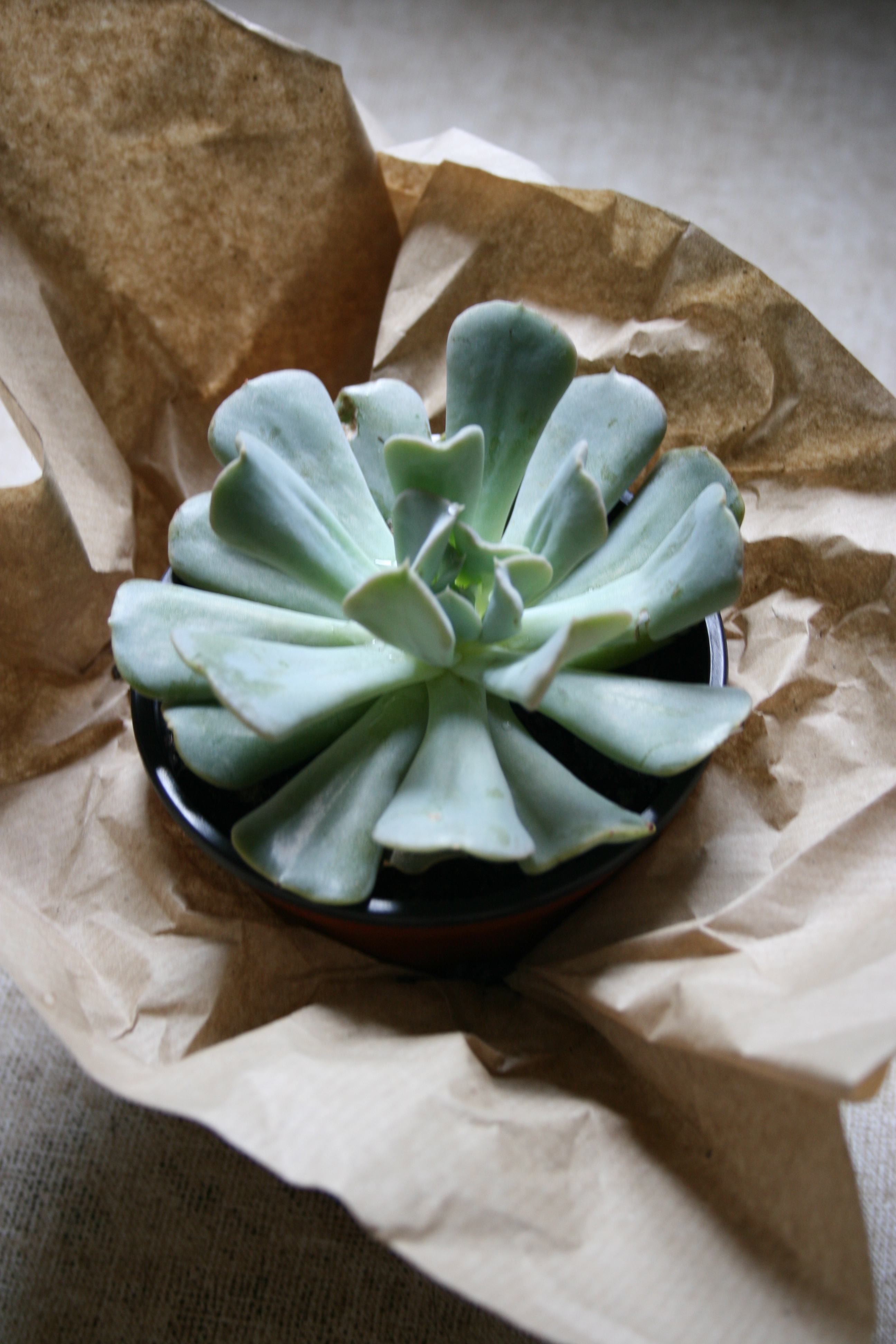
The potted succulent: a souvenir from KS's wedding

This last week I’ve spent a bit of time musing about a potted succulent that is currently sitting on my kitchen bench. The succulent is wrapped in brown paper and adorned with a natty dark red ribbon; it is a souvenir from KS’s wedding last weekend. I’ve been thinking about love and succulents, love and cactuses, love and other things that grow, wither and regenerate. Like many romantics who have stubbed their toe on the marital altar, I remain both deeply in love with the idea of love and scared to death of it. Weddings fill me with joy, hope, bitterness and terror in equal measure.

KS’s reception was held in an old warehouse style building with exposed beams and a high chapel style ceiling. At one point during the ceremony, the part where family members welcome the bride or husband as a new son, daughter or sibling, I daydreamed that giant birds were flying through the space, entering through one wall, winging their way through the triangular shapes of the ceiling beams, and exiting via the far wall, a giant unbroken stream of feathery wings. It was most peculiar. I still haven’t worked out what, if anything, it means.

The increasingly photogenic succulent in action.

***

Generation Y take note: when a person uses the word ‘random’, there is nothing genuinely random or uncalculated about it: they are choosing to highlight something that is important to them or the end point of intense deliberation. For example, a breezy Facebook-ism like ‘these are just some random photos of me’ represents a careful act of choosing. Similarly, I would describe this blog as containing ‘random stuff’.

***

I was in a department store once, years ago, and a woman came in to buy some fake nails. She was talking earnestly to the shop assistant, explaining that she needed the nails for her job. She was quite insistent that they were a job requirement, I got the impression she couldn’t work without them. I always wondered what she did. I wish I’d asked.

***

The Marcel Wave

Sitting on a train platform the other day, I noticed a group of elegant elderly women sitting in front of me. They were clearly dressed up for an important day out; the woman directly in front of me had her hair styled into four immaculately sculpted waves. Another old woman came and sat down beside me. She gestured to the group sitting in front of us and grinned conspiratorially, ‘I wonder where they’re off to’ she muttered under her breath. We speculated: perhaps a day in the country, maybe a concert or a play? ‘You don’t often see people dressed up like that’ the woman mused, sounding a bit envious. I told her that my friend (KS) was getting married that weekend and she was thinking of styling her hair into classic 1920s waves, like the woman in front of us. The old woman thought hard for a minute, ‘I can’t remember what they call that style’ she said ‘it’s on the tip of my tongue…’ Minutes passed and the train creaked and groaned into the station. ‘The Marcel Wave’ the old woman suddenly announced ‘that’s what they used to call it’. I thanked her, we agreed that finding out where the women were going would spoil the mystery, and I got on the train.

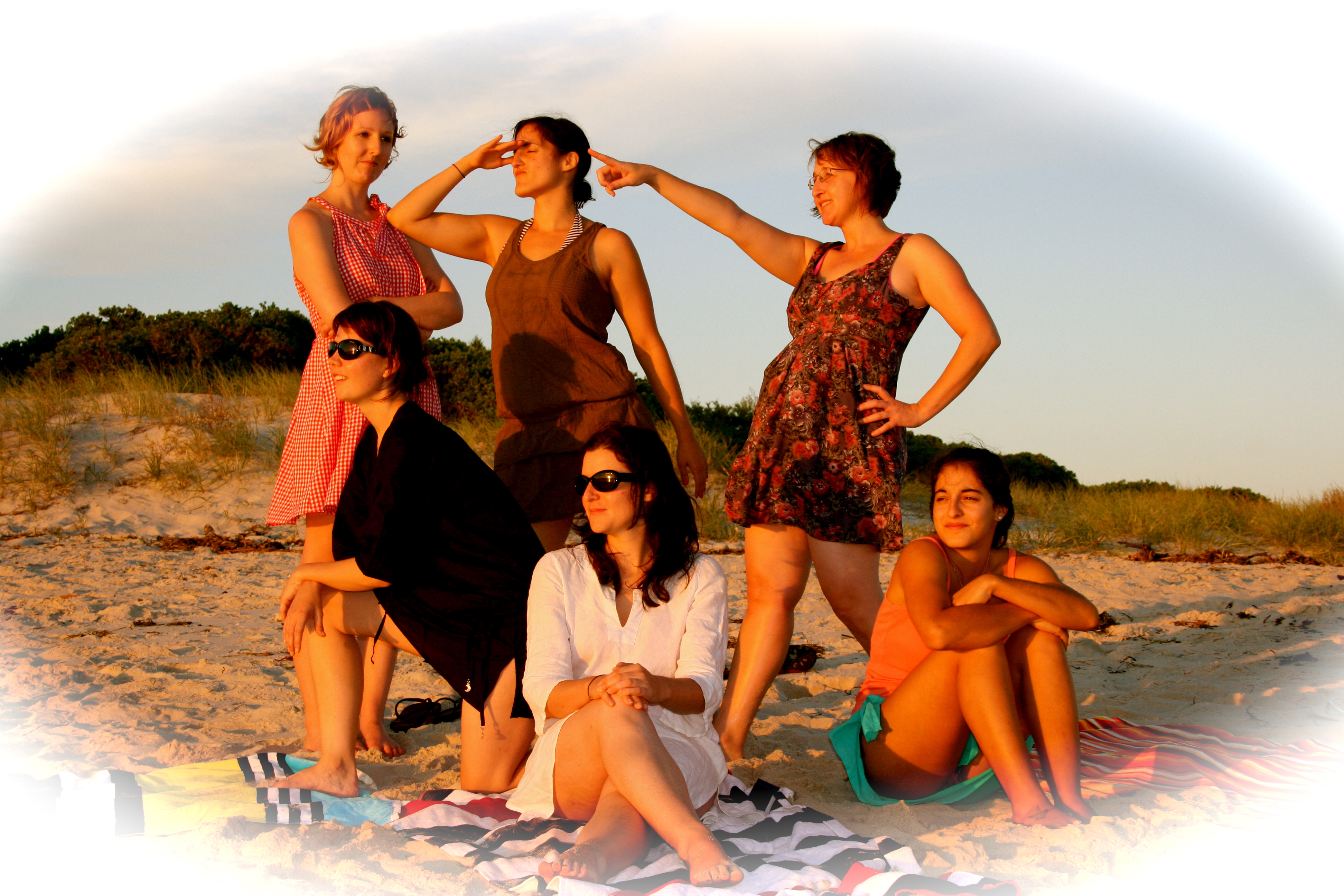
Hen's weekend at Hawk's Nest- last weekend


A strange experience last night, when I fell head over heels into a depression pit, for no sensible reason. It’s an odd sensation, like suddenly dropping into a hole, a deep badly lit hole, with greasy walls. You shake yourself, try a bit of sensible self-scolding ‘oh for God’s sake princess, harden up’ but nothing works. All the good stuff: humour, resilience, self-discipline, optimism, energy, seems to suddenly vanish leaving this grey world. Going through the motions, it’s like your own personal electricity supply has been shut down, leaving you half alive and not quite sure how to get back to normal.

I’d had a good weekend. Sophie’s swim lesson first thing Saturday morning, the joy of watching a toddler practice their starfish float, bubbles and rocket arms; then I drove north for KS’s hens night at a beach cottage in Hawks Nest, so the plunge into greyness was surprising. Like a lot of creative people, actually like everyone, I experience occasional bouts of sadness, but it’s rarely something that lasts very long, I usually snap out of it in a day or two. I have friends with serious depression, and it’s nowhere near that level, more of a feeling that for a short period the colour has leached out of everything and everything becomes an effort. I remember one of my drawing teachers in Hobart had an endlessly sunny disposition, but every once in a while he’d be grey, delicate and shy. We asked him what was wrong once and he seemed surprised and touched that anyone had noticed, muttered something about him trying not to let it effect his teaching. (It’s small moments like this that feed my endless affection for artists).

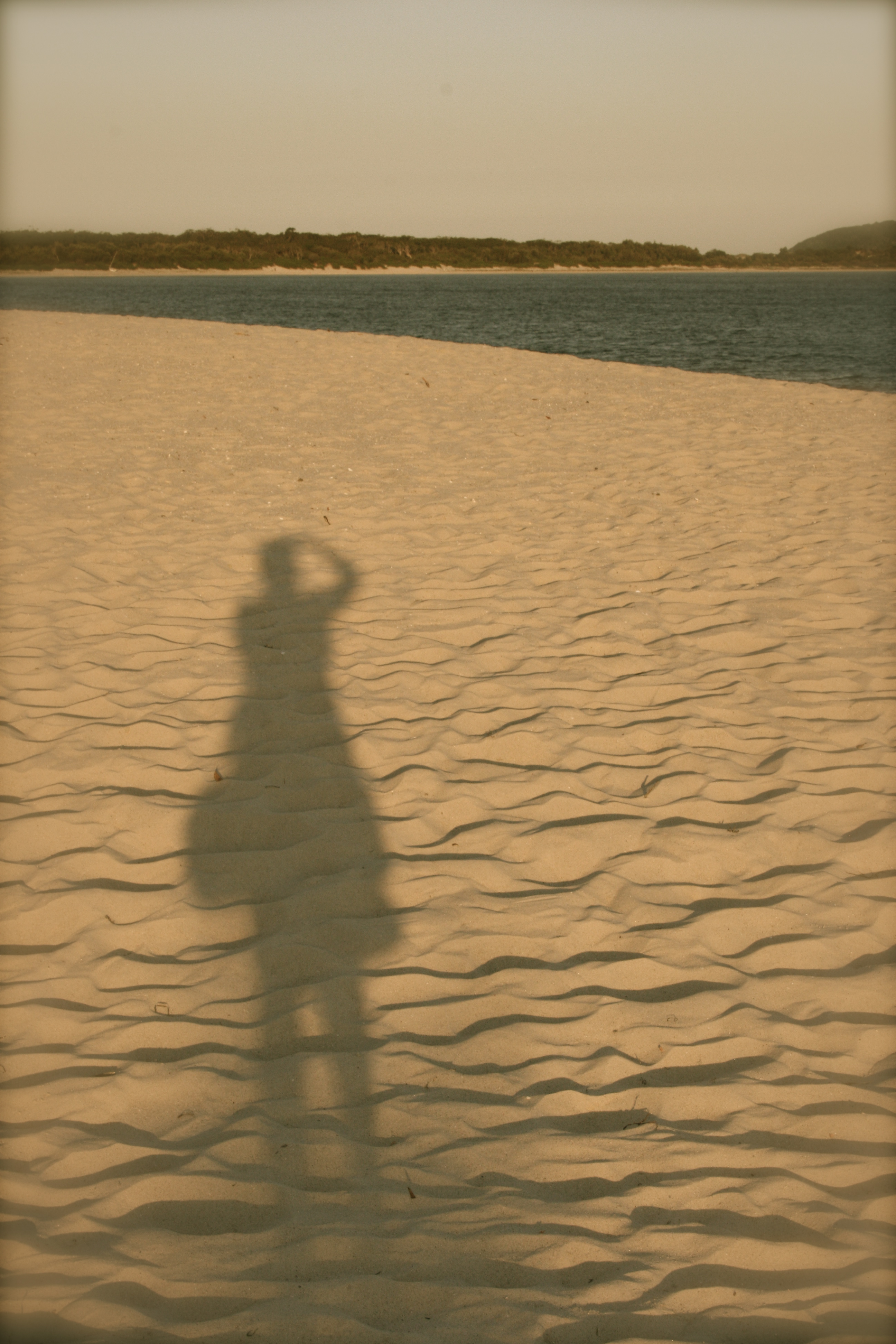
Late afternoon at Hawk's Nest

I’ve long ago accepted this as part of my emotional landscape. If I can feel it approaching, I’ll be kind to myself, do very little, rest and eat a lot. The reason I mention it is that last night I did all these things and woke up this morning feeling fine. I realised that I’d just been extremely tired and had mistaken one thing for another. Years ago, working and working in my studio, preparing for my Masters show in London, I didn’t realise how run down I’d got until I literally fell over. Sitting in a daze on my studio floor it suddenly dawned on me that I was buggered. Beat. Totally stuffed. It’s something that has happened periodically over the years, particularly during highly creative periods. And I didn’t really mind it, not at all, it was just the price you paid; and usually if you’ve been working that hard you get something good out of it. Stepping off at the end of an intense creative cycle, real life seems as dull as cabbages.

Hawk's Nest at sunset

But this is the first time this has happened since I became a mother, so it was a shock. In the past I was pretty much free to curl up in a ball until I’d recovered, but now I’m not. Toddlers demand their parents to be 100% switched on, engaged, available, not sitting on the sofa wondering how to glue their brain back together. Luckily Aaron came over and played with Sophie, she went to bed at a reasonable hour and I got a decent night’s sleep. When I awoke this morning, the world felt like a completely different place.

It probably happened because I’ve been trying to cram so much into my life. It’s the combination of many factors: turning forty, knowing the university holidays are about to end and that I’ll have to start teaching again, a renewed determination to earn a living solely from painting and writing, a fear of wasting potential and time, the knowledge that the GFC has made it that much harder for artists to generate income.  Nearly every minute of my waking life has some purpose or activity attached to it: there is bugger all sit-on-the-sofa-and-eat-Tim-Tams down time.

Sunset at Hawk's Nest

Feeling this sense of urgency, I experiment with different ways of optimising time. Last week I read two things that counselled completely different time management strategies. In his post ‘My single greatest tip for achieving the perfect state of flow‘, writer and adventurer Shawn Mihalik suggested turning off the clock at the top of your computer in order to facilitate creativity. A day later KS emailed me to say that she was thinking of trying the Pomadoro Technique. It involves breaking the working day into 25 minute chunks and concentrating on one task at a time. It’s supposed to maximise efficiency and align with the brain’s innate concentration patterns:  I guess there’s not enough time to get bored and wonder what’s for lunch!

Anyway, it struck me that as an artist and a parent there are significant opposing forces at work in my life. As a mother I try and keep things to a fairly predictable routine (bedtimes, naps, meals and all that); as an artist I find inspiration strikes at the strangest times, at the gym or while grocery shopping, and that creativity doesn’t always line up with the parenting cycle. (For an engaging, though sometimes histrionic, exploration of the subject of art and motherhood, see Rachel Power’s The Divided Heart. Power writes eloquently on the paradoxical dilemma facing many female artists when they become mothers: they approach their creative practice with new-found determination, focus and intensity… at a period in their lives when they have very little time to produce work).

I’ve been collecting time management anecdotes from other artists, particularly those with families. Sculptor MC tells me that she was most productive when she had teenage children: she used to line up pieces of sculpture in the kitchen and sand them in between preparing the evening dinner (‘this pasta tastes gritty Mum!’) I went to a public lecture by the painter Leo Robba the other day and he spoke about snatching whatever minutes were available (at the beach, when other people were watching television) and working then. After flicking through slides of dozens of paintings, and noting the presence of hundreds more in his studio, he observed that over the years these minutes add up.

Summer day at a Tasmanian beach (a direct contradiction in terms)

The University semester starts next week bringing my beloved summer holidays to an abrupt end. One minute living in old jeans and egg splattered t-shirt; the next making an effort to look vaguely professional and like I know what I’m talking about. We’ve re-jigged one of the courses I’m teaching this semester so this week has been spent reading, reading, reading in preparation. Students, bless them, assume you know everything about the subject you’re teaching, and one doesn’t want to shatter their illusions, so I’m cramming.

My friend AV, who lectures in Fine Art at a University in Northern England, said she has perfected a thoughtful gaze, accompanied with an interested ‘ah…’ when yet another bright young thing bounces up to chat about an artist or theory she has only a passing acquaintance with. God bless Google is all I can say.

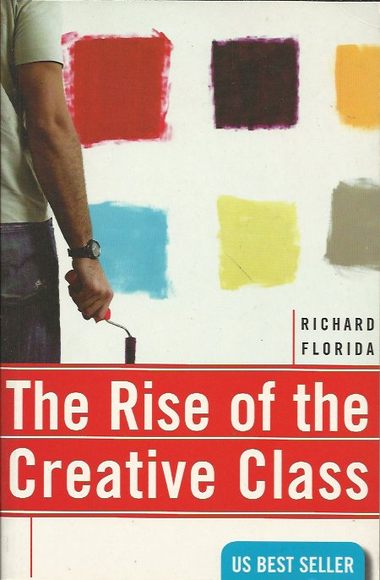
The Rise of the Creative Class by Richard Florida

I’m currently reading The rise of the creative class by Richard Florida, with The Cambridge handbook of creativity (eds James C. Kaufman and Robert J. Sternberg) waiting in the wings. Florida’s book is on a three day loan from the library so it had to take precedence. I’m enjoying it, I found his emphatic style off-putting to begin with, then started to appreciate him for his candour. Interestingly, he articulates profound changes to the way creative people live and work, stuff I’d been thinking about, but hadn’t really internalised that millions of other people were on exactly the same path. It’s a comforting realisation. Over the last five years I’ve been adapting my way of working so that I’m more often self employed than working for an employer; able to work from home (to accommodate motherhood); become much more selective about the work that I do and significantly more entrepreneurial; and consciously blurred the line between my personal and professional lives.

Here’s a couple of nice paragraphs from Florida’s book:

Creativity involves the ability to synthesise. Einstein captured it nicely when he called his own work ‘combinatory play’. It is a matter of sifting through data, perceptions and materials to come up with combinations that are new and useful. A creative synthesis is useful in such varied ways as producing a practical device, or a theory or insight that can be applied to solve a problem, or a work of art that can be appreciated.

Creativity requires self-assurance and the ability to take risks. In her comprehensive review of the field, The Creative Mind, Margaret Boden writes that creativity

‘involves not only a passionate interest but self-confidence too. A person needs a healthy self-respect to pursue novel ideas, and to make mistakes, despite criticism from others. Self-doubt there may be, but it cannot always win the day. Breaking generally accepted rules, or even stretching them, takes confidence. Continuing to do so, in the face of scepticism and scorn, takes even more’.

Speaking of self-doubt, today I painted for the first time in months. I’ve pretty much given up on the idea of renting a studio, I’m on a waiting list at a community art space, so I’ve cleaned out the back shed at home and I’m working there. I figure that I can get quite a bit done after my daughter is in bed, during her afternoon nap or when Aaron is looking after her; Mum is visiting next week, so potentially that’s more time in the studio.

Over the years I’ve noticed a series of quite predictable emotions and behaviours before I start painting, especially if there has been a longish break. First is this general feeling that life is black and white, not colour, and that everything is sort of crappy and second rate. This eventually segues into grumpiness and bitchy intolerance. Next is frantic procrastination, usually accompanied by house cleaning, dish washing, furniture moving, weed pulling and floor washing. The dominant emotion during the frantic activity phase is nameless dread. Finally, when self-doubt and internal negativity have become overwhelmingly pervasive, I go into the studio, wipe off the glass pallete so it’s nice and clean, and line my brushes up in a grid formation. Once I start I’m fine. There’s this quiet tidal wave of relief, pleasure, fulfilment. I find at the beginning of a painting cycle, which is where I am now, I see things really clearly: my eyes measure angles and tiny marks quite accurately. It’s only when I’m in the middle of a cycle (I’m talking in terms of months, if not years) that I tend to lose some visual clarity. Towards the end it sharpens up again.

I want to end this blog entry by quoting a great response I got to the last entry ‘A literary diet’ by my cousin’s partner KG. They live in Darwin and she writes:

Subject: Place and its influence

Hi Helen

Just read your ‘literary diet’. I remember visiting Venice after I’d been living in the Territory for a few years. The contrast was amazingly diverse. At complete opposite ends of the spectrum. Venice was full of beauty, art and opulence. A city that has been enduring dedicated to the zenith of man’s artistic and cultural achievements. I absolutely loved it. But in comparison to the Indigenous landscape of the Top End it seemed somehow inconsequential, a mere folly perhaps of humanity (perhaps that’s a little extreme). Here life, art, landscape, is ephemeral, transient yet infinitely enduring. ‘Art’ per se, and its practice almost seems trivial alongside day to day and cultural survival. Like so much of Aboriginal life, art is not a seperate entity but a deeply entwined component of social and cultural meaning. Having been born into a Weternised concept of life and art, I’m finding the landscape here challenges my core concepts and beliefs.

And on a very practical level, I don’t take on projects that I would ‘down south’. The weather conditions here simply mean that things don’t last. Dry weather and humidity mean that most objects deteriorate rapidly (such as books, paintings, textiles). And then cyclones obliterate written histories and urban community continuity! I think “Thank goodness the digital age is here”, but then we probably won’t be able to read any of our antiquated computer systems in twenty years either.

Well … that’s my initial response to reading your article’.

Kangaroo Valley


Sadly January, designated as my Fun Month, will shortly come to a close. Latest activity in pursuit of hedonism was TM’s 40th birthday party in Kangaroo Valley last weekend. The valley is a beautiful place, high sides and its own weather, lush greenery, mists. Population the usual mix of disaffected Sydneysiders and hardened country folk. Party included lots of kids and some great toys: walled trampoline, shark head water slides, swimming pool, mobile sandpit, glow sticks and ground-hugging scooters. If you’re planning a holiday in the Valley, here’s a link with some tourist and accommodation info:

http://www.kangaroovalleytourist.asn.au/home/

As part of the whole sustainability lifestyle thing, I’m aiming to use my car less, with the eventual goal of learning to live without it. To get to the party I caught a train to Central, carrying Sophie’s car seat, and then got a lift to Kangaroo Valley with two of TM’s friends. Coming back, there was trackwork, which meant a lift to Bowral with the same two friends, now very hungover; a bus to Liverpool; an un-airconditioned train from Liverpool to Central; another train from Central to Morisset; and then a lift from Morisset to Dora Creek. It ended up being an all day event.

Two remarkable people and one notable meal encountered en route. The first person I got talking to at the Bowral bus station. It’s a wealthy area, and I couldn’t be bother carrying the car-seat and suitcase any longer, so I’d left them on the station seat and was walking with Sophie up towards the town to get a cup of tea. Coming down the road towards me was a likeable looking woman (bad teeth, sweet smile, scruffy hair) who looked like she was heading towards the station: she was. I asked if she’d keep an eye on my bag, she agreed (later noting that she herself wouldn’t have left it there) and then, because Sophie was having the toddler equivalent of a bad hair day, walked across the road with us towards the town, holding Sophie’s other hand, chatting all the way.

Gumnut Patisserie, Bowral

Which leads me to the notable meal, purchased at Bowral’s Gumnut Patisserie, a country bakery with a reassuring array of trophies for things like scones and bread lined up on the top shelf. Great food. Sophie and I ate a couple of small quiches, and a custard pie, so rich it left a layer of creamy fat on the top of your mouth. We shared a miniature fruit tart with an enormous blueberry teetering on its edge, only just held in place with sugar glaze, like the boulder at the top of Ambush Valley in an old fashioned Western movie. Sophie got the blueberry.

Returning to the station, the suitcase and the strange lady. Odd snippets of our conversation spring to mind: her son is studying veterinary science and lives in Toowoomba. Despite having lost all his belongings in the flood, the thing that really bothered him was that all his friends in a nearby town were air-lifted out by Black Hawk choppers. We discussed the layout of the Mittagong primary school playground as opposed to the one in Bowral: Mittagong infinitely superior, Bowral involves a road crossing and a parcel of land behind a church; the age children stop whining: six to sixteen, after and before that, forget it; shoeing horses: how people think it’s easy; falling off horses: how not to do it. And the poisonous nature of agapantha sap: toddler diverted as she headed towards the station’s attractive, flowery bushes.

I’m pretty sure this woman thought I was a frigging idiot, wandering around on a super-hot day, with a car-seat and toddler, both wearing freebie Corona hats that Jules had given us, and a certain post party vibe that is as easy to spot as it is hard to hide. But I really liked her. When she got on her bus, ducking to avoid an elderly man who was getting off, apparently the lawyer who had settled her grandmother’s estate (“country towns…” I cracked, and she grinned). I said to Sophie “that was your fairy godmother” as we waved to her. No idea what her name was.

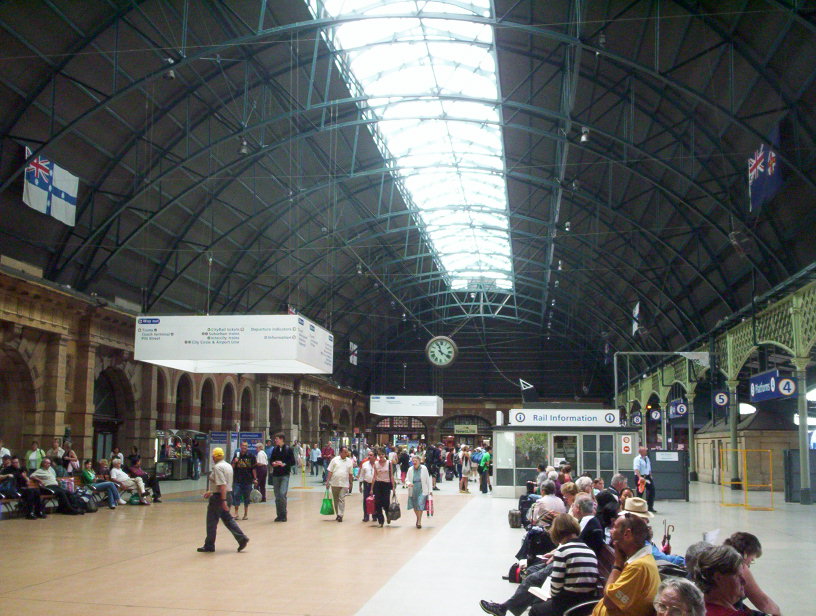
Central Station, Sydney

Second remarkable individual encountered somewhere on the line from Liverpool to Central. Young guy jumps on train with two toddlers and sits down near us. Thongs, tattoes, shaved head with rat-tail, shorts. He’s shirtless but stands up to pull a t-shirt on, realises it’s back to front, pulls it off again and eventually gets it on. I notice him mainly because he has a beautiful body, because the t-shirt is already stained with sweat, and because he seems so typically Australian, whatever that is. Sophie has, by this point, had enough of public transport and is behaving pretty badly. At certain points, there’s lots of screaming. I’m hot, crabby and not helping matters by trying to control her too much, instead of just accepting that a toddler is a toddler, not an adult, and you can’t expect them to sit there and look out the window. Sometimes you do have to let them crawl around on the crappy train floor looking for treasure.

The guy, on the other hand, is handling his two toddlers wonderfully. Segued smoothly from ‘can we see a butterfly out the window?’ to witty bouts of ‘look, Daddy’s wearing toddler hat’ and back to ‘Look! There is a butterfly out the window, you just missed it’. Brilliant stuff: masterful. Got talking to the guy, admired his skills, he looked pleased when I said that I he was obviously closely bonded to his kids. Here are some fragments of the conversation: kids names are Mark and Matthew; Matthew is two years older, but has been diagnosed with autism, ‘he’s my angel’; Dad has been through hell with his kids, he has them on the weekends, their Mum went away for a year; Mark is wearing a cool t-shirt with a carp on it; Dad used to work at a Japanese coy farm, t-shirt a hand me down but lasting well. Got off train, guy offered to help, he ended up holding Sophie’s hand and Sophie ended up holding Matthew’s hand; three transit cops looked amused as trio of wobbly toddlers exited train.

Guy tried to hit on me, politely deflected it, didn’t want to waste his time, and I know a bad boy when I see one (something about the tattoes, the body, the emphasis on being just a little bit too honest, a bit twitchy around authority figures). But I mention him, because whatever his relationship with the criminal justice system, and I’m sure there’s been one, he was managing two toddlers on a hot day like a pro.


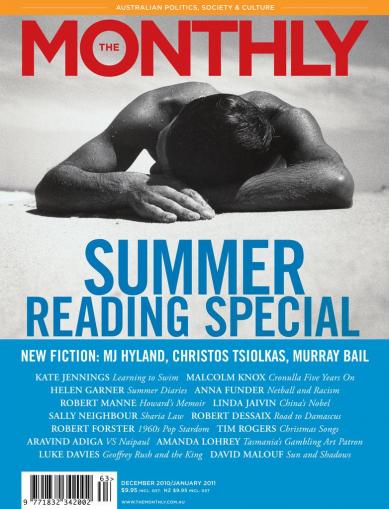
December/January 2011 edition of The Monthly

People are always suggesting that you read this or that, some great book or article, and mostly you don’t. In my case it’s not laziness, ill will or a lack of faith in their judgement, more a sense that the right books come to you when you’re ready for them, and what may be deeply fascinating to one reader is as “interesting as a bucket full of warm spit” (to borrow a description of the US Vice Presidency role) to another. So when a writer friend said that I should read a profile of Tasmanian art collector David Walsh in The Monthly, describing it as very well written, I responded enthusiastically with no intention of actually doing so.

About a week later I was standing at Central Station waiting for a train to the airport. Looking at the magazine covers on offer at the nearby newsstand, I saw a copy of The Monthly with a copy of Max Dupain’s Sunbaker on the cover. http://www.themonthly.com.au/

Now I have a particular interest in this image, having recently suffered through a pile of undergraduate essays on the topic of the expression of Australian national identity in the visual arts, so I was drawn to it. Handed over my $9.95 and ended up enjoying the magazine, and the profile, enormously. Great selection of diary entries by Helen Garner; nifty article on swimming by Kate Jennings; and an album review by Chistos Tsiolkas of the Gaza Strips that sent me scurrying into the nearest Sanity record store, only to be told by the attendant, after checking his computer, that he had a listing for the Gaza Strippers, and was that what I was after?

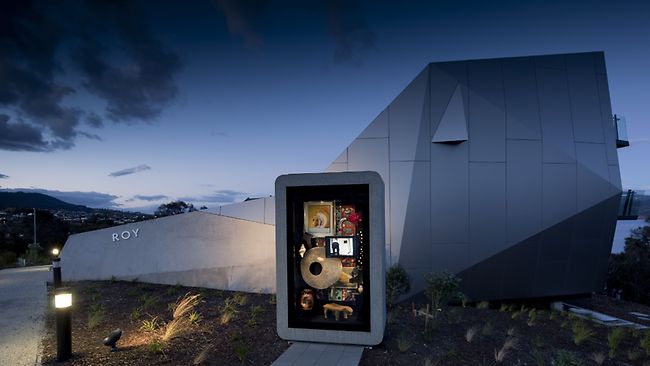
MONA: source The Australian newspaper

MONA, the museum of old and new art, David Walsh’s brainchild, recently opened in Hobart, so I was curious about him and his collection. One of his comments caused me a fair bit of angst. It was words to the effect that when he questions artists about their work, quite often they don’t seem to know what they’re actually doing, or don’t have a strong rationale for why they do what they do. Yup, after years of fluffing answers to these kind of questions, I knew exactly what he was talking about. Since then I’ve been mulling over how to describe what I do, why I do it, and what keeps me doing it. Oh, I forgot to mention, Walsh also noted that artists seem to be driven by the twin poles of sex or death: artistic peacocking behaviour for procreation purposes, or seeking immortality via the creation of cultural artefacts. Honestly, I’d have to stick myself in the first category, purely on the basis that sex appears to be much more fun than death.

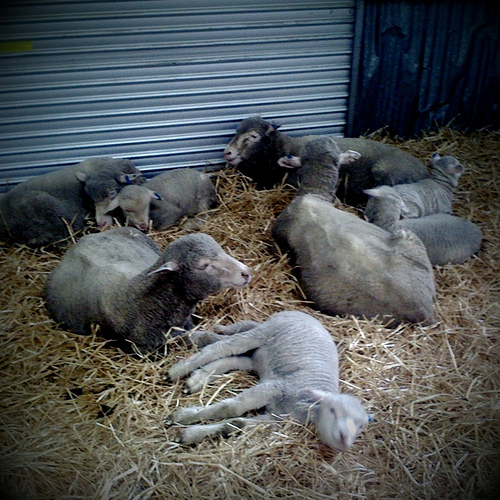
To answer questions about why I continue to like making art, it makes sense to look back at where and when the behaviour originated. Very early (still in nappies and before my parents’ marriage busted up) I remember pulling a red geranium apart and being absolutely fascinated by the colour. I thought it was incredible that the more I ripped the flower up, the more red there was. At kindergarten, I fell in love with a Pakistaani carer, and used to dash off bird drawings just for the intense pleasure of his praise. After kindergarten, I painted a black sheep from the Royal Hobart Show with a blue ribbon around its neck, standing on yellow straw. I remember agonising over how to paint the eye, given that I had already used the darkest colour in my palette for the fleece. (In the end I gave the eye a brown outline and coloured it black too). About the same time, Mum and I were visiting one of her friends, and I was deeply envious of one of their kid’s paintings stuck on the fridge. It was a painting of a rainbow and all the colours had bled into each other: I wasn’t sure how I could get paint to do this (nothing more complex than wet on wet paint application).  So very early on I was noticing colour and paintings and thinking about how to make them, how to match the picture in my mind with what came out on the paper.

The next generation of Royal Hobart Show sheep: photo ozjimbob @ flickr.com

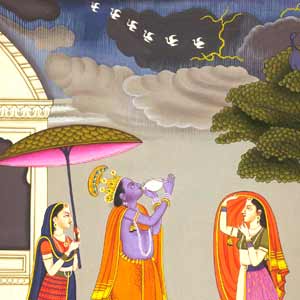
My grandparents both painted and ran a commercial art gallery, and my Mum had been a curator at a State Art Gallery, so I was lucky to have been exposed to lots of interesting imagery. Another key early influence was MP, the writer I mentioned earlier, who suggested I read the David Walsh piece. In the 70s she used to import Indian miniature paintings and artefacts so I grew up looking at images of half human/animal gods with anti-naturalistic colour, non western perspective, pattern used to describe pictorial depth and animate figures and clothing. These had a huge impact, though I didn’t realise it at the time, something that remains with me to this day.

As I got older, I became attuned to the idea that art could be used as a wild zone where you could express forbidden feelings, thoughts and desires. It was a visual code that only you could crack, a powerful but quiet form of protest, creation as a transcendent space. I began to use animal imagery as a signifier for human experience, partly because I like animals and their forms, and partly to make the code more oblique. The animals would become stand-ins for human actors and actions. I’ve mentioned early that I didn’t like growing up in Hobart, always felt really out of place, couldn’t wait to leave. I experienced the place as claustrophobic, it gave me a feeling of being locked in a room in which the air is slowly being sucked out. For a long time, and this is really juvenile, my greatest fear was becoming a paraplegiac, unable to speak, and being stuck in a hospital bed with a view of Hobart City.

Indian miniature painting

Sometimes, of course, art was a handy social tool. Kids who can draw are always useful or entertaining for other kids, and so it was with me too. I remember drawing a friend in primary school, the drawing turned out well (her face was turned ¾ away from me and the light was hitting her cheekbone), and having a queue of little girls wanting me to draw them too. I also remember becoming aware of human beauty at this age. I remember watching a boy and a girl run around the oval like wild animals, the curve of a friend’s spine as she got dressed after gym.

Over the years I have returned again and again to the same cycle of images, mostly based around interactions between humans and animals, or combinations of human and animal forms. There are often two girls, I call them the fishwives, standing side by side near the ocean. My cousin Rachel were, and are, as different as two people can be, but because we grew up together she is like my sister, the other to which I define myself. This is a perennial issue, but parents seem to be stricter on their girls than their boys, and keep them closer to home. I paint the two girls frozen in immobility, wearing their best dresses, waiting for a metaphorical ship (life, action, whatever) that may or may not arrive.

Another recurring images, again two figures, standing outside an old fashioned squat colonial church, shades of American Gothic. Not sure entirely what this one is about, but I paint it when I’m in love, and when I’m out of love, the expressions of the couple changing each time. It’s an image that only works when the emotional conditions are right, I’ve tried painting a replica of one that I sold and it didn’t work. Another image that I like, but am yet to paint in a way that I am satisfied with, a cat with a woman’s head, lactating milk on the floor of a red, velvet tent, with little ships sailing in the milk. Other recurring images: a tree draped with human bodies and animals; a man standing in a boat, his arms outstretched; human and animal heads on striped poles, like cocktail swizzle sticks or channel markers; a ship in a bottle experiencing a violent squall.

So the central themes, I guess, are claustrophobia; dislocation; the pressure between inner and outer selves, social expectation; the female condition; sensuality versus morality; freedom versus confinement; stasis against adventure. A pressure valve of sorts. And all bound up in the weird psychic resonance of the Tasmanian landscape, with its beauty, suppression of history, violent past and present, and disconnected, bottom of the world sense of place. I’m always trying to balance the sweetness and horror of the island: I suppose all places are, to some extent, like this, but I’ve always experienced Tasmania more intensely than most places I’ve been.

It would be tempting at this moment to conclude ‘well, it’s just therapy, innit?’ And in many ways, I can reluctantly admit that it’s true: art does bring me psychic calm, I get shitty when I’m not painting, I don’t feel like I’m properly alive. But although art does have a therapeutic role, aligning my inner and outer selves, this is not why I continue painting and exhibiting. I am driven to try and create one true image, one image where everything works and nothing can be changed, something that speaks to the viewer in a clear voice. I know that this is far from being a novel idea, but I’ve always felt that the universal is reached via the personal, and that my obligation is to be an honest conduit of what I feel and experience. My main job at the moment is to nail the techniques so I create the best possible version of the images in my imagination. In a strange sort of way, I feel like I was born with all the images I ever wanted to paint, and that the only thing that I need to continue to work on is how to do it.

Well, I’m afraid that’s my best answer to the question of why I make art and what I’m trying to do. Hopefully I won’t run into David Walsh at a dinner party anytime soon.

***

Two bits of trivia about sex: late one night, afterwards, I had this intense visualisation of a blue diamond shape embedded in the flesh near my navel. Days later, and this peculiar image remained. I tried googling the symbolism of the blue diamond shape, but apart from finding out that natural blue diamonds are extremely expensive and rare, and that a blue diamond tattoo is used by elite security forces, nothing much of consequence.

Toying with the idea of painting myself blue and renting myself out as a tantric sex instructor for a laugh. Burn some dodgy incence, look ethereal and smug, talk about chakras, dogmas and karmas. Beautiful. Read a few books on the subject beforehand and hey presto! The perfect scam. The idea reminds me of a funny film about a New Zealand travel writer who never actually visited the places he wrote about or recommended. People used to abuse him in the street: ‘I took my girlfriend there on our honeymoon!’

***

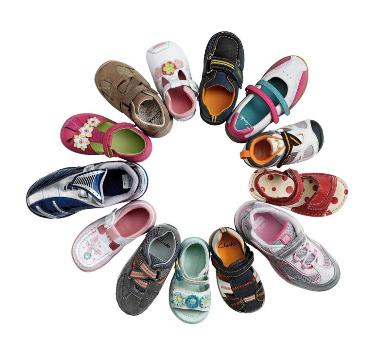
Sophie needed new shoes so Aaron and I took her shopping. David Jones in Newcastle is closing down, the end of an era, and lots of things are on sale. She got a practical pair of brown Velcro sandals, a white pair of trainers and a sparkly pair of white sandals for when she’s a bit bigger. Her Dad wasn’t so keen on the sparkly sandals, but she loved them so, holding them as if they were priceless treasure.