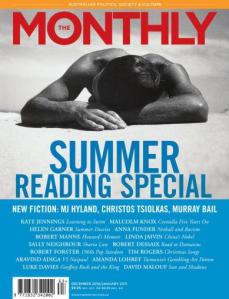
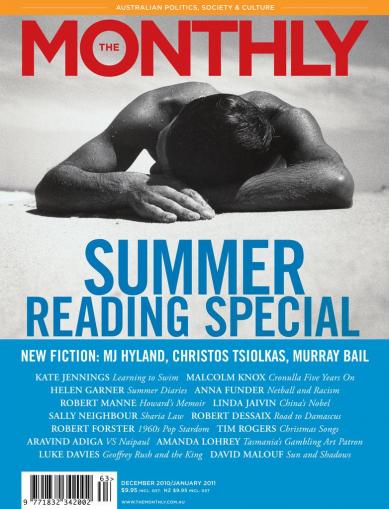
December/January 2011 edition of The Monthly
People are always suggesting that you read this or that, some great book or article, and mostly you don’t. In my case it’s not laziness, ill will or a lack of faith in their judgement, more a sense that the right books come to you when you’re ready for them, and what may be deeply fascinating to one reader is as “interesting as a bucket full of warm spit” (to borrow a description of the US Vice Presidency role) to another. So when a writer friend said that I should read a profile of Tasmanian art collector David Walsh in The Monthly, describing it as very well written, I responded enthusiastically with no intention of actually doing so.
About a week later I was standing at Central Station waiting for a train to the airport. Looking at the magazine covers on offer at the nearby newsstand, I saw a copy of The Monthly with a copy of Max Dupain’s Sunbaker on the cover. http://www.themonthly.com.au/
Now I have a particular interest in this image, having recently suffered through a pile of undergraduate essays on the topic of the expression of Australian national identity in the visual arts, so I was drawn to it. Handed over my $9.95 and ended up enjoying the magazine, and the profile, enormously. Great selection of diary entries by Helen Garner; nifty article on swimming by Kate Jennings; and an album review by Chistos Tsiolkas of the Gaza Strips that sent me scurrying into the nearest Sanity record store, only to be told by the attendant, after checking his computer, that he had a listing for the Gaza Strippers, and was that what I was after?

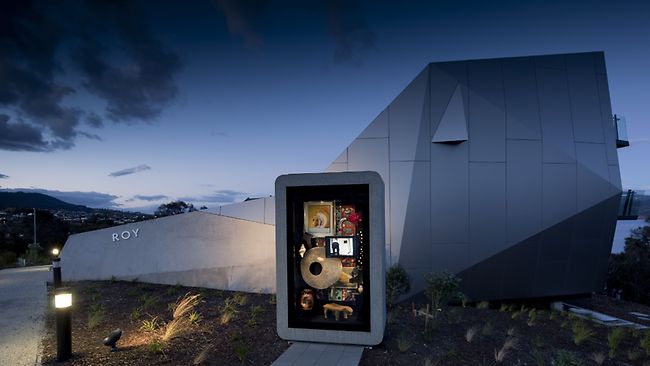
MONA: source The Australian newspaper
MONA, the museum of old and new art, David Walsh’s brainchild, recently opened in Hobart, so I was curious about him and his collection. One of his comments caused me a fair bit of angst. It was words to the effect that when he questions artists about their work, quite often they don’t seem to know what they’re actually doing, or don’t have a strong rationale for why they do what they do. Yup, after years of fluffing answers to these kind of questions, I knew exactly what he was talking about. Since then I’ve been mulling over how to describe what I do, why I do it, and what keeps me doing it. Oh, I forgot to mention, Walsh also noted that artists seem to be driven by the twin poles of sex or death: artistic peacocking behaviour for procreation purposes, or seeking immortality via the creation of cultural artefacts. Honestly, I’d have to stick myself in the first category, purely on the basis that sex appears to be much more fun than death.
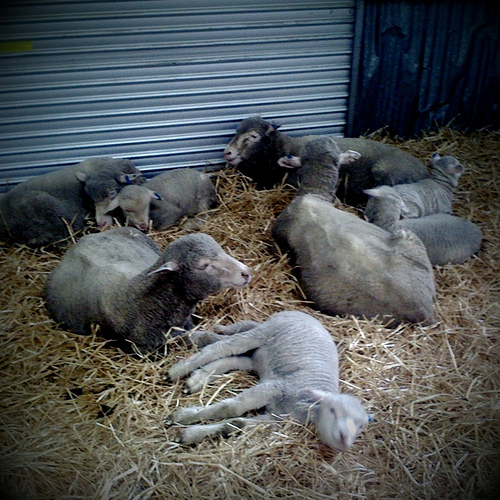
To answer questions about why I continue to like making art, it makes sense to look back at where and when the behaviour originated. Very early (still in nappies and before my parents’ marriage busted up) I remember pulling a red geranium apart and being absolutely fascinated by the colour. I thought it was incredible that the more I ripped the flower up, the more red there was. At kindergarten, I fell in love with a Pakistaani carer, and used to dash off bird drawings just for the intense pleasure of his praise. After kindergarten, I painted a black sheep from the Royal Hobart Show with a blue ribbon around its neck, standing on yellow straw. I remember agonising over how to paint the eye, given that I had already used the darkest colour in my palette for the fleece. (In the end I gave the eye a brown outline and coloured it black too). About the same time, Mum and I were visiting one of her friends, and I was deeply envious of one of their kid’s paintings stuck on the fridge. It was a painting of a rainbow and all the colours had bled into each other: I wasn’t sure how I could get paint to do this (nothing more complex than wet on wet paint application). So very early on I was noticing colour and paintings and thinking about how to make them, how to match the picture in my mind with what came out on the paper.
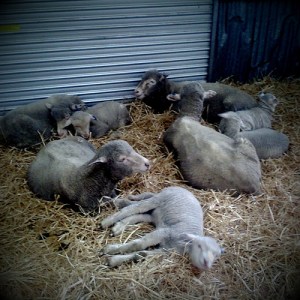
The next generation of Royal Hobart Show sheep: photo ozjimbob @ flickr.com
My grandparents both painted and ran a commercial art gallery, and my Mum had been a curator at a State Art Gallery, so I was lucky to have been exposed to lots of interesting imagery. Another key early influence was MP, the writer I mentioned earlier, who suggested I read the David Walsh piece. In the 70s she used to import Indian miniature paintings and artefacts so I grew up looking at images of half human/animal gods with anti-naturalistic colour, non western perspective, pattern used to describe pictorial depth and animate figures and clothing. These had a huge impact, though I didn’t realise it at the time, something that remains with me to this day.
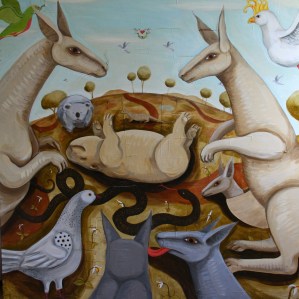
As I got older, I became attuned to the idea that art could be used as a wild zone where you could express forbidden feelings, thoughts and desires. It was a visual code that only you could crack, a powerful but quiet form of protest, creation as a transcendent space. I began to use animal imagery as a signifier for human experience, partly because I like animals and their forms, and partly to make the code more oblique. The animals would become stand-ins for human actors and actions. I’ve mentioned early that I didn’t like growing up in Hobart, always felt really out of place, couldn’t wait to leave. I experienced the place as claustrophobic, it gave me a feeling of being locked in a room in which the air is slowly being sucked out. For a long time, and this is really juvenile, my greatest fear was becoming a paraplegiac, unable to speak, and being stuck in a hospital bed with a view of Hobart City.
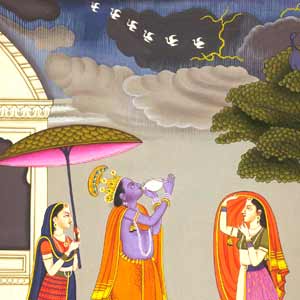
Indian miniature painting
Sometimes, of course, art was a handy social tool. Kids who can draw are always useful or entertaining for other kids, and so it was with me too. I remember drawing a friend in primary school, the drawing turned out well (her face was turned ¾ away from me and the light was hitting her cheekbone), and having a queue of little girls wanting me to draw them too. I also remember becoming aware of human beauty at this age. I remember watching a boy and a girl run around the oval like wild animals, the curve of a friend’s spine as she got dressed after gym.
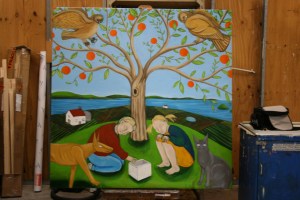
Over the years I have returned again and again to the same cycle of images, mostly based around interactions between humans and animals, or combinations of human and animal forms. There are often two girls, I call them the fishwives, standing side by side near the ocean. My cousin Rachel were, and are, as different as two people can be, but because we grew up together she is like my sister, the other to which I define myself. This is a perennial issue, but parents seem to be stricter on their girls than their boys, and keep them closer to home. I paint the two girls frozen in immobility, wearing their best dresses, waiting for a metaphorical ship (life, action, whatever) that may or may not arrive.
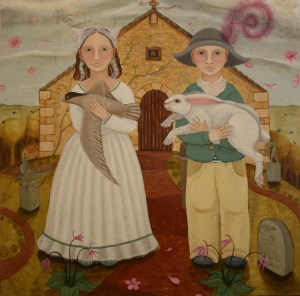
Another recurring images, again two figures, standing outside an old fashioned squat colonial church, shades of American Gothic. Not sure entirely what this one is about, but I paint it when I’m in love, and when I’m out of love, the expressions of the couple changing each time. It’s an image that only works when the emotional conditions are right, I’ve tried painting a replica of one that I sold and it didn’t work. Another image that I like, but am yet to paint in a way that I am satisfied with, a cat with a woman’s head, lactating milk on the floor of a red, velvet tent, with little ships sailing in the milk. Other recurring images: a tree draped with human bodies and animals; a man standing in a boat, his arms outstretched; human and animal heads on striped poles, like cocktail swizzle sticks or channel markers; a ship in a bottle experiencing a violent squall.
So the central themes, I guess, are claustrophobia; dislocation; the pressure between inner and outer selves, social expectation; the female condition; sensuality versus morality; freedom versus confinement; stasis against adventure. A pressure valve of sorts. And all bound up in the weird psychic resonance of the Tasmanian landscape, with its beauty, suppression of history, violent past and present, and disconnected, bottom of the world sense of place. I’m always trying to balance the sweetness and horror of the island: I suppose all places are, to some extent, like this, but I’ve always experienced Tasmania more intensely than most places I’ve been.
It would be tempting at this moment to conclude ‘well, it’s just therapy, innit?’ And in many ways, I can reluctantly admit that it’s true: art does bring me psychic calm, I get shitty when I’m not painting, I don’t feel like I’m properly alive. But although art does have a therapeutic role, aligning my inner and outer selves, this is not why I continue painting and exhibiting. I am driven to try and create one true image, one image where everything works and nothing can be changed, something that speaks to the viewer in a clear voice. I know that this is far from being a novel idea, but I’ve always felt that the universal is reached via the personal, and that my obligation is to be an honest conduit of what I feel and experience. My main job at the moment is to nail the techniques so I create the best possible version of the images in my imagination. In a strange sort of way, I feel like I was born with all the images I ever wanted to paint, and that the only thing that I need to continue to work on is how to do it.
Well, I’m afraid that’s my best answer to the question of why I make art and what I’m trying to do. Hopefully I won’t run into David Walsh at a dinner party anytime soon.
***
Two bits of trivia about sex: late one night, afterwards, I had this intense visualisation of a blue diamond shape embedded in the flesh near my navel. Days later, and this peculiar image remained. I tried googling the symbolism of the blue diamond shape, but apart from finding out that natural blue diamonds are extremely expensive and rare, and that a blue diamond tattoo is used by elite security forces, nothing much of consequence.
Toying with the idea of painting myself blue and renting myself out as a tantric sex instructor for a laugh. Burn some dodgy incence, look ethereal and smug, talk about chakras, dogmas and karmas. Beautiful. Read a few books on the subject beforehand and hey presto! The perfect scam. The idea reminds me of a funny film about a New Zealand travel writer who never actually visited the places he wrote about or recommended. People used to abuse him in the street: ‘I took my girlfriend there on our honeymoon!’
***

Sophie needed new shoes so Aaron and I took her shopping. David Jones in Newcastle is closing down, the end of an era, and lots of things are on sale. She got a practical pair of brown Velcro sandals, a white pair of trainers and a sparkly pair of white sandals for when she’s a bit bigger. Her Dad wasn’t so keen on the sparkly sandals, but she loved them so, holding them as if they were priceless treasure.


 Helen Hopcroft: an artist's life


