Archives for posts with tag: literature

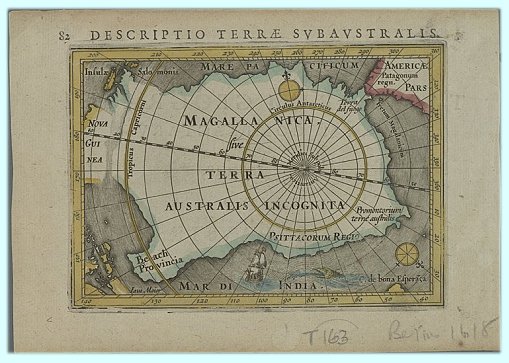
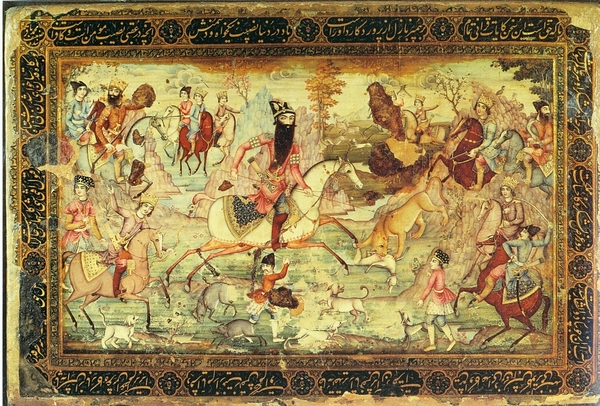
I woke up on Wednesday night at 3am, unable to sleep, and proceeded to write the introduction to the artist’s book, the project I’m working on with KRS, Caelli and Aunty Pam. KRS is doing the illustrations, Caelli is the designer and Aunty Pam the bookbinder. My story is a re-telling of the 1001 nights. Why I chose to link it to this famous tale is a story in itself. In a previous post, I mentioned keeping a private diary and its connection to a vague interest in someday writing erotic literature (probably inspired in part by Nikki Gemmell’s barn storming sequences in The Bride Stripped Bare, a lingering fascination for Lady Chatterley’s Lover and art student memories of The Story of O).

I knew that I wanted to use my diaries as reference material, and as I started keeping a diary when my marriage went (sound of plane crashing) perhaps link the Scheherazade narrative to a very modern tale of marital breakdown. I felt that 1001 nights would allow for a slightly fragmented, diary style narrative, written from the perspective of the female main character, with this constant atmosphere of anxiety pervading her stories and giving them intensity. I also liked the idea of people in times of stress taking refuge in fantasy, albeit in this case, erotic fantasy.

When I told her about using the Scheherazade character, KS made the excellent point that 1001 nights is art about art: the seductive powers of literature, the role of the author and their relationship with the reader etc. I liked these ideas too, and thought that they’d blend well with a slightly self-conscious, literary narrator.
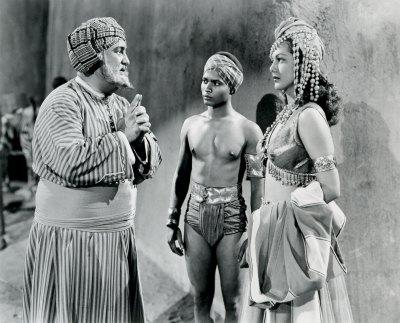
Anyway, it didn’t happen. Maybe because it’s all too close to home, or perhaps just because I knew it wouldn’t make good literature, I ended up abandoning that idea. Instead I decided to write a version of 1001 nights that retained the Scheherzade character and setting (a vague somewhere on the Arabian Peninsula a long time ago) but which foregrounded the erotic potential of the story. Which is not entirely without precedent: in the original tale, by the end of the 1001 nights of ‘story-telling’, Scheherazade and the Sultan had three sons, and some versions apparently contain erotica.

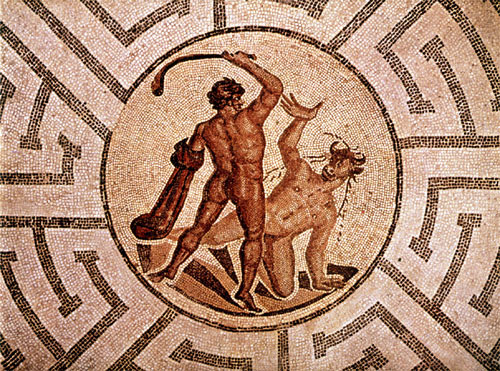
And it’s going ok (well, it’s going well actually, I just don’t want to jinx it). I’m at 10,000 words and I think that in the end it will be somewhere in the range of 15-20,000. Other than the general stuff you need to do to function and care for a kid, I’ve done very little this week except write. Like all pieces of writing, it only started to flow once I had the first sentence. I’m currently following the narrative as it unravels, like the myth of Ariadne’s lover, obsessively chasing her ball of red wool in the minotaur’s maze.
Sometimes, often when I’m driving or half asleep, I’ll think of the perfect sentence for a piece of writing. Then it’s a struggle to either find something to write with, memorise it, or just think bugger it, and go back to sleep. I’ve lost a lot of good stuff (or at least I remember it as being good: a bit like the fish that got away) by choosing to snooze. It was the middle of the night when the first sentence for 1001 nights arrived: ‘Soon the night will come, and to save my life, I must tell another story’. I sat up in bed, grabbed my trusty laptop, and wrote the first five pages. I was surprised at how easily the writing flowed in the middle of the night. I often think that writing when you’re half conscious is a good idea as it effectively suspends the critical mind.

The next morning, still dazed from my broken sleep, Sophie came rushing into my room to announce that she had wet her pull up: pool of urine on the floor, off comes the pull up. Then she dashed off to get some grapes out of the fridge, and brought them back into my bed for a snack and a cuddle. Being a kind toddler, she offered to share her grapes, and I politely took one. By the time I got up and was in the car, I was still in this half-crazed dream state.

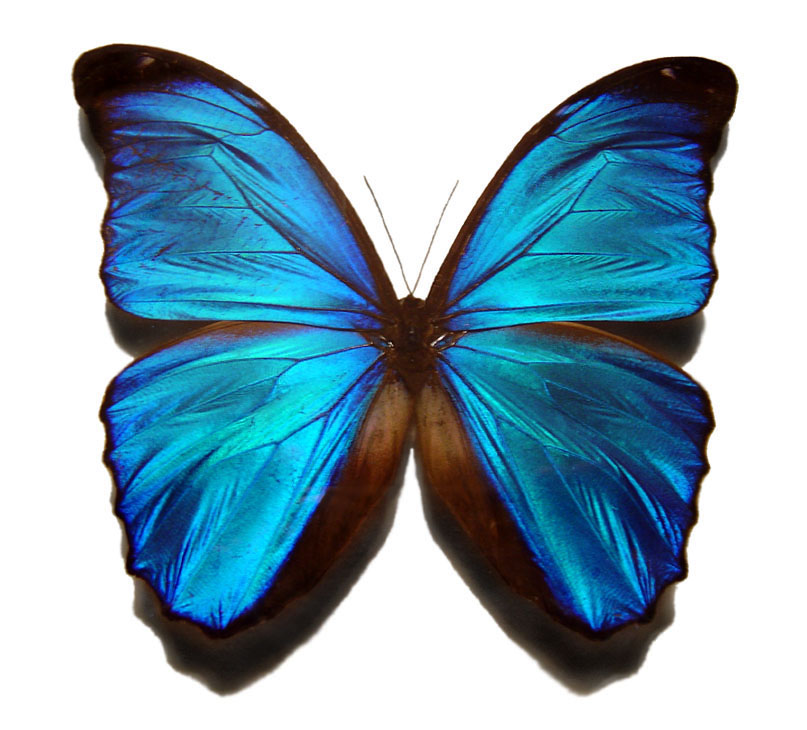
Twenty minutes later I was stuck in traffic, musing about the illustrations for 1001 nights: how many we needed, the etiquette of asking a friend to illustrate a book for you, whether I’d piss the friend off by being overly prescriptive with my suggestions for imagery, the sort of style that would work with the text. I was thinking about butterflies (yesterday Sophie was given her first butterfly net) and musing that as a metaphorical image, butterflies tied in nicely with ideas about female eroticism. Both species being difficult to define, hard to capture, glorious, uplifting, beauty destroyed by any attempt to preserve, exotic and fleeting. If I was being cynical, I’d say that they’re both something that animate life, but don’t stay around very long.

I was musing on the sad fact that women rarely trust their partners with the full extent of their erotic imagination, considering the reasons for, who responsible, strategies to negate, historical and cultural antecedents, impact of religious thinking upon, whether widespread phenomenon or fairly narrow, and if there was a great deal of difference in the degrees of erotic imagination amongst individuals (I mean, you’d expect there to be, but how can you tell?) Bang. Had to slam on the brakes as realized that I was about to rear end a four wheel drive with, wait for it, blue butterflies plastered across its spare wheel cover. Apologised to Sophie and made a mental note to email KRS with the butterfly suggestion.
Another funny little co-incidence: in the draft of 1001 nights, I’ve used a nightingale to signify a portal to another world. It marks the line between the everyday mind and the erotic imagination, conscious and unconscious. I’ve been daydreaming about how, once we’ve finished this book, I’d like to have it professionally published with a cover illustration by Del Kathryn Barton. Yes, I can dream. Anyway, I was flicking through a magazine in the hairdressers today, two things I rarely do, and I found an article about DKB. Apparantely she is busily illustrating Oscar Wilde’s fairytale The Nightingale and the Rose, with the book published later this year. Gosh! I almost dropped my cup of you-paid-too-much-for-this-haircut mule urine herbal tea that fashionable saloons feel compelled to serve, and which suckers like me feel compelled to drink.

It’s funny, and I know other people feel this too, but it’s amazing how much more life makes sense if you just do what you want to do and let things take their own shape. Versus doing what you think you should be doing. It’s the blessing of following some kind of instinctive guidance or understanding. Or perhaps just bloody mindedness paying dividends.
This week’s cute toddler moment: Sophie dragging her clickety clack wooden crocodile toy across the floor yelling, with Lleyton Hewitt style fervour, ‘C’mon!’
Kangaroo Valley


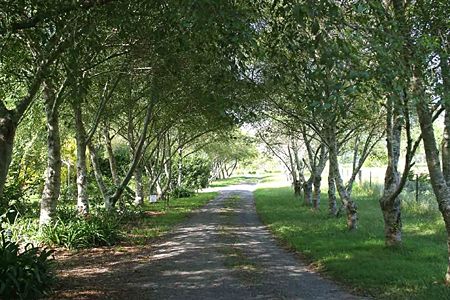
Sadly January, designated as my Fun Month, will shortly come to a close. Latest activity in pursuit of hedonism was TM’s 40th birthday party in Kangaroo Valley last weekend. The valley is a beautiful place, high sides and its own weather, lush greenery, mists. Population the usual mix of disaffected Sydneysiders and hardened country folk. Party included lots of kids and some great toys: walled trampoline, shark head water slides, swimming pool, mobile sandpit, glow sticks and ground-hugging scooters. If you’re planning a holiday in the Valley, here’s a link with some tourist and accommodation info:

http://www.kangaroovalleytourist.asn.au/home/

As part of the whole sustainability lifestyle thing, I’m aiming to use my car less, with the eventual goal of learning to live without it. To get to the party I caught a train to Central, carrying Sophie’s car seat, and then got a lift to Kangaroo Valley with two of TM’s friends. Coming back, there was trackwork, which meant a lift to Bowral with the same two friends, now very hungover; a bus to Liverpool; an un-airconditioned train from Liverpool to Central; another train from Central to Morisset; and then a lift from Morisset to Dora Creek. It ended up being an all day event.

Two remarkable people and one notable meal encountered en route. The first person I got talking to at the Bowral bus station. It’s a wealthy area, and I couldn’t be bother carrying the car-seat and suitcase any longer, so I’d left them on the station seat and was walking with Sophie up towards the town to get a cup of tea. Coming down the road towards me was a likeable looking woman (bad teeth, sweet smile, scruffy hair) who looked like she was heading towards the station: she was. I asked if she’d keep an eye on my bag, she agreed (later noting that she herself wouldn’t have left it there) and then, because Sophie was having the toddler equivalent of a bad hair day, walked across the road with us towards the town, holding Sophie’s other hand, chatting all the way.

Gumnut Patisserie, Bowral

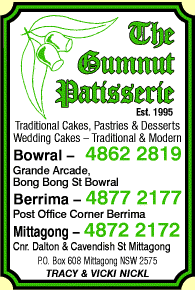
Which leads me to the notable meal, purchased at Bowral’s Gumnut Patisserie, a country bakery with a reassuring array of trophies for things like scones and bread lined up on the top shelf. Great food. Sophie and I ate a couple of small quiches, and a custard pie, so rich it left a layer of creamy fat on the top of your mouth. We shared a miniature fruit tart with an enormous blueberry teetering on its edge, only just held in place with sugar glaze, like the boulder at the top of Ambush Valley in an old fashioned Western movie. Sophie got the blueberry.

Returning to the station, the suitcase and the strange lady. Odd snippets of our conversation spring to mind: her son is studying veterinary science and lives in Toowoomba. Despite having lost all his belongings in the flood, the thing that really bothered him was that all his friends in a nearby town were air-lifted out by Black Hawk choppers. We discussed the layout of the Mittagong primary school playground as opposed to the one in Bowral: Mittagong infinitely superior, Bowral involves a road crossing and a parcel of land behind a church; the age children stop whining: six to sixteen, after and before that, forget it; shoeing horses: how people think it’s easy; falling off horses: how not to do it. And the poisonous nature of agapantha sap: toddler diverted as she headed towards the station’s attractive, flowery bushes.

I’m pretty sure this woman thought I was a frigging idiot, wandering around on a super-hot day, with a car-seat and toddler, both wearing freebie Corona hats that Jules had given us, and a certain post party vibe that is as easy to spot as it is hard to hide. But I really liked her. When she got on her bus, ducking to avoid an elderly man who was getting off, apparently the lawyer who had settled her grandmother’s estate (“country towns…” I cracked, and she grinned). I said to Sophie “that was your fairy godmother” as we waved to her. No idea what her name was.

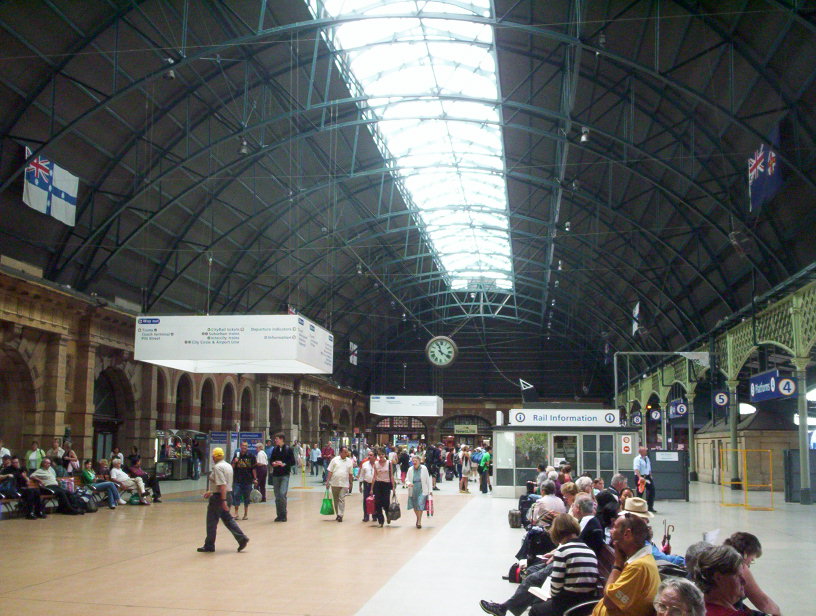
Central Station, Sydney

Second remarkable individual encountered somewhere on the line from Liverpool to Central. Young guy jumps on train with two toddlers and sits down near us. Thongs, tattoes, shaved head with rat-tail, shorts. He’s shirtless but stands up to pull a t-shirt on, realises it’s back to front, pulls it off again and eventually gets it on. I notice him mainly because he has a beautiful body, because the t-shirt is already stained with sweat, and because he seems so typically Australian, whatever that is. Sophie has, by this point, had enough of public transport and is behaving pretty badly. At certain points, there’s lots of screaming. I’m hot, crabby and not helping matters by trying to control her too much, instead of just accepting that a toddler is a toddler, not an adult, and you can’t expect them to sit there and look out the window. Sometimes you do have to let them crawl around on the crappy train floor looking for treasure.

The guy, on the other hand, is handling his two toddlers wonderfully. Segued smoothly from ‘can we see a butterfly out the window?’ to witty bouts of ‘look, Daddy’s wearing toddler hat’ and back to ‘Look! There is a butterfly out the window, you just missed it’. Brilliant stuff: masterful. Got talking to the guy, admired his skills, he looked pleased when I said that I he was obviously closely bonded to his kids. Here are some fragments of the conversation: kids names are Mark and Matthew; Matthew is two years older, but has been diagnosed with autism, ‘he’s my angel’; Dad has been through hell with his kids, he has them on the weekends, their Mum went away for a year; Mark is wearing a cool t-shirt with a carp on it; Dad used to work at a Japanese coy farm, t-shirt a hand me down but lasting well. Got off train, guy offered to help, he ended up holding Sophie’s hand and Sophie ended up holding Matthew’s hand; three transit cops looked amused as trio of wobbly toddlers exited train.

Guy tried to hit on me, politely deflected it, didn’t want to waste his time, and I know a bad boy when I see one (something about the tattoes, the body, the emphasis on being just a little bit too honest, a bit twitchy around authority figures). But I mention him, because whatever his relationship with the criminal justice system, and I’m sure there’s been one, he was managing two toddlers on a hot day like a pro.


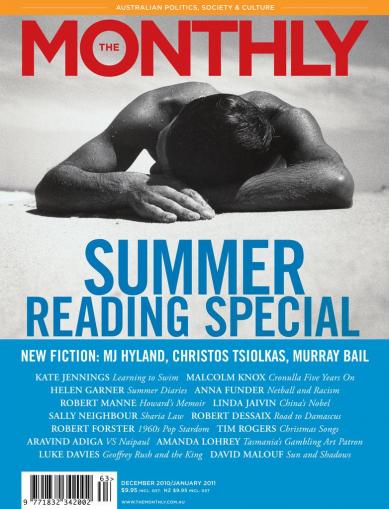
December/January 2011 edition of The Monthly

People are always suggesting that you read this or that, some great book or article, and mostly you don’t. In my case it’s not laziness, ill will or a lack of faith in their judgement, more a sense that the right books come to you when you’re ready for them, and what may be deeply fascinating to one reader is as “interesting as a bucket full of warm spit” (to borrow a description of the US Vice Presidency role) to another. So when a writer friend said that I should read a profile of Tasmanian art collector David Walsh in The Monthly, describing it as very well written, I responded enthusiastically with no intention of actually doing so.

About a week later I was standing at Central Station waiting for a train to the airport. Looking at the magazine covers on offer at the nearby newsstand, I saw a copy of The Monthly with a copy of Max Dupain’s Sunbaker on the cover. http://www.themonthly.com.au/

Now I have a particular interest in this image, having recently suffered through a pile of undergraduate essays on the topic of the expression of Australian national identity in the visual arts, so I was drawn to it. Handed over my $9.95 and ended up enjoying the magazine, and the profile, enormously. Great selection of diary entries by Helen Garner; nifty article on swimming by Kate Jennings; and an album review by Chistos Tsiolkas of the Gaza Strips that sent me scurrying into the nearest Sanity record store, only to be told by the attendant, after checking his computer, that he had a listing for the Gaza Strippers, and was that what I was after?

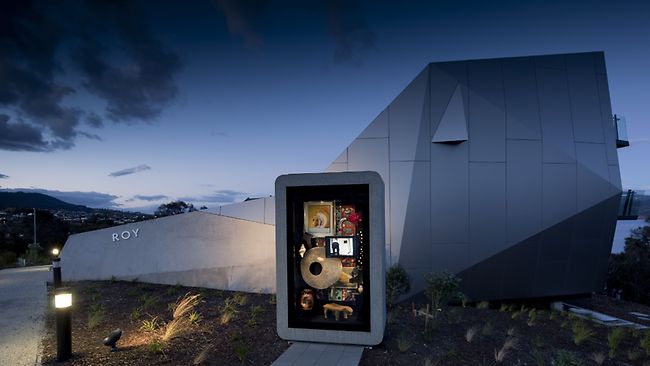
MONA: source The Australian newspaper

MONA, the museum of old and new art, David Walsh’s brainchild, recently opened in Hobart, so I was curious about him and his collection. One of his comments caused me a fair bit of angst. It was words to the effect that when he questions artists about their work, quite often they don’t seem to know what they’re actually doing, or don’t have a strong rationale for why they do what they do. Yup, after years of fluffing answers to these kind of questions, I knew exactly what he was talking about. Since then I’ve been mulling over how to describe what I do, why I do it, and what keeps me doing it. Oh, I forgot to mention, Walsh also noted that artists seem to be driven by the twin poles of sex or death: artistic peacocking behaviour for procreation purposes, or seeking immortality via the creation of cultural artefacts. Honestly, I’d have to stick myself in the first category, purely on the basis that sex appears to be much more fun than death.

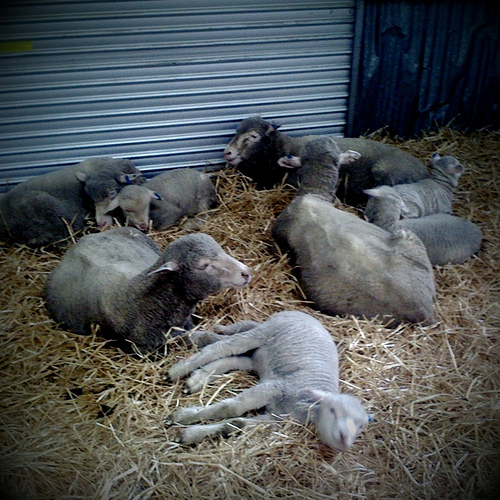
To answer questions about why I continue to like making art, it makes sense to look back at where and when the behaviour originated. Very early (still in nappies and before my parents’ marriage busted up) I remember pulling a red geranium apart and being absolutely fascinated by the colour. I thought it was incredible that the more I ripped the flower up, the more red there was. At kindergarten, I fell in love with a Pakistaani carer, and used to dash off bird drawings just for the intense pleasure of his praise. After kindergarten, I painted a black sheep from the Royal Hobart Show with a blue ribbon around its neck, standing on yellow straw. I remember agonising over how to paint the eye, given that I had already used the darkest colour in my palette for the fleece. (In the end I gave the eye a brown outline and coloured it black too). About the same time, Mum and I were visiting one of her friends, and I was deeply envious of one of their kid’s paintings stuck on the fridge. It was a painting of a rainbow and all the colours had bled into each other: I wasn’t sure how I could get paint to do this (nothing more complex than wet on wet paint application).  So very early on I was noticing colour and paintings and thinking about how to make them, how to match the picture in my mind with what came out on the paper.

The next generation of Royal Hobart Show sheep: photo ozjimbob @ flickr.com

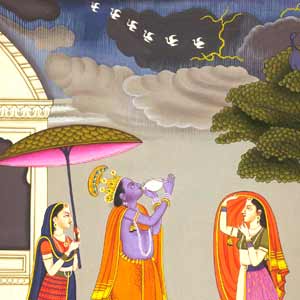
My grandparents both painted and ran a commercial art gallery, and my Mum had been a curator at a State Art Gallery, so I was lucky to have been exposed to lots of interesting imagery. Another key early influence was MP, the writer I mentioned earlier, who suggested I read the David Walsh piece. In the 70s she used to import Indian miniature paintings and artefacts so I grew up looking at images of half human/animal gods with anti-naturalistic colour, non western perspective, pattern used to describe pictorial depth and animate figures and clothing. These had a huge impact, though I didn’t realise it at the time, something that remains with me to this day.

As I got older, I became attuned to the idea that art could be used as a wild zone where you could express forbidden feelings, thoughts and desires. It was a visual code that only you could crack, a powerful but quiet form of protest, creation as a transcendent space. I began to use animal imagery as a signifier for human experience, partly because I like animals and their forms, and partly to make the code more oblique. The animals would become stand-ins for human actors and actions. I’ve mentioned early that I didn’t like growing up in Hobart, always felt really out of place, couldn’t wait to leave. I experienced the place as claustrophobic, it gave me a feeling of being locked in a room in which the air is slowly being sucked out. For a long time, and this is really juvenile, my greatest fear was becoming a paraplegiac, unable to speak, and being stuck in a hospital bed with a view of Hobart City.

Indian miniature painting

Sometimes, of course, art was a handy social tool. Kids who can draw are always useful or entertaining for other kids, and so it was with me too. I remember drawing a friend in primary school, the drawing turned out well (her face was turned ¾ away from me and the light was hitting her cheekbone), and having a queue of little girls wanting me to draw them too. I also remember becoming aware of human beauty at this age. I remember watching a boy and a girl run around the oval like wild animals, the curve of a friend’s spine as she got dressed after gym.

Over the years I have returned again and again to the same cycle of images, mostly based around interactions between humans and animals, or combinations of human and animal forms. There are often two girls, I call them the fishwives, standing side by side near the ocean. My cousin Rachel were, and are, as different as two people can be, but because we grew up together she is like my sister, the other to which I define myself. This is a perennial issue, but parents seem to be stricter on their girls than their boys, and keep them closer to home. I paint the two girls frozen in immobility, wearing their best dresses, waiting for a metaphorical ship (life, action, whatever) that may or may not arrive.

Another recurring images, again two figures, standing outside an old fashioned squat colonial church, shades of American Gothic. Not sure entirely what this one is about, but I paint it when I’m in love, and when I’m out of love, the expressions of the couple changing each time. It’s an image that only works when the emotional conditions are right, I’ve tried painting a replica of one that I sold and it didn’t work. Another image that I like, but am yet to paint in a way that I am satisfied with, a cat with a woman’s head, lactating milk on the floor of a red, velvet tent, with little ships sailing in the milk. Other recurring images: a tree draped with human bodies and animals; a man standing in a boat, his arms outstretched; human and animal heads on striped poles, like cocktail swizzle sticks or channel markers; a ship in a bottle experiencing a violent squall.

So the central themes, I guess, are claustrophobia; dislocation; the pressure between inner and outer selves, social expectation; the female condition; sensuality versus morality; freedom versus confinement; stasis against adventure. A pressure valve of sorts. And all bound up in the weird psychic resonance of the Tasmanian landscape, with its beauty, suppression of history, violent past and present, and disconnected, bottom of the world sense of place. I’m always trying to balance the sweetness and horror of the island: I suppose all places are, to some extent, like this, but I’ve always experienced Tasmania more intensely than most places I’ve been.

It would be tempting at this moment to conclude ‘well, it’s just therapy, innit?’ And in many ways, I can reluctantly admit that it’s true: art does bring me psychic calm, I get shitty when I’m not painting, I don’t feel like I’m properly alive. But although art does have a therapeutic role, aligning my inner and outer selves, this is not why I continue painting and exhibiting. I am driven to try and create one true image, one image where everything works and nothing can be changed, something that speaks to the viewer in a clear voice. I know that this is far from being a novel idea, but I’ve always felt that the universal is reached via the personal, and that my obligation is to be an honest conduit of what I feel and experience. My main job at the moment is to nail the techniques so I create the best possible version of the images in my imagination. In a strange sort of way, I feel like I was born with all the images I ever wanted to paint, and that the only thing that I need to continue to work on is how to do it.

Well, I’m afraid that’s my best answer to the question of why I make art and what I’m trying to do. Hopefully I won’t run into David Walsh at a dinner party anytime soon.

***

Two bits of trivia about sex: late one night, afterwards, I had this intense visualisation of a blue diamond shape embedded in the flesh near my navel. Days later, and this peculiar image remained. I tried googling the symbolism of the blue diamond shape, but apart from finding out that natural blue diamonds are extremely expensive and rare, and that a blue diamond tattoo is used by elite security forces, nothing much of consequence.

Toying with the idea of painting myself blue and renting myself out as a tantric sex instructor for a laugh. Burn some dodgy incence, look ethereal and smug, talk about chakras, dogmas and karmas. Beautiful. Read a few books on the subject beforehand and hey presto! The perfect scam. The idea reminds me of a funny film about a New Zealand travel writer who never actually visited the places he wrote about or recommended. People used to abuse him in the street: ‘I took my girlfriend there on our honeymoon!’

***

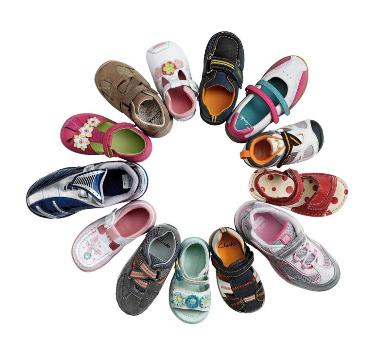
Sophie needed new shoes so Aaron and I took her shopping. David Jones in Newcastle is closing down, the end of an era, and lots of things are on sale. She got a practical pair of brown Velcro sandals, a white pair of trainers and a sparkly pair of white sandals for when she’s a bit bigger. Her Dad wasn’t so keen on the sparkly sandals, but she loved them so, holding them as if they were priceless treasure.